
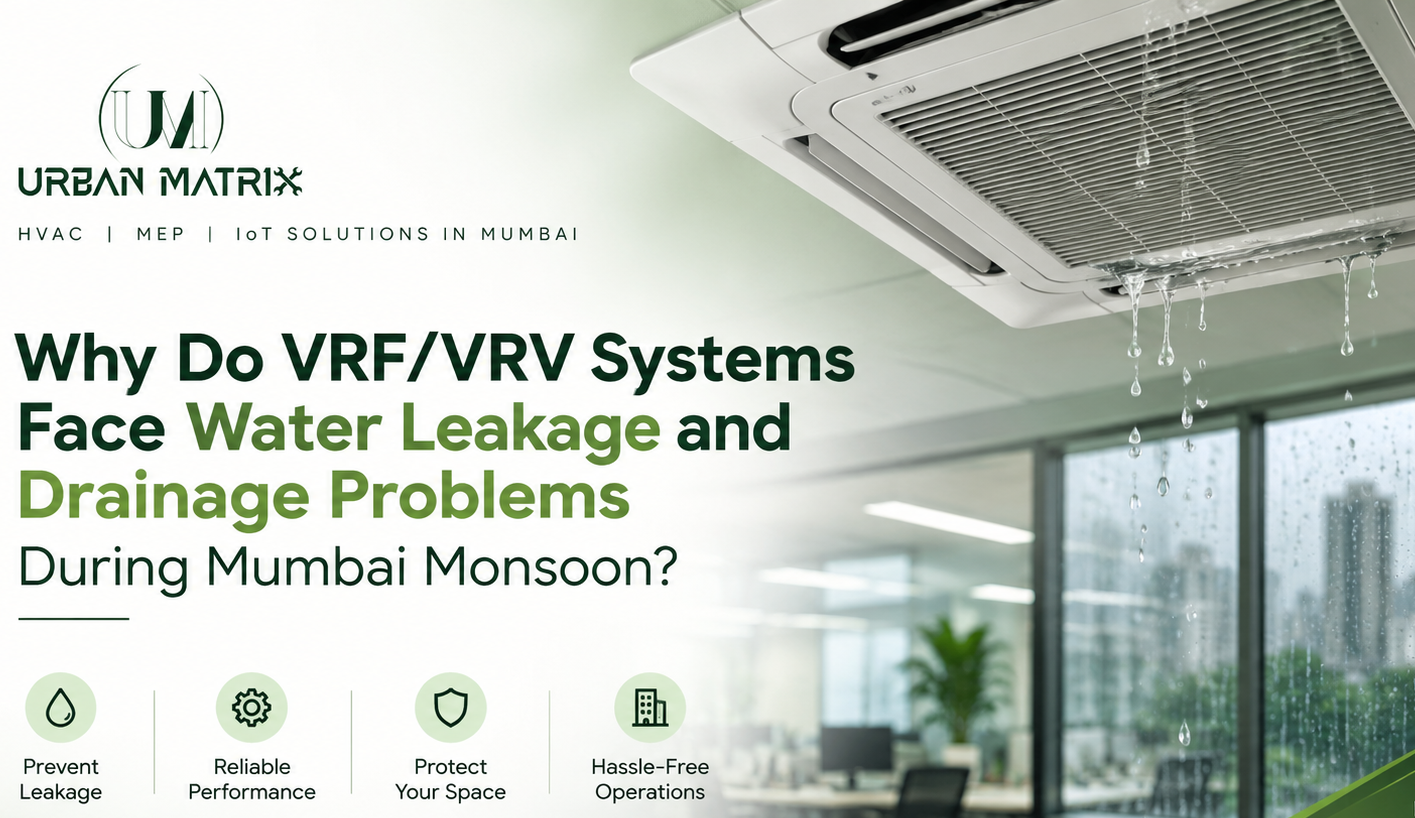
Mumbai’s monsoon can expose HVAC problems that remain unnoticed during the rest of the year. One of the most common complaints in commercial offices is simple: “The AC is cooling, so why is water suddenly dripping from the ceiling?” In many cases, the issue is not the cooling itself. It is the condensate drainage system. High humidity means an air-conditioning system has more moisture to remove from indoor air. If a drain pipe is partially blocked, the drain pump is weak, insulation is damaged, or the drainage slope is incorrect, that extra condensate can expose the problem quickly. This is why timely VRF AC repair in Mumbai becomes especially important during monsoon. Ignoring a small drainage issue may eventually lead to ceiling stains, damaged interiors, mould, electrical risks and disruption inside the workplace. For businesses using VRF or VRV systems, regular inspection is often much easier than dealing with water dripping over workstations, reception areas or expensive equipment later. Why Do VRF/VRV Systems Develop Drainage Problems During Monsoon? VRF and VRV systems can face drainage problems during monsoon because high humidity increases condensate formation. Blocked drain lines, incorrect drainage slopes, faulty drain pumps, dirty drain pans and damaged insulation can prevent water from draining correctly, resulting in AC water leakage, ceiling stains, unpleasant odours and indoor moisture problems. What Are VRF/VRV Drainage Problems? VRF, or Variable Refrigerant Flow, systems use multiple indoor units connected to an outdoor system. VRV is a commonly used term for the same general type of variable-refrigerant technology. During cooling, indoor units do more than lower room temperature. As humid air passes over the cold cooling coil, moisture from the air condenses into water. That water is collected in a drain pan and should move safely through a condensate drain pipe. If the drainage system cannot handle or remove this water properly, AC water leakage may occur. Manufacturer installation guidance stresses that condensate drain piping should have a proper downward slope and that drainage should be tested to confirm water flows smoothly. Guidance also warns that inadequate insulation in very humid environments can contribute to condensation problems. That is why a drainage inspection should be part of VRF AC maintenance, especially before and during Mumbai’s monsoon season. What Causes VRF/VRV Drainage Problems During Mumbai Monsoon? Several problems can contribute to water leakage. Sometimes there is one obvious fault. In other cases, two or three small issues are happening together. The U.S. EPA recommends keeping indoor relative humidity below 60%, and ideally between 30% and 50% where practical, because excessive moisture increases the risk of condensation and mould. It also specifically recommends keeping HVAC drip pans clean and drain lines unobstructed. Monsoon water leakage is not always a major VRF failure. It may begin with a blocked drain, weak pump, damaged insulation or incorrect drainage slope. A professional inspection helps identify the actual cause before unnecessary replacement work is considered. How Does VRF AC Repair in Mumbai Work for Drainage Problems? A proper inspection should go beyond simply cleaning the visible drain outlet. Step 1: Identify the Source of Water First, the technician checks whether the water is actually coming from the indoor VRF unit, condensate piping, insulation, surrounding plumbing or another building service. This matters because every ceiling leak near an AC unit is not automatically an AC fault. Step 2: Inspect the Drain Pan The drain pan is checked for standing water, dirt, cracks, microbial buildup and overflowing. If water is collecting faster than it can drain, the technician needs to identify why. Step 3: Check the Condensate Drain Line The drain line is inspected for: Professional VRF AC service in Mumbai should also verify whether water is flowing smoothly after cleaning. Step 4: Check the Drain Pump If the indoor unit uses a condensate pump, technicians check whether the pump is receiving power, operating correctly and removing water at the required rate. A malfunctioning float switch or drain pump can sometimes trigger error codes or cause the indoor unit to stop. Step 5: Inspect the Cooling Coil and Airflow Poor airflow can affect coil conditions and overall system performance. Technicians may therefore inspect filters, cooling coils, blower operation and airflow rather than treating the drain line as an isolated component. Step 6: Inspect Insulation Wet, damaged or poorly sealed insulation can create visible dripping that may look like a blocked drain. This is particularly important in Mumbai’s humid conditions. Step 7: Test the System After corrective work, the system should be operated and the drainage path checked again. The goal of VRV AC repair in Mumbai is not simply to stop today’s leak. It is to understand why it happened and reduce the chance of it returning. What Are the Benefits of Preventive VRF AC Maintenance? Regular VRV VRF maintenance can help commercial facilities by: For a busy commercial property, prevention can also mean fewer complaints from employees, tenants and customers. Reactive Repair vs Preventive AMC vs IoT Monitoring Approach What Happens Best Use Reactive AC repair Technician visits after leakage or failure occurs Sudden breakdowns and emergency problems Preventive VRF maintenance Drainage, coils, pumps, controls and system condition are checked periodically Offices and commercial facilities wanting fewer breakdowns HVAC AMC Scheduled maintenance across HVAC equipment throughout the year Larger commercial properties IoT-based monitoring Operating parameters, alarms and selected equipment conditions can be monitored digitally Facilities requiring greater visibility and proactive maintenance A combination of physical inspection and intelligent monitoring can be useful for businesses searching for HVAC MEP & IoT Solutions in Mumbai rather than treating each breakdown separately. Who Needs VRF AC Repair and Preventive Maintenance? Professional maintenance is particularly useful for buildings with several indoor VRF/VRV units or areas where even a small water leak could interrupt daily operations. This may include: Properties already noticing ceiling stains, dripping water, musty smells, repeated drain blockages or AC error codes should consider an inspection instead of waiting for the problem to become more serious. Businesses searching for commercial AC repair in Mumbai
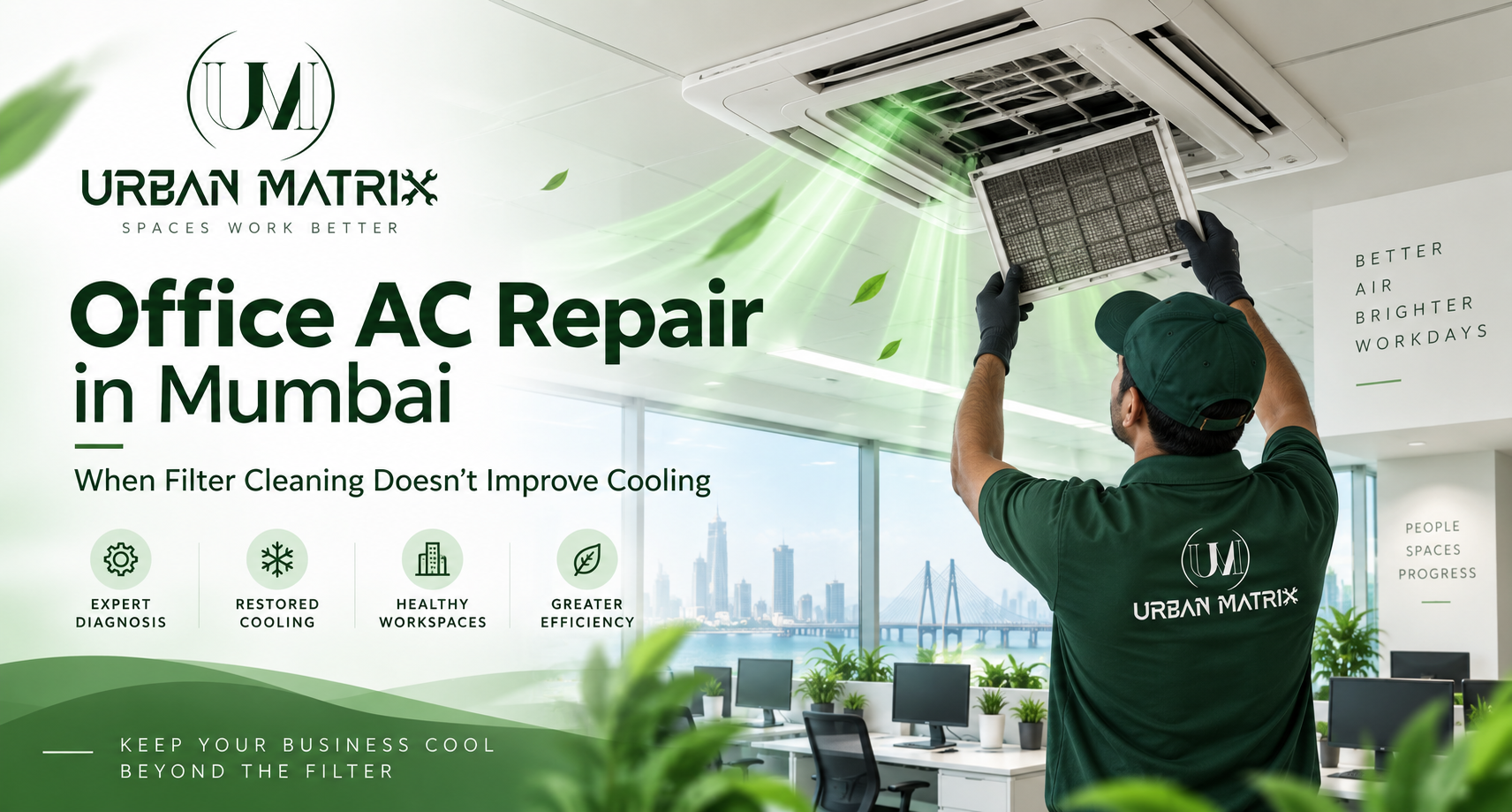
Office AC Repair in Mumbai: What Should You Check When Filter Cleaning Doesn’t Improve Cooling?
Your office AC filters are clean, but the workspace still feels warm or cooling remains uneven? This is a common issue in commercial spaces, and it usually means the problem goes beyond the filter.For businesses looking for Office AC Repair in Mumbai, poor cooling can be caused by dirty coils, low refrigerant, restricted airflow, duct leakage, faulty sensors, AHU issues or improper air balancing. Sound familiar? This is a common problem in commercial spaces. Filter cleaning is important, but it is only one part of HVAC maintenance. If the system still struggles after cleaning, the real issue may be hidden in the coils, airflow, refrigerant circuit, controls, ductwork, AHU, or even system balancing. A professional HVAC Contractor in Mumbai should look at the complete system rather than one component. This becomes even more important in offices using central AC, VRF/VRV systems, ducted units, chillers, or AHU-based cooling. At Urban Matrix, the focus is on finding the root cause first because a small unresolved issue today can become an uncomfortable office, a higher electricity bill, or an unexpected breakdown tomorrow. Why Does an Office AC Still Cool Poorly After Filter Cleaning? Poor cooling after HVAC filter cleaning can happen because the filter is only one part of the system. Dirty coils, low refrigerant, restricted airflow, duct leakage, faulty sensors, AHU issues, incorrect controls, or poor air balancing can still reduce cooling. A complete HVAC inspection is needed to identify the actual cause. What Is Office AC Repair in Mumbai When Filter Cleaning Does Not Work? Office AC Repair in Mumbai involves diagnosing and correcting problems in commercial air-conditioning systems when basic servicing, such as filter cleaning, does not restore proper cooling. The process may include checking airflow, coils, refrigerant levels, electrical components, thermostat readings, sensors, motors, ductwork, AHUs, condensate drains, compressors, and control systems. For a commercial office, AC repair is rarely about one part alone. A qualified HVAC company in Mumbai looks at the system as a whole and determines whether the issue needs repair, adjustment, preventive maintenance, retrofitting, or replacement. Clean filters improve airflow, but they cannot fix refrigerant leaks, dirty coils, faulty controls, duct leakage, compressor problems, or poor system balancing. Why Does an HVAC System Still Perform Poorly After Filter Cleaning? There are several reasons why an HVAC system still performs poorly after filter cleaning. 1. Dirty Evaporator or Condenser Coils Filters catch airborne particles, but dust and deposits can still build up on coils over time. Dirty coils reduce heat transfer, making the AC work harder to deliver the same level of cooling. 2. Low or Incorrect Refrigerant Charge A refrigerant problem can reduce cooling even when filters are perfectly clean. It may also cause longer operating cycles and unnecessary strain on the compressor. 3. Restricted Airflow The problem may be inside the ductwork, blower, fan, damper, or AHU. This is one of the common causes of poor cooling after HVAC filter cleaning. 4. Duct Leakage Cool air may be escaping before it reaches the workspace. In a large office, this can create hot and cold zones across different rooms or departments. 5. Faulty Sensors or Thermostats An incorrect temperature reading can make the HVAC system cycle at the wrong time. That means the AC may stop cooling even though the room has not reached the desired temperature. 6. AHU Problems An Air Handling Unit plays a major role in airflow and air distribution. Poor fan performance, dirty coils, worn belts, damaged motors, or control issues can all affect cooling. Professional AHU Maintenance in Mumbai can help identify these problems early. 7. Poor Air Balancing Sometimes, the AC itself is working properly. The problem is that the conditioned air is not being distributed correctly throughout the office. How Does an Office AC Inspection Work? A professional Commercial AC Service in Mumbai should follow a structured diagnostic process. Step 1: Understand the Complaint The technician first identifies what is actually happening. Is the entire office warm? Is one zone warmer? Has the electricity bill increased? Does the system run continuously? Step 2: Check Airflow The team checks filters, blowers, fans, dampers, diffusers, return air, and duct restrictions. Step 3: Inspect Coils Evaporator and condenser coils are examined for dust, scale, blockage, or reduced heat-transfer performance. Step 4: Check Refrigerant and Compressor Performance Pressure, temperature, compressor condition, and refrigerant performance may be evaluated. Step 5: Inspect Electricals and Controls Sensors, thermostats, relays, contactors, wiring, VFDs, and control panels are checked. Step 6: Check AHU and Duct Systems For larger offices, the AHU, ductwork, dampers, and air distribution system are inspected. Step 7: Recommend the Right Solution The final recommendation may involve servicing, repair, component replacement, balancing, retrofitting, or preventive maintenance. This is where an experienced HVAC Consultant in Mumbai can help businesses avoid unnecessary replacement decisions. What Are the Benefits of a Complete HVAC Inspection? A complete HVAC inspection can provide several practical benefits: For commercial offices, preventive maintenance is usually more practical than waiting for the AC to stop during working hours. Filter Cleaning vs Complete HVAC Maintenance Filter Cleaning Only Complete HVAC Inspection Cleans one component Checks the complete cooling system Can improve basic airflow Identifies airflow restrictions Does not check refrigerant Evaluates refrigeration performance Does not inspect ducts Checks duct leakage and distribution May not detect AHU problems Includes AHU and blower inspection Does not check controls deeply Tests sensors and controls Short-term maintenance step Supports long-term reliability This explains why filter cleaning alone does not improve HVAC performance in every situation. When businesses repeatedly clean filters without diagnosing the rest of the system, HVAC efficiency problems after filter cleaning may continue. Who Needs Professional Office AC Repair? Professional Commercial AC Repair in Mumbai is especially useful for: Businesses operating from Kandivali, Andheri, Malad, Goregaon, Bandra, BKC, Lower Parel, Powai, Navi Mumbai, and other commercial areas may require faster HVAC support because AC downtime can directly affect daily operations. If an office uses central air-conditioning, VRF AC Service in Mumbai, VRV AC Maintenance in
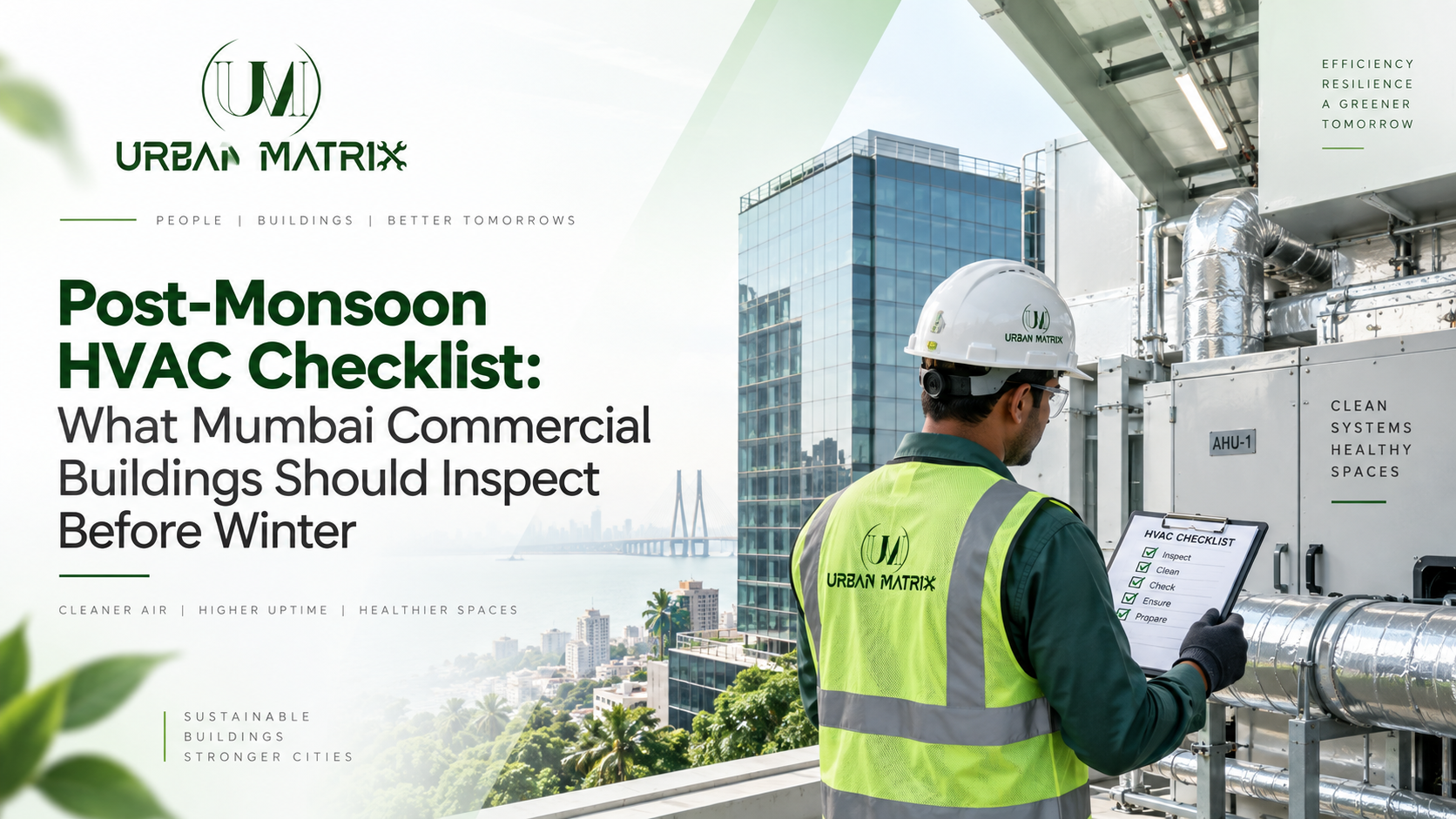
Post-Monsoon HVAC Checklist: What Mumbai Commercial Buildings Should Inspect Before Winter
Cleaning HVAC filters is an important maintenance step, but it does not always solve cooling or efficiency problems. If your system is still underperforming, there may be other issues such as dirty coils, restricted airflow, refrigerant problems, duct leakage, or faulty controls. Understanding why filter cleaning alone does not improve HVAC performance can help facility managers identify the real cause of poor cooling instead of repeatedly treating only one part of the system. For commercial buildings in Mumbai, a complete HVAC inspection can help improve airflow, energy Here’s a simple checklist to start with. 1. Check the HVAC Filters Filters are usually the first thing teams inspect, and for good reason. During the monsoon, dust and moisture can build up faster than expected, which may restrict airflow and reduce cooling efficiency. Check whether filters need cleaning, replacement or more frequent attention. A reliable HVAC contractor in Mumbai can also help ensure filter maintenance is part of a complete system check rather than the only step taken. 2. Inspect AHUs and Airflow After the monsoon, AHUs should get more than a quick visual check. Look at cooling coils, blowers, belts, bearings, drain trays and condensate lines. Also check whether airflow feels consistent across different areas of the building. If one zone is too warm while another is too cold, the issue may not be the thermostat. It could be related to airflow, balancing or AHU performance. Regular commercial HVAC services in Mumbai can help catch these issues before they start affecting comfort and energy consumption. 3. Don’t Ignore the Cooling Tower Cooling towers often work quietly in the background, which is why small problems can go unnoticed. Regular cooling tower maintenance services in Mumbai can help identify issues like scaling, clogged nozzles, uneven water distribution, reduced airflow, and declining cooling efficiency before they affect the overall HVAC system. After the monsoon, check for: If the cooling tower is not working efficiently, the rest of the HVAC system may have to work harder. That can eventually show up as higher energy bills or reduced cooling performance. Including cooling tower checks as part of HVAC AMC services in Mumbai can help avoid these issues. 4. Check Electrical and MEP Systems Too Post-monsoon maintenance should not stop at HVAC. Moisture can also affect electrical panels, pumps, motors, wiring, plumbing lines, contactors and control systems. This is where integrated HVAC and MEP solutions in Mumbai make a difference. A proper post-monsoon check should cover: Experienced MEP consultant in Mumbai can help facility teams identify connected issues instead of looking at each system separately. For offices and commercial buildings, regular MEP maintenance services in Mumbai can also reduce the risk of sudden breakdowns. 5. Look for Moisture, Leakage and Drainage Problems Mumbai’s humidity can create problems that are easy to miss. Check equipment areas for blocked drains, water leakage, damp insulation, condensation or signs of corrosion. A small moisture issue may not look serious today, but over time it can affect equipment life, indoor comfort and maintenance costs. That’s why preventive maintenance services in Mumbai are especially important after the rainy season. 6. Compare Your Energy Consumption One of the easiest ways to spot an efficiency problem is to look at your energy usage. If occupancy and working hours are almost the same but electricity consumption has gone up, your HVAC system may be working harder than it should. Possible reasons include: Using IoT solutions in Mumbai can help facility teams understand what is happening between routine service visits. With IoT-based HVAC monitoring solutions in Mumbai, unusual energy consumption or equipment behaviour can be spotted earlier. 7. Use IoT Monitoring to Stay Ahead of Problems Most maintenance problems do not appear overnight. There are usually small warning signs first. IoT monitoring can help facility teams track things like temperature, equipment runtime, energy consumption, operating status and system alerts. With MEP system monitoring in Mumbai, teams can identify unusual patterns earlier instead of waiting for a complaint or breakdown. For commercial properties, IoT solutions for commercial buildings in Mumbai can make maintenance more proactive and easier to manage. 8. Review Your AMC An AMC should not only mean calling someone after something stops working. A good maintenance plan should include regular inspections, preventive servicing, equipment health checks and performance monitoring. Businesses using commercial HVAC AMC services in Mumbai or MEP AMC services in Mumbai can reduce the chances of unexpected downtime. Working with a reliable HVAC consultant in Mumbai that can handle installation, maintenance, AMC and monitoring under one approach can also make facility management simpler. Why an Integrated HVAC, MEP & IoT Approach Helps In a commercial building, systems are connected. An HVAC problem may be linked to a pump, electrical component, cooling tower, sensor or water system. That’s why looking at the complete building system often gives better results than fixing one component at a time. With HVAC MEP & IoT Solutions in Mumbai, India facility teams can bring together HVAC maintenance, MEP maintenance, AMC, energy monitoring and IoT-based alerts under one strategy. The goal is simple: identify problems earlier and keep the building running efficiently. Before You Finish the Post-Monsoon Check Ask your facility team a few simple questions: Is the airflow consistent across all areas? Has cooling performance dropped recently? Are AHUs and cooling towers being checked properly? Has energy consumption increased without a clear reason? Is maintenance mostly preventive, or do you usually act after a breakdown? Most importantly, do you know how your HVAC and MEP systems are performing between service visits? At Urban Matrix, we provide HVAC solutions in Mumbai, MEP solutions in Mumbai, HVAC installation services in Mumbai, commercial HVAC services in Mumbai, AMC solutions in Mumbai and IoT solutions in Mumbai for commercial buildings. The idea is not just to fix problems when they happen. It is to spot them earlier, maintain systems better and keep building operations more reliable. Why Filter Cleaning Alone May Not Improve HVAC Performance You cleaned the HVAC filters, but the cooling
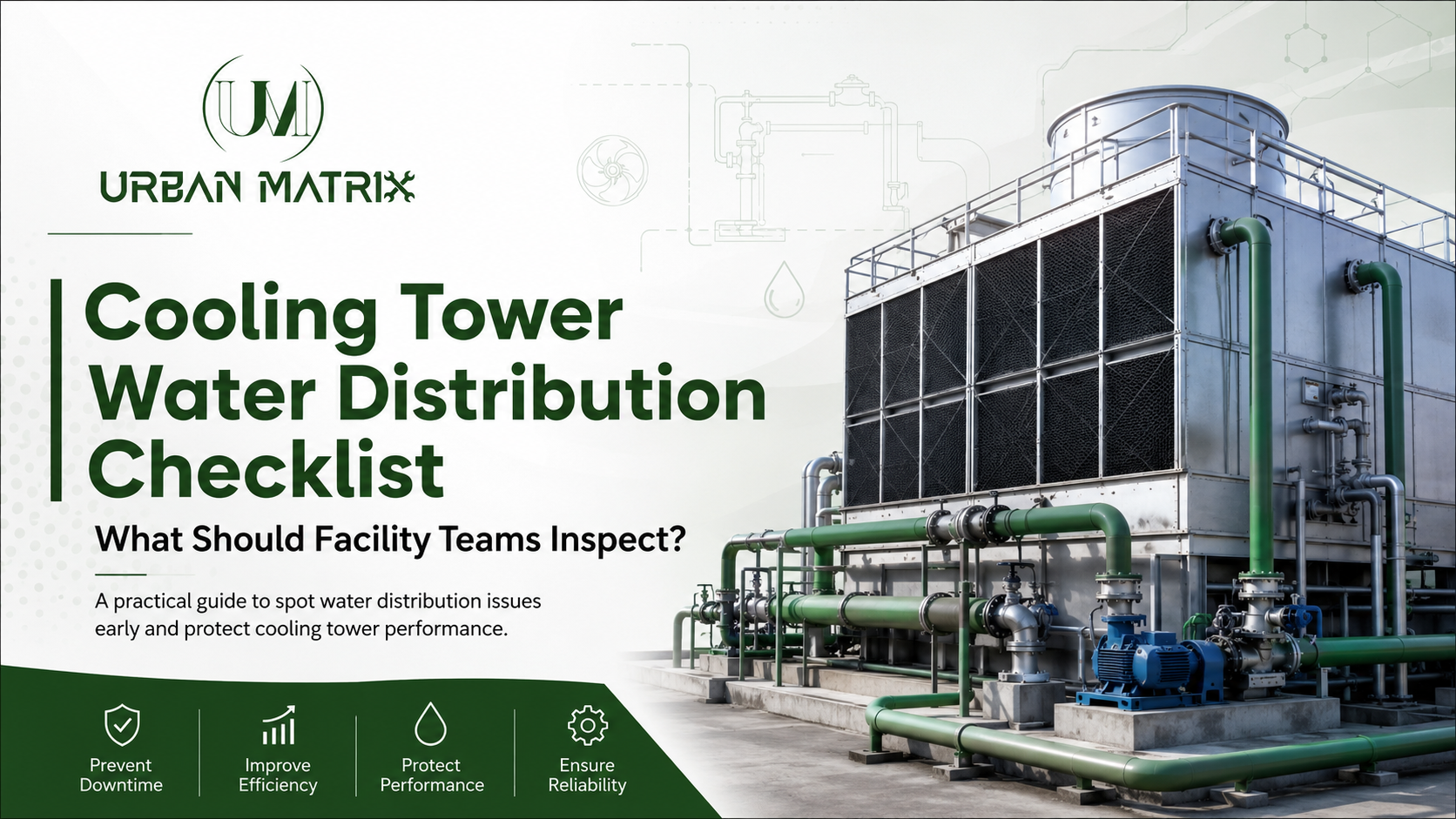
How Can Poor Water Distribution Reduce Cooling Tower Performance?
A cooling tower can appear to be operating normally even when its performance has already started to drop.The fan may be running. Water may still be circulating. The chiller may continue to provide cooling. Yet inside the tower, water may not be reaching the fill media evenly.For commercial facilities, regular cooling tower maintenance in Mumbai should therefore focus not only on cleaning and servicing equipment but also on checking how effectively water is distributed throughout the tower. This is where a small distribution problem can begin affecting the entire HVAC system. Poor water distribution can create dry spots, reduce heat transfer, encourage scale buildup and increase the workload on connected equipment. Over time, this can lead to higher energy consumption, declining cooling performance and more frequent maintenance. This guide explains why water distribution matters, what causes uneven flow and what facility teams should inspect to maintain efficient cooling tower performance. What Is Water Distribution in a Cooling Tower? A cooling tower helps remove heat from warm condenser water before that water returns to the chiller. Warm water enters the tower and is distributed over the fill media. The fill increases the surface area available for contact between water and air, supporting the heat rejection process. For the cooling tower to work efficiently, water should reach the fill as evenly as possible. If one area receives too much water while another remains relatively dry, part of the available heat-transfer surface is not being used properly. This is known as uneven or poor water distribution. The cooling tower may continue running, but its ability to reject heat can gradually decline. Why Does Even Water Distribution Matter? Think of the cooling tower fill as a large surface designed to spread water across as much area as possible. When water reaches the full surface, the tower can use its available heat-transfer capacity effectively. When sections stay dry, that usable area becomes smaller. Poor water distribution may contribute to: This is why facility teams should not look at cooling towers and chillers as completely separate pieces of equipment. Their performance is closely connected. What Causes Poor Water Distribution in Cooling Towers? Several mechanical and water-related issues can affect distribution. 1. Clogged Spray Nozzles Spray nozzles help distribute water over different sections of the cooling tower. Over time, they may become partially blocked by: When a nozzle becomes restricted, the amount of water reaching that section of the fill decreases. If several nozzles are affected, larger dry areas may develop. Inspecting and cleaning nozzles should therefore be an important part of preventive cooling tower maintenance in Mumbai. 2. Damaged or Misaligned Nozzles A nozzle does not need to be fully blocked to affect performance. If it becomes damaged, loose or incorrectly positioned, its spray pattern may change. One section may receive excessive water while another receives very little. This reduces the effective use of the fill media and can affect overall cooling performance. 3. Insufficient Circulating Water Flow Poor distribution may also occur when the system is not circulating enough water. Possible causes include: An experienced HVAC company in Mumbai should therefore evaluate the entire condenser-water circuit rather than examining only the cooling tower itself. 4. Scale Inside Distribution Pipes Mineral deposits can gradually build up inside pipes. As the internal opening becomes smaller, both water flow and pressure can change. This may cause some areas of the tower to receive sufficient water while others receive less. Over time, the imbalance can affect cooling tower performance. 5. Incorrect Water Pressure Cooling tower nozzles are designed to operate within specific flow and pressure conditions. If pressure is too low, water may not reach the intended coverage area. Simply seeing water coming from the nozzle does not mean the distribution pattern is correct. The amount, direction and coverage of water all matter. How Does Poor Water Distribution Affect Heat Transfer? The main job of the cooling tower is to reject heat from the condenser-water system. To do this effectively, water and air need enough contact across the fill surface. When certain areas remain dry, less surface is available for effective heat transfer. As a result, the cooling tower may send warmer condenser water back to the chiller. The chiller then has to work harder to achieve the required cooling. Facility teams may begin to notice: For this reason, chiller maintenance services Mumbai should sometimes include a wider assessment of the cooling tower and condenser-water system. The chiller may be working correctly, while the actual performance issue begins elsewhere. Cooling Tower Water Distribution Checklist: What Should Facility Teams Inspect? A practical inspection checklist can help identify problems before they affect the complete HVAC system. 1. Check Spray Nozzles Inspect the nozzles for: Water should be reaching the intended fill areas consistently. Weak or irregular spray should be investigated. 2. Look for Dry Spots on the Fill Visible dry areas can be one of the clearest signs of uneven distribution. Where accessible and safe to inspect, facility teams should check whether the fill appears to be receiving water consistently across its surface. Repeated dry sections may point to problems with nozzles, water flow or distribution piping. 3. Inspect the Fill Media The fill should be checked for: Dirty or clogged fill can reduce both water flow and airflow, further affecting heat rejection. 4. Check Circulating Water Flow Confirm that sufficient water is moving through the condenser-water system. Inspect: Low circulation can reduce the amount of water reaching different sections of the cooling tower. 5. Inspect Pumps and Strainers Even clean nozzles may perform poorly if the pump is not delivering sufficient flow. Strainers should also be checked for blockage. Restrictions upstream can affect water distribution throughout the tower. 6. Inspect Distribution Pipes Look for: Restrictions inside distribution piping can reduce water flow to certain areas. 7. Monitor Condenser-Water Temperature Temperature trends can provide useful clues about cooling tower performance. If condenser water leaving the tower is consistently warmer than expected under similar conditions, the heat rejection system may need

Top 10 MEP Consultants in Mumbai (2026): Compare the Best MEP Contractors, Services and Companies?
Top 10 MEP Consultants in Mumbai (2026): Compare the Best MEP Contractors, Services and Companies? Managing a commercial building in Mumbai requires more than installing air-conditioning equipment, electrical panels and plumbing lines. These systems must work together efficiently, safely and reliably throughout the building’s operating life. Poor coordination can lead to frequent HVAC breakdowns, high electricity consumption, water leakage, electrical faults, indoor humidity, fire-safety gaps and repeated maintenance expenses. Choosing between the many MEP consultants in Mumbai, therefore, requires a careful comparison of design capability, execution experience, maintenance support and system-integration expertise. This guide compares ten established engineering consultancies, contractors and MEP service providers in Mumbai. It covers companies working across HVAC, electrical, plumbing, fire protection, building automation, project execution and preventive maintenance. The list is not a universal ranking. A large engineering consultancy may be suitable for an airport or infrastructure project, while a responsive local contractor may be more practical for an office renovation, HVAC AMC or facility-maintenance requirement. Property owners, architects, developers and facility managers should use this comparison as a starting point before requesting proposals, arranging site surveys and checking relevant project experience. Which Are the Best MEP Consultants in Mumbai? The best MEP consultants in Mumbai are firms with relevant project experience, qualified engineering teams, coordinated HVAC, electrical and plumbing capabilities, clear documentation, testing procedures and dependable post-installation support. The right firm depends on whether the project requires design consultancy, turnkey execution, retrofitting, automation or ongoing MEP maintenance. Do not select an MEP company only by brand name or quotation value. Compare its technical scope, similar-project experience, exclusions, testing process, assigned team and maintenance support. What Is MEP Consultancy? MEP consultancy is the planning, design and coordination of a building’s mechanical, electrical and plumbing systems. The mechanical scope usually includes HVAC, ventilation and associated equipment. Electrical engineering covers power distribution, lighting, backup power, panels, controls and safety systems. Plumbing engineering covers water supply, drainage, pumps, tanks and sanitation. Depending on the project, MEP work may also include: An MEP consultant normally develops the design and technical specifications. An MEP contractor generally procures, installs, tests and commissions the systems. Some turnkey MEP contractors in Mumbai provide both consultancy and complete project execution. Why Do Mumbai Buildings Need Professional MEP Consultants? Mumbai buildings face demanding operating conditions, including high humidity, dense occupancy, limited service space, changing office layouts and long cooling hours. Professional MEP planning is important because it can help address: MEP coordination is especially important during fit-outs and renovations. A change in partitions, occupancy, equipment load or working hours can affect cooling, ventilation, lighting and electrical demand. Without coordinated planning, one contractor may install services that block access to another system. These conflicts can increase rework, delay handover and make future maintenance difficult. How Does an MEP Project Work? A professional MEP project usually follows a structured process. Step 1: Requirement Assessment The consultant begins by understanding: Step 2: Site Survey The team inspects existing HVAC equipment, electrical systems, plumbing, drainage, controls and available service space. For renovation projects, the survey should identify capacity limitations and systems that can be reused, repaired or replaced. Step 3: Load Calculations and Concept Design Engineers calculate cooling, electrical, water and ventilation requirements. The concept design may include equipment capacities, zoning, distribution routes, plant-room requirements and control strategies. Step 4: Detailed Engineering and Coordination The consultant prepares coordinated drawings, equipment schedules, technical specifications and bills of quantities. Where required, BIM can help identify clashes between ducts, pipes, cable trays, structural elements and architectural features before installation begins. Step 5: Procurement and Installation The approved design is converted into a working system through equipment procurement, material supply, installation and site coordination. Step 6: Testing and Commissioning Equipment and systems are tested to confirm that they operate according to the approved design. Testing may include airflow, water flow, electrical loads, alarms, controls, equipment sequencing and safety functions. Step 7: Handover and Maintenance The project should conclude with: A suitable MEP maintenance contractor in Mumbai can then manage inspections, servicing, fault diagnosis and performance reporting. What Are the Benefits of Integrated HVAC, MEP and IoT Solutions? Integrated HVAC, MEP & IoT solutions can offer several operational advantages: IoT monitoring does not replace engineering inspections. It supports facility teams by providing operating data, alerts and trends that can guide maintenance decisions. Building owners should also remember that efficient design alone is not enough. Filters, coils, controls, sensors, belts, drains and electrical connections must be maintained throughout the system’s life. Integrated systems provide the most value when design, installation, controls and maintenance are planned together rather than managed as isolated services. Top 10 MEP Consultants, Contractors and Companies in Mumbai The following firms are presented as a practical comparison shortlist. They differ considerably in size, project type and service model. 1. Urban Matrix Urban Matrix provides integrated HVAC, MEP, IoT monitoring and facility-maintenance support for commercial properties in Mumbai. Its service model is relevant to businesses that require one team to inspect connected cooling, electrical, plumbing and control-related issues instead of treating every fault as an isolated problem. Core capabilities include: Urban Matrix may be considered by offices, retail properties and commercial facilities looking for ongoing maintenance and smart system visibility. Best suited for: Commercial properties seeking integrated HVAC, MEP & IoT solutions and responsive operational support. Editorial disclosure: This article is published by Urban Matrix. The company is included using the same service categories applied to the other firms. 2. Sterling and Wilson Sterling and Wilson offers broad MEP and EPC capabilities. Its official service information covers HVAC, electrical, fire-fighting, plumbing, integrated building-management systems and operations-and-maintenance contracts. Its corporate office is in Mumbai, and its project profile makes it relevant to large commercial, institutional, infrastructure and specialised projects. Best suited for: Large turnkey projects, complex buildings and clients requiring extensive engineering and execution capacity. 3. Voltas Voltas provides MEP project solutions covering design, supply, installation, testing and commissioning. Its stated project sectors include commercial buildings, hospitality, urban mobility and other large facilities.
How Do You Choose the Best HVAC Contractors in Mumbai?
How Do You Choose the Best HVAC Contractors in Mumbai? The best HVAC contractors in Mumbai do more than supply and install air conditioners. They inspect the property, calculate the cooling requirement, plan ventilation and airflow, coordinate electrical and drainage work, test the completed system and provide dependable maintenance support. The right contractor protects comfort, operating continuity and long-term equipment performance. Choosing an HVAC contractor can feel confusing. Every company may promise quality, fast service and competitive pricing. Yet two quotations for the same building may include completely different equipment, controls, ducting materials, warranties and maintenance support. That difference matters. A poor decision may not become obvious on installation day. It may appear later as warm areas, high electricity consumption, repeated tripping, water leakage, noisy ducts or equipment that is difficult to maintain. This guide explains what commercial and residential property owners should check before hiring an HVAC contractor in Mumbai. It covers system design, installation, maintenance, MEP coordination, AMC contracts, cost factors, warning signs and the questions that should be answered before work begins. Quick answer: Choose an HVAC contractor that performs a proper site survey, explains the proposed system, provides a detailed scope, follows recognised engineering practices, coordinates HVAC with electrical and plumbing services, completes testing and commissioning, and offers documented after-sales support. What Does an HVAC Contractor Do? An HVAC contractor plans, installs, tests, repairs and maintains heating, ventilation and air-conditioning systems. The work may include cooling-load assessment, equipment selection, ducting, refrigerant or chilled-water piping, ventilation, insulation, drainage, electrical coordination, controls, testing, commissioning and preventive maintenance. HVAC stands for heating, ventilation and air conditioning. In Mumbai, cooling and ventilation are normally the most visible functions, but a dependable system must do more than lower the temperature. It should also: The US Environmental Protection Agency describes adequate ventilation, filtration and thermal comfort as core purposes of HVAC systems. ASHRAE Standard 180 also connects commercial HVAC inspection and maintenance with thermal comfort, energy efficiency and indoor air quality. Typical HVAC Contractor Responsibilities Project stage Contractor responsibilities Assessment Site survey, usage review, existing-system inspection and preliminary requirements Design Load calculation, system selection, airflow, ventilation, zoning and control planning Estimation Equipment schedule, material quantities, labour, controls, testing and exclusions Installation Equipment placement, piping, ducting, wiring coordination, drainage and insulation Testing Pressure tests, electrical checks, airflow review, drainage checks and controller testing Commissioning Start-up, settings, performance verification and issue correction Handover Drawings, manuals, warranty information, asset list and operating guidance Maintenance Inspection, cleaning, readings, fault diagnosis, repairs and reporting Why Do Mumbai Buildings Need a Specialised HVAC Contractor? Mumbai buildings require HVAC planning that considers building density, occupied workspaces, equipment access, drainage, ventilation, electrical capacity and monsoon exposure. A contractor should understand how these factors affect installation, insulation, condensate removal, corrosion risk, maintenance access and uninterrupted building operations. A system that works in an open standalone property may not be suitable for a high-rise office, retail store, hotel, clinic or residential tower. Mumbai projects often involve practical limitations such as: India’s building-energy guidance treats HVAC design as part of a wider building-performance system. The Energy Conservation and Sustainable Building Code 2024 addresses HVAC zoning, equipment capacities, efficiencies, ventilation, fan performance and part-load operation. The National Building Code framework also includes planning, system selection, installation, commissioning and operation and maintenance. Expert note: A Mumbai contractor should not select equipment from floor area alone. Occupancy, lighting, computers, windows, orientation, operating hours, ventilation and actual use can all affect the required capacity. What Services Should HVAC Contractors in Mumbai Provide? A capable HVAC contractor should provide either complete project delivery or a clearly defined specialist scope. Common services include system design, equipment supply, installation, ducting, ventilation, piping, controls, testing, commissioning, repair, retrofit, AMC and performance monitoring. HVAC Design and Engineering Good design defines what the system must achieve before equipment is purchased. The design stage may include: A quotation without enough design information may be only a price estimate not a reliable project proposal. HVAC Installation Installation converts the design into a working system. Even high-quality equipment can underperform when piping, drainage, airflow, insulation, controls or electrical work is poor. The installation scope may include: Testing and Commissioning Testing and commissioning confirm that the completed system is installed, configured and operating as intended. This stage should check equipment operation, piping, drainage, airflow, electrical safety, controls, alarms and performance under practical operating conditions. The handover should not consist only of switching on the unit. Ask for records of: HVAC Maintenance and AMC Preventive maintenance is a planned process of inspection, cleaning, measurement, adjustment and fault reporting. It should help facility teams identify deterioration before it develops into a larger comfort, safety or operational problem. A maintenance visit may include: What Is the Difference Between Commercial and Residential HVAC Work? Commercial HVAC systems normally serve larger, more complex and longer-operating spaces than residential systems. They may involve multiple zones, duct networks, VRF systems, chillers, AHUs, ventilation equipment, controls and facility-management requirements. Residential projects are usually smaller but still require correct capacity, drainage, placement and after-sales support. Factor Commercial HVAC Residential HVAC Typical properties Offices, malls, hotels, hospitals, retail and factories Apartments, villas and residential towers Operating hours Often extended or continuous Usually based on household use Zoning Multiple departments or occupancy areas Individual rooms or home zones Common systems VRF, chillers, AHUs, package units and ventilation Split, cassette, ductable or residential VRF Controls Central controller, BMS or IoT Individual or app-based controls Maintenance Planned around business operations Planned around resident availability Risk of downtime Revenue, comfort or process disruption Household discomfort Documentation More detailed asset and service reporting Usually simpler but still important Coordination Strong HVAC, electrical, plumbing and fire interface Electrical, drainage and interior coordination Who Needs a Commercial HVAC Contractor? A commercial HVAC contractor in Mumbai may be required for: How Should You Choose an HVAC Contractor in Mumbai? Choose a contractor through a structured comparison rather than selecting the lowest total. Begin with a site survey, verify relevant experience, review the proposed system,

How to Choose the Best HVAC Contractors in Mumbai for Commercial & Residential Buildings?
Choosing the right HVAC contractors in Mumbai is not only about installing an air conditioning system. It is about comfort, safety, energy efficiency, indoor air quality and long-term building performance. For commercial buildings, poor HVAC planning can affect employee productivity, customer comfort, equipment safety and monthly electricity bills. For residential buildings, weak cooling, water leakage, poor ventilation, electrical tripping and frequent breakdowns can disturb daily life. Many property owners search for the best HVAC contractors in Mumbai only when the system stops working. But the right HVAC contractor should help before problems become expensive. From HVAC installation and maintenance services in Mumbai to MEP maintenance services in Mumbai and smart monitoring, every building needs a planned approach. Urban Matrix provides HVAC, MEP & IoT SOLUTIONS for commercial, residential and industrial buildings that need reliable support, preventive maintenance and smart system performance. How do you choose the best HVAC contractors in Mumbai? To choose the best HVAC contractors in Mumbai, check their experience, HVAC and MEP technical knowledge, AMC support, safety process, response time, project handling ability and smart monitoring options. A reliable HVAC contractor should provide installation, maintenance, repair, energy-efficiency support and long-term system care for commercial and residential buildings. What is an HVAC contractor and why does your building need one? An HVAC contractor is a technical service provider who designs, installs, repairs, maintains and optimizes heating, ventilation and air conditioning systems. In Mumbai, HVAC contractors are commonly required for offices, hospitals, hotels, malls, factories, housing societies, apartments, villas and high-rise buildings. A professional HVAC contractor in Mumbai does more than AC repair and servicing. They inspect the complete system, including airflow, cooling performance, ducting work, electrical load, ventilation system, indoor air quality, AHU maintenance, chiller maintenance, VRF system, VRV system and centralized AC system. For modern buildings, HVAC is also connected with MEP services. MEP means Mechanical, Electrical and Plumbing. That is why many commercial properties prefer HVAC MEP contractors in Mumbai who can manage cooling systems along with electrical and plumbing coordination. Today, buildings also need smart monitoring. IoT based HVAC monitoring helps track equipment performance, energy use, overheating risk, abnormal readings and system faults before major breakdowns happen. A good HVAC contractor should not only repair AC units. They should understand HVAC, MEP, energy efficiency, preventive maintenance and smart building maintenance. Why is choosing the right HVAC contractor important? The need for experienced HVAC contractors in Mumbai is increasing because buildings are becoming more complex. Commercial and residential spaces now need better cooling, cleaner air, lower downtime and controlled energy costs. According to the Bureau of Energy Efficiency, India’s building sector accounts for over 30% of the country’s total electricity consumption. This makes energy-efficient HVAC planning important for commercial and residential buildings. The International Energy Agency also reports that building operations account for around 30% of global final energy consumption and 26% of global energy-related emissions. This shows why HVAC efficiency and building maintenance are important for long-term sustainability. Here is why choosing the right HVAC company in Mumbai matters: A reliable HVAC contractor for commercial buildings Mumbai should understand load calculation, system performance, ventilation, equipment safety and preventive service planning. For homes and apartments, residential HVAC contractors in Mumbai should focus on comfort, leakage prevention, airflow, noise reduction and regular service. How do HVAC contractors in Mumbai work? Step-by-step process The best HVAC contractors in Mumbai follow a proper technical process. They do not start with random repair or installation. They first understand the site, system requirement and long-term usage pattern. Step 1: Site inspection The process starts with a detailed site inspection. The HVAC contractor checks the building type, room size, usage, heat load, electrical capacity, ventilation needs and existing equipment condition. For commercial properties, this includes offices, hotels, hospitals, malls, factories and retail spaces. For residential buildings, this includes apartments, villas, housing societies and high-rise towers. Step 2: HVAC and MEP assessment A professional team checks the complete HVAC and MEP system. This may include air conditioning system, ducting work, AHU, chiller, VRF system, VRV system, pumps, electrical panels, plumbing lines and ventilation systems. This is where HVAC MEP contractors in Mumbai provide better value because they understand how mechanical, electrical and plumbing systems work together. Step 3: Requirement planning After inspection, the contractor identifies whether the building needs HVAC installation, HVAC repair services in Mumbai, preventive maintenance, AMC support, system upgrade or IoT monitoring. For example, a commercial office may need commercial HVAC maintenance Mumbai with regular AMC visits. A housing society may need HVAC maintenance for residential buildings and ventilation support. Step 4: System design or repair plan For new projects, HVAC installation contractors in Mumbai plan the correct system based on cooling load, airflow, duct design, indoor air quality and energy efficiency. For existing systems, HVAC maintenance contractors in Mumbai prepare a repair or servicing plan. This may include filter cleaning, coil cleaning, leakage checks, gas pressure checks, electrical inspection, thermostat testing and system performance review. Step 5: Installation or maintenance execution Once the plan is approved, the technical team completes the installation, repair or maintenance work. This includes safe handling, proper tools, equipment testing and quality checks. For commercial buildings, the work must be planned in a way that reduces downtime. For homes, the focus is on comfort, safety and clean execution. Step 6: Testing and commissioning After installation or repair, the system is tested. The team checks cooling performance, airflow, noise level, electrical load, drainage, ventilation and overall system performance. Testing is important because even a good HVAC system can underperform if commissioning is not done properly. Step 7: AMC and preventive maintenance HVAC AMC services in Mumbai help keep the system healthy throughout the year. Regular servicing reduces sudden breakdowns and improves equipment life. HVAC AMC for commercial buildings is especially important because offices, hotels, hospitals and malls depend heavily on cooling and ventilation. Step 8: Smart monitoring with IoT Urban Matrix also supports smart HVAC monitoring Mumbai through IoT-enabled systems. This helps track temperature, humidity,
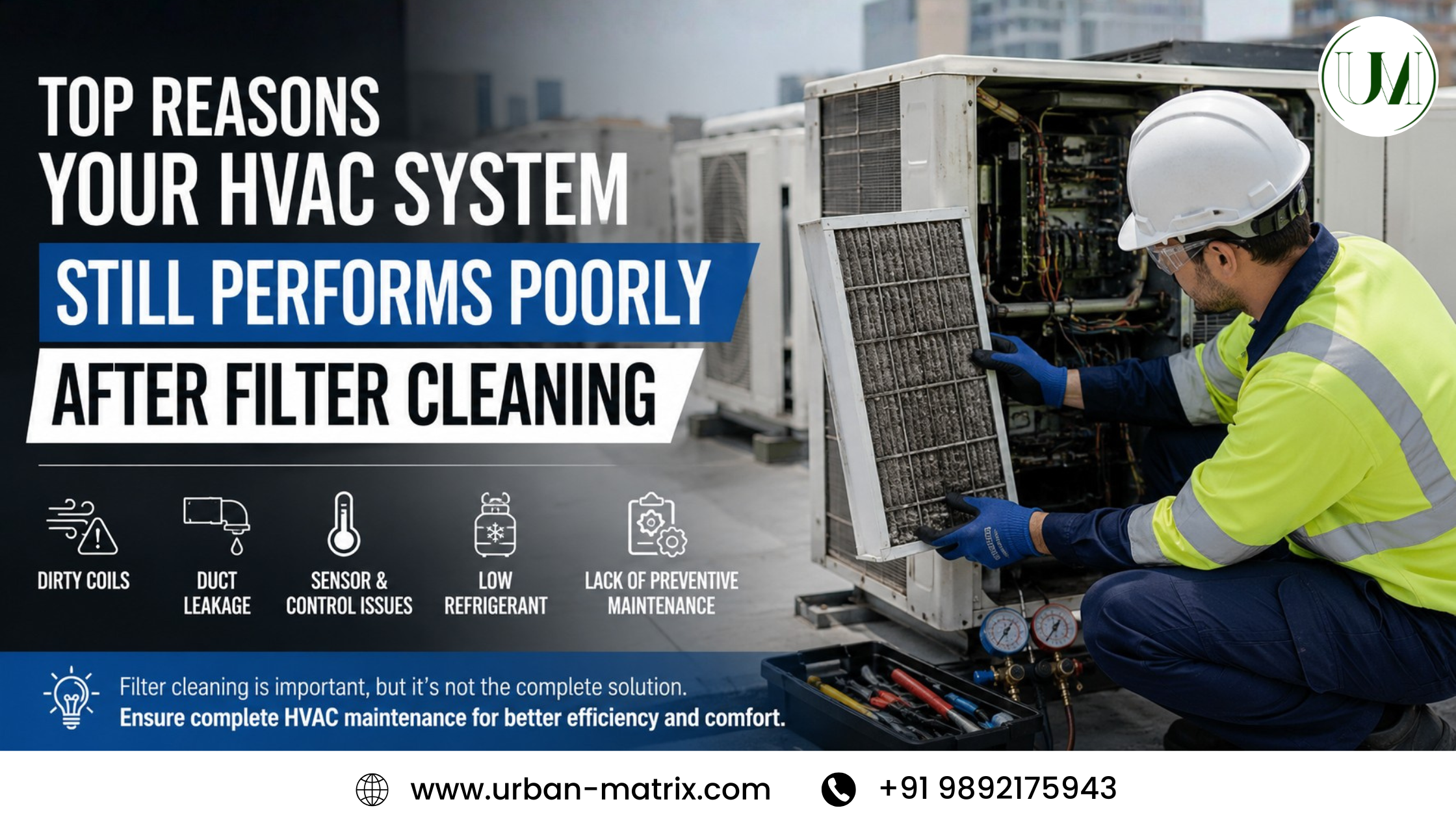
Top Reasons Your HVAC System Still Performs Poorly After Filter Cleaning?
Top Reasons Your HVAC System Still Performs Poorly After Filter Cleaning? Filter cleaning is important, but it is not a complete solution for every HVAC problem. Many commercial buildings, offices, hospitals, retail spaces and industrial facilities in Mumbai still face poor cooling, high electricity bills, low airflow and repeated complaints even after regular air filter cleaning. This is where professional HVAC, MEP & IoT Solutions in Mumbai become important. A commercial HVAC system is connected to multiple parts such as coils, ducts, refrigerant lines, electrical panels, sensors, controls, drainage systems and MEP infrastructure. If any one of these parts is not working properly, the system may still perform poorly even when the filter looks clean. For facility managers and business owners, understanding the real reason behind poor HVAC performance can help reduce downtime, improve comfort and control energy costs. Your HVAC system may still perform poorly after filter cleaning because the issue is not always limited to the air filter. Dirty coils, duct leakage, low refrigerant levels, blocked drain lines, faulty sensors, poor thermostat calibration, electrical load issues, humidity problems and lack of preventive maintenance can all reduce HVAC efficiency. For commercial buildings in Mumbai, a complete inspection by a reliable HVAC maintenance company in Mumbai can help identify the actual cause and improve system performance. Key Takeaways Why HVAC, MEP & IoT Solutions in Mumbai Matter After Filter Cleaning In many commercial buildings, the first response to poor cooling is simple: clean the filter. This is useful, but it only solves one part of the problem. A commercial HVAC system works like a connected network. Air filters, coils, ducts, AHUs, FCUs, VRF systems, chillers, drain lines, sensors, electrical systems and controls all need to work together. If one part is weak, the entire system can become inefficient. This is why businesses now look for complete HVAC, MEP & IoT Solutions in Mumbai instead of only basic filter cleaning. HVAC takes care of cooling and ventilation. MEP supports electrical, mechanical and plumbing-related building performance. IoT adds smart monitoring, data tracking and predictive maintenance. Together, they help facility teams move from complaint-based maintenance to performance-based maintenance. 1. Dirty HVAC Coils Can Still Reduce Cooling One of the biggest reasons for poor HVAC performance after filter cleaning is dirty coils. Even if the filter is clean, dust and dirt may already be deposited on the evaporator coil or condenser coil. Why it matters The evaporator coil absorbs heat from indoor air. The condenser coil releases heat outside. When these coils are dirty, heat transfer becomes weak. As a result, the system runs for longer hours but gives less cooling. Common signs of dirty coils For commercial properties, evaporator coil cleaning and condenser coil cleaning should be part of regular preventive HVAC maintenance. 2. Low Airflow May Come From Duct Leakage or Blockage Many people think low airflow means the filter is dirty. But after filter cleaning, if the airflow is still weak, the problem may be inside the ducting system. Duct leakage, blocked ducts, damaged insulation or poor duct design can reduce the amount of conditioned air reaching the required area. This is a common issue in offices, showrooms, malls, hospitals and commercial buildings. Example A corporate office in Mumbai may clean its HVAC filters every month, but if the duct joints are leaking above the false ceiling, a large amount of cooled air may escape before reaching the workstations. Employees may complain about poor cooling, while the system continues consuming more electricity. This is why commercial HVAC services in Mumbai should include duct inspection, airflow testing and insulation checks. 3. Low Refrigerant Level Can Affect Cooling Efficiency If your HVAC system is still not cooling properly after cleaning the filter, low refrigerant level can be another reason. Refrigerant is responsible for absorbing and transferring heat. When the refrigerant is low, the system cannot cool effectively. Causes of low refrigerant Warning signs Low refrigerant should not be treated as a simple refill job. The leak must be detected and repaired properly. 4. Thermostat Calibration and Sensor Issues Can Disturb Performance Sometimes the HVAC system is mechanically fine, but the controls are not working properly. Faulty sensors, wrong thermostat placement or poor thermostat calibration can confuse the system. For example, if the thermostat is placed near a heat source or direct sunlight, it may read the wrong temperature. The HVAC system may overcool or undercool the space. Common control-related problems This is where smart HVAC monitoring in Mumbai and IoT based HVAC monitoring for commercial buildings can help. IoT sensors can track temperature, humidity, airflow, energy use and system performance in real time. 5. Electrical and MEP Issues Can Increase HVAC Load HVAC performance is not only about cooling equipment. It also depends on the supporting MEP system. Electrical panels, cables, breakers, earthing, control wiring, pumps and drainage systems all affect the performance and safety of HVAC operations. A weak electrical connection, overload condition or control panel issue can reduce efficiency and increase downtime risk. This is why businesses should work with a professional MEP contractor in Mumbai or a complete HVAC and MEP maintenance company in Mumbai for commercial building maintenance. Many people search for Hvac contactor in mumbai or Mep contactor in mumbai, but the correct terms are HVAC contractor in Mumbai and MEP contractor in Mumbai. A qualified contractor can inspect both HVAC equipment and the supporting MEP system. 6. Drain Line Blockage Can Affect Indoor Comfort Drain lines remove condensate water from HVAC systems. During Mumbai’s humid weather and monsoon season, drain lines can get clogged due to dust, algae, sludge or poor slope. A blocked drain line can cause leakage, water dripping, ceiling damage and humidity problems. Even if the filter is clean, the indoor environment may still feel uncomfortable because humidity is not controlled properly. Signs of drain line issues For Mumbai commercial buildings, drain line inspection is especially important before and during monsoon. 7. High Humidity Can Make Cooling Feel Weak In Mumbai, humidity plays
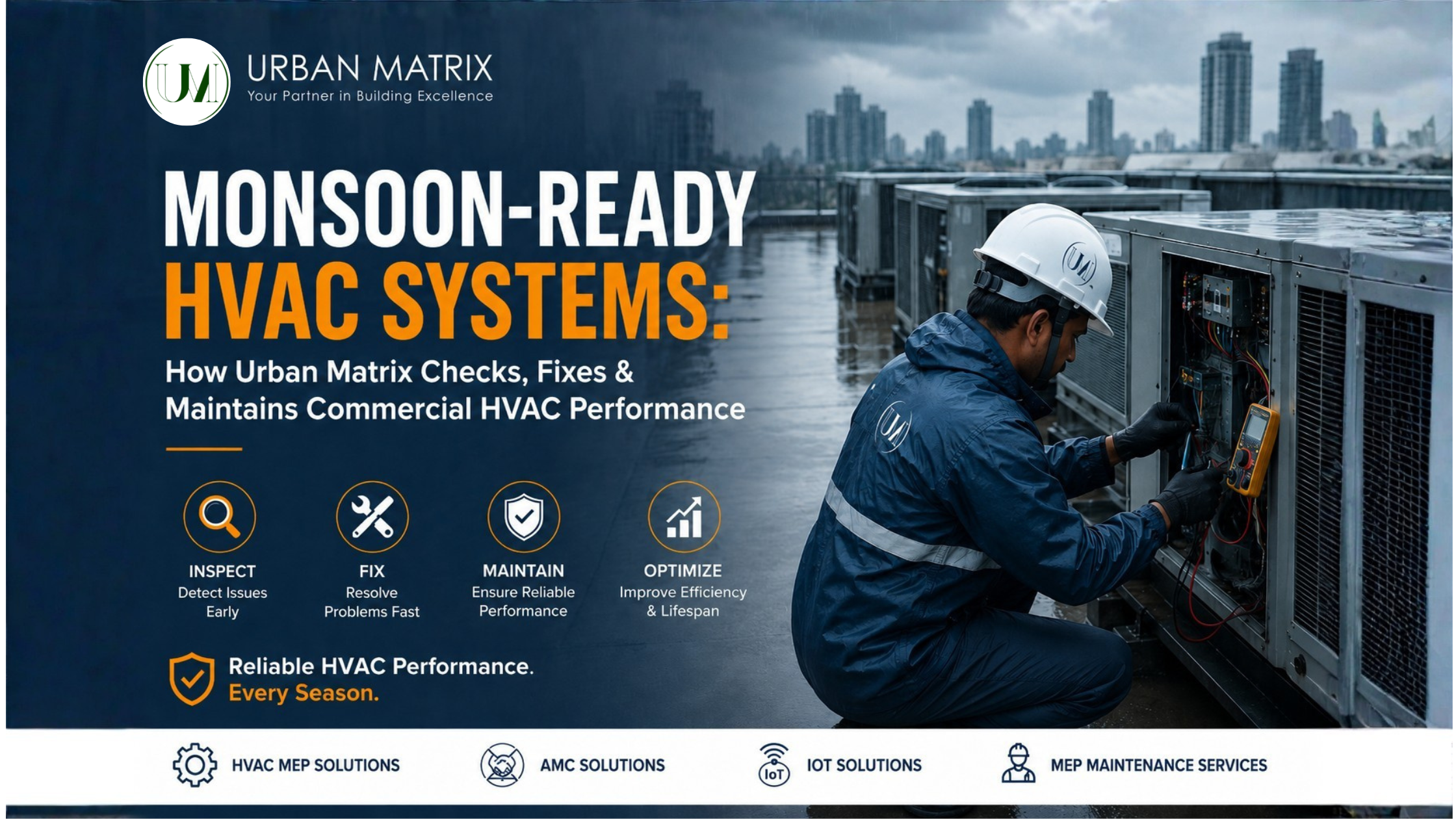
How Does Urban Matrix Make HVAC Systems Monsoon-Ready for Better Commercial HVAC Performance?
How Does Urban Matrix Make HVAC Systems Monsoon-Ready for Better Commercial HVAC Performance? Mumbai’s monsoon can expose weak HVAC systems faster than most commercial buildings expect. One week the cooling feels normal, and the next week there is water leakage, poor airflow, bad smell, high humidity, electrical tripping, or sudden breakdown. For offices, malls, hospitals, hotels, retail spaces, commercial complexes, and industrial facilities, HVAC failure during the rainy season is not just a comfort issue. It can affect employee productivity, customer experience, indoor air quality, equipment safety, and energy consumption. This is where planned HVAC MEP Solutions become important. A monsoon-ready HVAC system is not only about servicing the AC before rain starts. It is about checking drainage, airflow, electrical safety, coils, filters, humidity impact, corrosion risk, and overall building HVAC performance. Urban Matrix helps commercial buildings in Mumbai with professional HVAC inspection services, HVAC maintenance services, MEP maintenance services in Mumbai, AMC Solutions, IoT Solutions, and preventive HVAC maintenance. The goal is simple: identify problems early, fix them correctly, and maintain system performance before small issues become costly breakdowns. Monsoon-ready HVAC maintenance helps commercial buildings prevent water leakage, poor cooling, mould growth, humidity issues, corrosion, electrical faults, and sudden breakdowns. Urban Matrix HVAC Solutions check filters, coils, drain lines, airflow, electrical safety, and system performance to maintain reliable commercial HVAC performance during Mumbai’s rainy season. What is a Monsoon-Ready HVAC System? A monsoon-ready HVAC system is a heating, ventilation, and air conditioning system that has been inspected, cleaned, tested, and maintained to perform safely during high humidity, heavy rainfall, and moisture-heavy conditions. During monsoon, HVAC systems face extra pressure because the air contains more moisture. This can lead to condensation, AC water leakage during monsoon, HVAC drain blockage, mould in HVAC system, bad smell from AC during monsoon, electrical faults, corrosion, and poor cooling during monsoon. For commercial buildings, a monsoon-ready HVAC system includes: In simple words, monsoon HVAC maintenance in Mumbai helps buildings stay comfortable, safe, and operational during the rainy season. A monsoon-ready HVAC system is not just serviced. It is checked for drainage, airflow, electrical safety, humidity control, cooling performance, and long-term reliability. Why is HVAC Maintenance Important Before Monsoon? Preventive HVAC maintenance is important before monsoon because high humidity and rain can increase the chances of hidden system failures. Commercial HVAC maintenance Mumbai becomes especially important because buildings in the city face long cooling hours, heavy moisture, salt-laden air in some areas, dust, and high occupancy loads. Key reasons include: Monsoon does not create every HVAC problem. It reveals weak maintenance, poor drainage, dirty coils, loose electrical parts, and airflow issues that were already building up. How Does Urban Matrix Check, Fix and Maintain HVAC Performance? Urban Matrix follows a structured process for HVAC MEP Solutions, commercial HVAC services, and MEP and HVAC solutions in Mumbai. The focus is to inspect the complete system, fix priority issues, and maintain performance through planned AMC support. Step 1: HVAC System Health Check The first step is a complete HVAC system health check. Urban Matrix checks: This helps identify HVAC problems during monsoon before they turn into major failures. Step 2: Drainage and Water Leakage Inspection Drainage is one of the biggest monsoon HVAC concerns. Urban Matrix checks condensate drain lines, drain trays, slope, blockage, water backup, and leakage points. HVAC drain line cleaning helps reduce the risk of AC water leakage during monsoon. Common causes of leakage include: Step 3: Filter and Coil Cleaning Dirty filters and coils reduce airflow and cooling performance. They also increase system load. Urban Matrix provides HVAC system cleaning, HVAC coil cleaning, and filter inspection to improve cooling efficiency and indoor air quality. Clean coils help the system transfer heat better. Clean filters help maintain airflow and reduce dust circulation. Step 4: Airflow Testing Low airflow can cause poor cooling during monsoon. Urban Matrix performs HVAC airflow testing to check whether air is moving properly across ducts, vents, AHUs, FCUs, and indoor areas. Airflow issues can happen due to: Step 5: Electrical Safety Check Moisture damage in HVAC system can create electrical risks. Urban Matrix checks panels, wiring, terminals, sensors, controls, breakers, and connections through an HVAC electrical safety check. This reduces the risk of tripping, short circuits, sudden shutdowns, and equipment damage. Step 6: Performance Check and Repair After inspection, Urban Matrix identifies what needs immediate repair and what can be planned under AMC. The team may recommend: Step 7: Preventive HVAC AMC Support HVAC AMC services in Mumbai help commercial buildings avoid repeated emergency repairs. With Commercial HVAC AMC, Urban Matrix provides planned inspection, preventive checks, maintenance scheduling, and service support. This approach supports HVAC breakdown prevention and better commercial HVAC performance across the season. Urban Matrix checks the system, finds weak points, fixes leakage, airflow, coils, drainage and electrical issues, and maintains long-term performance through preventive HVAC AMC. What Are the Benefits of Monsoon HVAC Maintenance? Professional HVAC maintenance services during monsoon help commercial buildings stay ready, safe, and efficient. Main benefits include: For buildings that depend on consistent cooling, HVAC AMC services can reduce the pressure on facility teams. Instead of reacting after a breakdown, the building gets planned support. Reactive Repair vs Preventive HVAC Maintenance vs Smart HVAC Monitoring Approach What It Means Main Issue Best For Reactive Repair Repair after system failure Higher downtime and urgent repair cost Small one-time issues Preventive HVAC Maintenance Scheduled checks and servicing Needs proper planning Offices, malls, hotels, hospitals Predictive / Smart Monitoring Uses IoT Solutions and performance data Needs setup and monitoring Large commercial buildings and critical facilities Commercial HVAC AMC Regular maintenance contract Needs reliable service partner Long-term HVAC performance Reactive repair may look cheaper at first, but it usually becomes expensive when breakdowns happen during peak monsoon pressure. Preventive HVAC maintenance is more practical for most commercial buildings because it helps detect issues early. IoT-based monitoring is useful for buildings that want real-time alerts, energy insights, and performance visibility. Urban Matrix combines HVAC Solutions, MEP Solutions,

How to Choose the Right HVAC Contractors in Mumbai for Commercial Buildings?
How to Choose the Right HVAC Contractors in Mumbai for Commercial Buildings? Commercial buildings in Mumbai need reliable HVAC systems to maintain cooling comfort, indoor air quality, energy efficiency, and smooth daily operations. But many building owners face problems like high electricity bills, uneven cooling, poor airflow, sudden breakdowns, and delayed maintenance. This usually happens when HVAC planning, installation, MEP coordination, and AMC are handled without a complete technical approach. Choosing the right HVAC contractors in Mumbai is important because commercial HVAC systems are more complex than normal residential AC systems. Offices, hospitals, malls, hotels, industrial spaces, and commercial complexes need proper load calculation, ducting, ventilation planning, electrical coordination, system testing, and preventive maintenance. Urban Matrix helps businesses with complete HVAC, MEP & IoT Solutions in Mumbai, including installation, maintenance, AMC, smart monitoring, and performance-focused building solutions. To choose the right HVAC contractors in Mumbai, check their commercial project experience, HVAC installation process, MEP coordination, AMC support, energy efficiency approach, response time, and ability to provide IoT-based monitoring. A good contractor should offer complete HVAC solutions, not just basic repair or installation. What Is a Commercial HVAC Contractor? A commercial HVAC contractor is a professional service provider who designs, installs, maintains, and optimizes heating, ventilation, and air conditioning systems for commercial buildings. Unlike basic AC vendors, commercial HVAC contractors manage larger systems, ducting, ventilation, electrical coordination, cooling load planning, testing, commissioning, and long-term maintenance. For Mumbai-based commercial buildings, this is especially important because high humidity, continuous usage, pollution, and high occupancy can put extra load on HVAC systems. Why Is Choosing the Right HVAC Contractor Important? Choosing the right contractor matters because HVAC affects: A poor HVAC system can lead to frequent breakdowns, high power bills, uncomfortable indoor spaces, and costly repairs. How to Choose the Right HVAC Contractors in Mumbai 1. Check Commercial Project Experience Choose contractors who have worked on commercial buildings, not only small residential jobs. They should understand: 2. Check HVAC Design and Load Calculation A reliable contractor should not suggest equipment without understanding your building. They should check: 3. Check MEP Coordination Commercial HVAC systems must work with electrical, plumbing, drainage, fire safety, and automation systems. This is why choosing HVAC and MEP contractors in Mumbai is better than hiring separate vendors without coordination. 4. Check AMC and Maintenance Support For commercial buildings, HVAC AMC is important. A good AMC plan should include: 5. Check Smart Monitoring Capability Modern buildings need smart monitoring. IoT-based HVAC monitoring can help track: This helps facility teams take action before a small issue becomes a major breakdown. Benefits of Hiring Professional HVAC Contractors Hiring experienced commercial HVAC contractors in Mumbai can help you get: Why Choose Urban Matrix in Mumbai? Urban Matrix provides complete HVAC, MEP & IoT Solutions in Mumbai for commercial and industrial buildings. Urban Matrix helps with: The Urban Matrix focuses on performance, reliability, preventive maintenance, and smart building efficiency instead of only basic HVAC servicing. FAQs 1. How to choose the right HVAC contractors in Mumbai? Choose HVAC contractors based on commercial experience, technical knowledge, AMC support, MEP coordination, service response time, and ability to provide energy-efficient solutions. 2. What should I check before hiring an HVAC contractor? Check their project experience, installation process, maintenance support, team capability, safety practices, service scope, and whether they understand commercial HVAC requirements. 3. Why do commercial buildings need HVAC AMC? Commercial buildings need HVAC AMC to reduce breakdowns, improve cooling performance, control energy usage, extend equipment life, and avoid emergency repair costs. 4. What is the difference between HVAC contractors and AC vendors? HVAC contractors handle complete commercial systems, including design, ducting, ventilation, installation, MEP coordination, AMC, and performance monitoring. AC vendors usually handle basic installation or repair. 5. Which HVAC company in Mumbai is suitable for commercial buildings? A suitable HVAC company in Mumbai should provide HVAC installation, maintenance, AMC, MEP coordination, energy optimization, and smart monitoring support for commercial buildings. Conclusion Looking for reliable HVAC contractors in Mumbai for your commercial building? Urban Matrix can help you with complete HVAC, MEP & IoT Solutions, including HVAC installation, AMC, maintenance, smart monitoring, and energy-efficient building solutions. Contact Urban Matrix today to make your commercial building smarter, more efficient, and more reliable.