
Managing a commercial building is rarely about fixing one machine at a time.
A cooling issue may begin with an AHU, but the actual cause could be poor airflow, an electrical problem, incorrect controls or inadequate maintenance. A rise in electricity consumption may be linked to a chiller, pump, sensor or operating schedule.
For commercial properties looking at HVAC, MEP & IoT solutions in Mumbai,India this broader approach can make it easier to understand what is working, what needs attention and where improvements should be prioritised.
A complete building systems audit helps facility managers understand how HVAC, electrical, plumbing, controls and smart monitoring systems are performing together. More importantly, it helps identify small problems before they turn into expensive breakdowns, uncomfortable workplaces or unnecessary energy costs.
For offices, hospitals, retail spaces, hotels, industrial facilities and commercial properties, a structured audit can provide a clearer roadmap for maintenance, upgrades and long-term system performance.
What Is a Complete HVAC, MEP & IoT Building Systems Audit?
A building systems audit is a detailed review of the major services that keep a commercial property running.
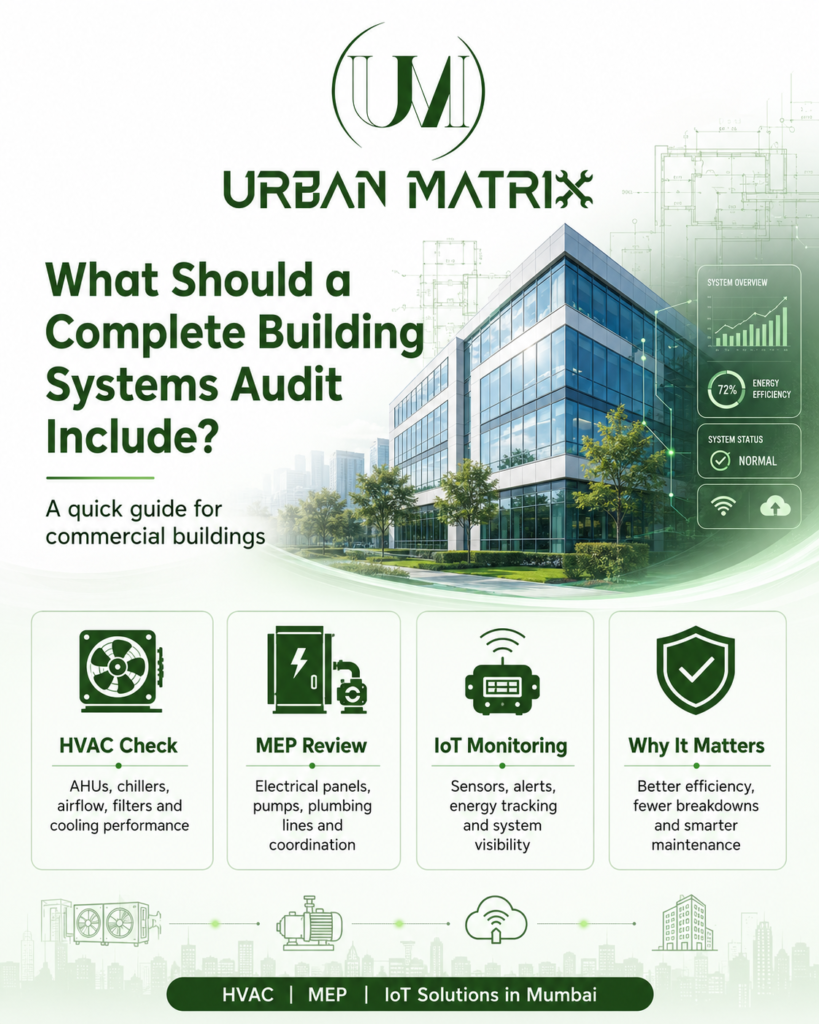
It usually covers:
- HVAC equipment and cooling performance
- AHUs and ventilation systems
- Chillers, pumps and motors
- Electrical panels and distribution systems
- Plumbing and drainage systems
- MEP coordination
- Controls and sensors
- Energy consumption
- Maintenance history
- IoT monitoring systems
The purpose is not simply to find faults.
A good audit should help answer three practical questions:
- What is working properly?
- What needs attention now?
- What can be improved to reduce future operating costs?
This wider approach is particularly useful when businesses are evaluating HVAC, MEP & IoT solutions in Mumbai for existing facilities, retrofits or new projects.
Why Should Commercial Buildings Conduct a Systems Audit?
Most building systems do not fail without warning.
There are usually smaller signs first.
You may notice that one office area is no longer cooling properly. Electricity bills may gradually increase. An AHU may start making more noise. A pump could require frequent repair. Employees may complain about inconsistent temperatures.
These problems are easy to deal with individually, but repeated issues often suggest that a deeper technical review is needed.
A building audit can help identify:
- Poor HVAC efficiency
- Unbalanced airflow
- Ageing equipment
- Incorrect operating schedules
- Electrical irregularities
- Plumbing leaks
- Poor equipment coordination
- Incomplete preventive maintenance
- Excessive energy consumption
- Opportunities for smart monitoring
Rather than waiting for a complete breakdown, facility teams can use these observations to plan maintenance more effectively.
1. Start With a Detailed HVAC System Inspection
HVAC is one of the most important systems in any commercial facility, especially in Mumbai where cooling systems may operate for long hours throughout the year.
An HVAC audit should look beyond whether the AC is simply “working.”
The inspection may include:
- Cooling capacity
- Supply and return air temperatures
- Airflow
- Filters
- Cooling coils
- Ductwork
- Insulation
- Motors and fans
- Refrigerant-related concerns
- Thermostats and controllers
- Electrical connections
- Noise and vibration
- Equipment operating hours
An experienced HVAC company in Mumbai should evaluate system performance as a whole rather than focusing only on visible faults.
For businesses planning a new system, an experienced HVAC installation contractor in Mumbai should also consider the actual cooling requirement, equipment location, airflow distribution and future maintenance accessibility rather than focusing only on equipment capacity.
Poor installation can create performance problems that continue for years.
2. Inspect AHUs Before Airflow Problems Become Serious
Air Handling Units play a major role in circulating and conditioning air throughout commercial buildings.
However, many AHUs receive attention only after cooling or airflow drops noticeably.
Professional AHU maintenance services Mumbai should include checks such as:
- Filter condition
- Cooling coil cleanliness
- Drain tray condition
- Drain line blockage
- Fan operation
- Motor condition
- Belt tension
- Bearing condition
- Damper movement
- Air leakage
- Noise and vibration
- Airflow performance
A simple issue such as a clogged filter may reduce airflow and force the system to work harder.
Over time, this can affect comfort, equipment efficiency and electricity consumption.
Regular inspection makes it easier to identify these issues early.
3. Review Chiller Performance, Not Just Chiller Operation
In buildings with central air-conditioning systems, chillers often represent a major part of HVAC energy consumption.
A chiller may continue operating even when its efficiency is gradually declining.
That is why chiller maintenance services Mumbai should focus on performance rather than only servicing schedules.
A chiller audit may evaluate:
- Chilled-water temperatures
- Condenser and evaporator condition
- Pump operation
- Water flow
- Electrical parameters
- Controls
- Noise and vibration
- Operating pressures
- Energy consumption trends
If a facility experiences recurring alarms, inconsistent cooling or increased electricity consumption, those patterns should be investigated instead of repeatedly resetting the equipment.
4. Check Electrical Systems Alongside HVAC
HVAC systems rely heavily on the electrical infrastructure supporting them.
Motors, chillers, AHUs, pumps and control systems all require reliable power.
This is where coordinated MEP maintenance services in Mumbai become valuable.
During an electrical audit, technicians may inspect:
- Electrical panels
- Circuit breakers
- Cables and connections
- Motor starters
- Protection systems
- Equipment loads
- Signs of overheating
- Loose connections
- Electrical imbalance
Sometimes what appears to be an HVAC problem is actually connected to an electrical issue.
That is why integrated system inspection can be more effective than treating mechanical and electrical services separately.
5. Do Not Ignore Plumbing and Drainage
Plumbing problems often begin quietly.
A small leak may seem harmless until it damages ceilings, walls, equipment or occupied spaces.
Routine plumbing maintenance services in Mumbai can be particularly important in commercial spaces where even a small issue may affect employees, tenants or daily operations.
- Leaking pipes
- Damaged valves
- Drainage blockages
- Pump problems
- Pressure irregularities
- Corrosion
- Water seepage
- Ageing plumbing lines
Commercial properties cannot afford to wait until a minor leak becomes an operational disruption.
Plumbing should therefore form an important part of every MEP audit.
6. Review MEP Coordination
Mechanical, electrical and plumbing systems operate in the same physical space.
They often share:
- Ceiling areas
- Service shafts
- Plant rooms
- Equipment rooms
- Maintenance access points
When these systems are not properly coordinated, maintenance becomes difficult.
For example, an electrical cable tray may block access to an HVAC valve. A duct may interfere with plumbing routes. Equipment may be installed in a position that makes future servicing difficult.
Professional MEP coordination services Mumbai can help prevent these conflicts.
Businesses working with mep contractors in mumbai should therefore consider not only installation quality but also long-term accessibility and coordination.
The same applies when selecting Mechanical electrical plumbing contractors Mumbai for new developments, refurbishments and retrofit projects.
Good coordination during the project stage can prevent years of maintenance problems.
7. Review the Existing HVAC AMC
Having an AMC does not automatically mean that a building is being maintained effectively.
The quality of the maintenance programme matters.
A reliable HVAC AMC contractor in Mumbai should maintain records and monitor recurring issues instead of simply performing routine visits.
During an audit, facility teams should ask:
- Which equipment breaks down most frequently?
- Are preventive maintenance visits happening on schedule?
- Are observations properly documented?
- Are filters, coils and electrical components being checked regularly?
- Are repeated faults being investigated?
- Is energy performance changing?
- Are critical systems receiving enough attention?
The same applies when evaluating an office AC maintenance contract in Mumbai. The scope should match the type of AC system, operating hours, equipment condition and importance of the space.
A server room, office floor and meeting area may all have different cooling priorities.
Maintenance plans should reflect those differences.
8. Use IoT to Improve System Visibility
Traditional maintenance depends on scheduled inspections and manual observations.
IoT monitoring can provide another layer of information.
Sensors may help monitor:
- Temperature
- Humidity
- Equipment operating status
- Energy consumption
- Selected electrical parameters
- Equipment runtime
- Alerts and abnormal conditions
A capable IoT solutions company in Mumbai should first understand what the facility actually needs to monitor.
Installing more sensors does not automatically make a building smarter.
The goal should be to collect useful information that helps maintenance teams make better decisions.
For example, an unusual temperature pattern could indicate a cooling issue before employees complain.
An abnormal operating duration may suggest that equipment is working harder than expected.
Early visibility allows teams to investigate sooner.
9. Monitor Energy Instead of Waiting for the Monthly Bill
Energy bills tell facility managers how much electricity has been consumed.
They do not always explain where the extra consumption is coming from.
This is where Energy monitoring solutions Mumbai can provide useful insights.
Monitoring can help teams compare energy use across:
- Equipment
- Floors
- Time periods
- Operating schedules
- Different HVAC systems
Suppose an air-conditioning system begins consuming noticeably more energy even though office operating hours remain the same.
That does not immediately identify the cause, but it gives the maintenance team a starting point.
Possible reasons might include:
- Dirty coils
- Clogged filters
- Incorrect temperature settings
- Poor airflow
- Extended equipment runtime
- Ageing components
- Control problems
The objective is to use data to guide maintenance instead of relying only on assumptions.
When Should You Consider an HVAC, MEP & IoT Audit?
A full building systems audit may be useful if you notice:
- Rising electricity bills
- Frequent HVAC breakdowns
- Uneven cooling
- Recurring chiller alarms
- Poor airflow
- Excessive equipment noise
- Water leakage
- Frequent plumbing problems
- Increasing maintenance expenses
- Occupant comfort complaints
- Ageing HVAC equipment
- Planned office renovation
- Building expansion
- Retrofit requirements
You may also consider an audit before changing contractors or renewing a major maintenance agreement.
Understanding the current condition of the building provides a stronger starting point for future planning.
Why Integrated HVAC, MEP & IoT Solutions Make Sense
Commercial buildings operate as connected environments.
Cooling affects electrical consumption. Pumps affect water circulation. Controls affect equipment runtime. Poor coordination affects maintenance access.
An HVAC company in Mumbai may identify a cooling issue, while electrical specialists may find that the real problem involves power quality or motor operation.
An integrated approach can make it easier to:
- Identify the root cause of recurring issues
- Reduce unnecessary maintenance
- Improve system coordination
- Plan upgrades more effectively
- Monitor energy consumption
- Improve equipment reliability
- Reduce unexpected breakdowns
- Support long-term facility planning
The goal is not to replace every piece of equipment.
Sometimes the best solution is better maintenance.
In other situations, controls may need improvement, equipment may require retrofitting or monitoring may need to be introduced.
A detailed audit helps determine the right next step.
Why Choose Urban Matrix for HVAC, MEP & IoT Solutions in Mumbai?
Urban Matrix provides integrated solutions across HVAC, MEP, annual maintenance, refurbishment, retrofitting and IoT-enabled system monitoring.
Instead of treating each building service as an isolated function, the focus is placed on how systems work together.
For organisations searching for HVAC, MEP & IoT solutions in Mumbai, this integrated approach can support everything from initial technical assessment and installation to preventive maintenance and performance monitoring.
Whether the requirement involves HVAC installation, AHU servicing, chiller maintenance, MEP coordination or energy monitoring, the first step should always be understanding the actual condition and operating requirements of the facility.
Final Thoughts
A commercial building usually provides warning signs before a major system failure occurs.
A room that takes longer to cool, an AHU making unusual noise, an increasing electricity bill or a recurring chiller alarm should not automatically be treated as separate issues.
They may be signs that the building needs a wider technical review.
A complete audit of HVAC, MEP & IoT solutions in Mumbai helps facility managers understand equipment condition, maintenance requirements, energy use and overall system performance.
The sooner these issues are identified, the easier it becomes to plan maintenance, prevent unexpected breakdowns and improve long-term building efficiency.
FAQs
What is included in HVAC, MEP & IoT solutions in Mumbai?
These solutions can include HVAC installation and maintenance, AHU and chiller servicing, electrical and plumbing maintenance, MEP coordination, IoT monitoring, system alerts and energy monitoring for commercial buildings.
How often should commercial HVAC systems be audited?
The frequency depends on equipment age, system type, operating hours and facility requirements. Buildings experiencing frequent breakdowns, increased energy consumption or inconsistent cooling may need an audit sooner.
Why is AHU maintenance important?
Regular AHU maintenance can help maintain airflow, cooling performance and indoor comfort while identifying issues such as dirty filters, coil buildup, belt wear and drainage problems.
What does an HVAC AMC contractor in Mumbai usually handle?
An HVAC AMC contractor may handle scheduled preventive maintenance, equipment inspections, cleaning, performance checks and troubleshooting depending on the agreed scope of the contract.
How can IoT monitoring help commercial buildings?
IoT monitoring can provide greater visibility into operating conditions, temperature trends, energy consumption and equipment performance. This can help facility teams identify unusual behaviour and respond earlier.
Need a Better Understanding of Your Building Systems?
If your commercial property is experiencing recurring HVAC problems, increasing energy consumption or maintenance challenges, a detailed system assessment can help identify where attention is really needed.
Urban Matrix provides HVAC, MEP, AMC and IoT solutions for commercial facilities in Mumbai.
Start with a technical assessment and build a maintenance strategy around the actual condition of your systems.