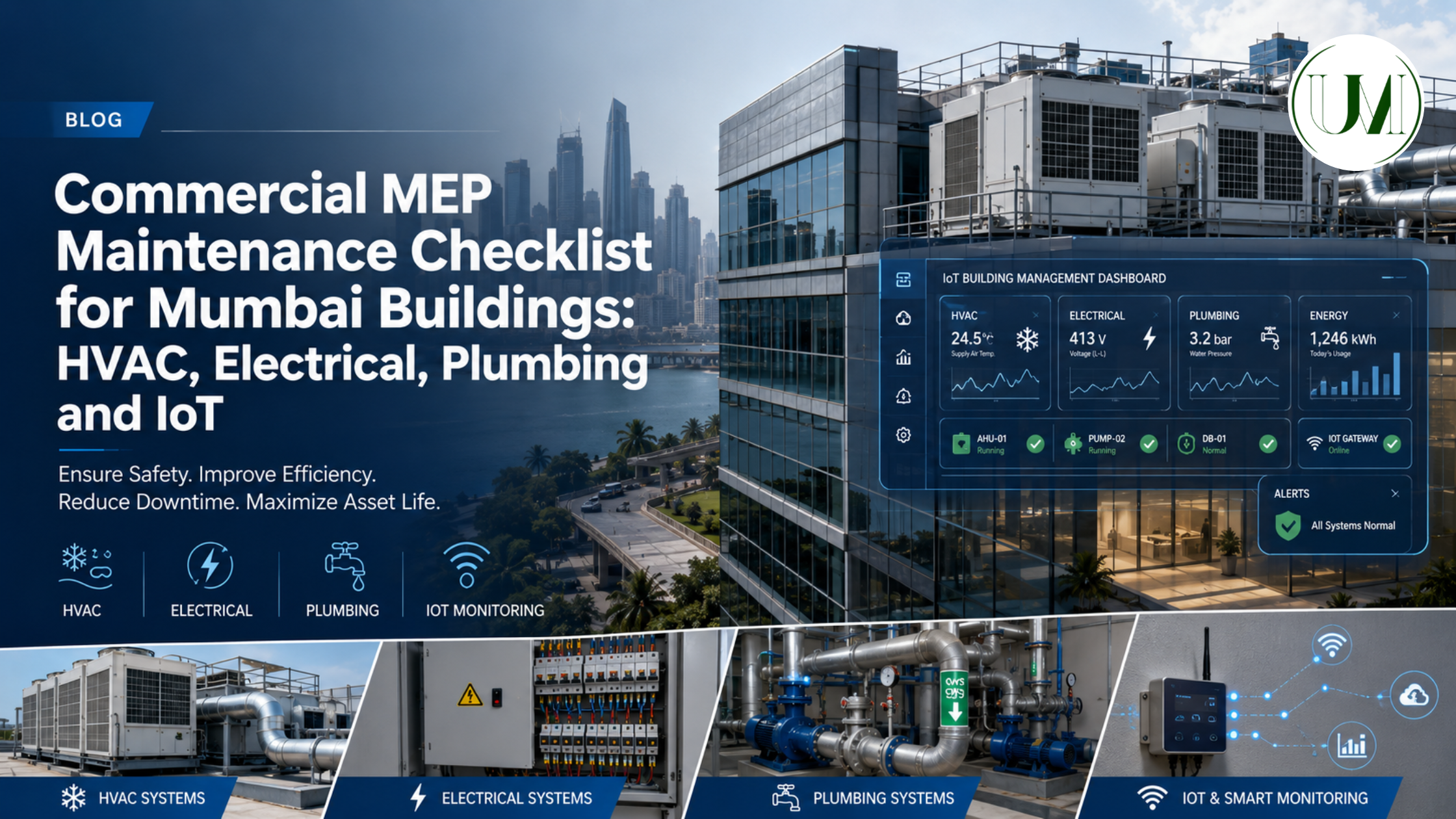
A commercial building can look perfectly normal while several hidden systems are already moving towards failure.
An air-handling unit may be operating with a clogged filter. An electrical panel may have a loose connection that is generating heat. A drainage pipe may be partially blocked. A pump may be drawing more current than usual. Meanwhile, a sensor may already be showing abnormal temperature, pressure or runtime data.
This is why reliable MEP Solutions in Mumbai should not begin only after something breaks. They should include planned inspections, cleaning, testing, performance monitoring and timely corrective work.
MEP stands for mechanical, electrical and plumbing. These systems support cooling, ventilation, power distribution, water supply, drainage, pumping and many other functions required for a building to operate safely and comfortably. MEP engineering also plays a role in building operation, documentation and long-term maintenance.
For Mumbai properties, maintenance requires special attention because commercial systems operate through heat, dust, humidity and heavy seasonal rainfall. IMD’s Mumbai observations regularly show high relative humidity during the monsoon period, reinforcing the need to protect electrical, HVAC and drainage assets from moisture-related problems.
This guide provides a practical commercial MEP maintenance checklist for Mumbai buildings, covering HVAC, electrical, plumbing, drainage, pumps, IoT devices and Building Management System operations.
Table of Contents
- What is commercial MEP maintenance?
- Why Mumbai buildings need preventive maintenance
- Daily, monthly, quarterly and annual maintenance schedule
- Commercial HVAC maintenance checklist
- Electrical preventive maintenance checklist
- Plumbing and drainage maintenance checklist
- Pump room maintenance checklist
- IoT, BMS and smart monitoring checklist
- Pre-monsoon MEP maintenance checklist
- Common MEP problems in commercial buildings
- Preventive versus predictive MEP maintenance
- What an MEP AMC should include
- How to choose an MEP maintenance company
- Frequently asked questions
What Is Commercial MEP Maintenance?
Commercial MEP maintenance is the planned inspection, cleaning, testing, servicing, monitoring and repair of a building’s mechanical, electrical and plumbing systems.
A complete maintenance programme may cover:
- Air-conditioning and ventilation equipment
- Air Handling Units and Fan Coil Units
- Chillers and cooling towers
- Electrical distribution panels
- Transformers, UPS units and generators
- Earthing and protection systems
- Water-supply pipelines
- Drainage and sewage systems
- Transfer, booster and sewage pumps
- Water tanks and level controls
- Building Management System equipment
- IoT sensors and remote monitoring dashboards
The purpose of preventive MEP maintenance is to identify deterioration before it causes a breakdown, safety concern, comfort complaint or business interruption.
A good MEP inspection checklist should also record what was checked, what condition was found, what measurements were taken, who performed the work and what corrective action is required.
Why Mumbai Commercial Buildings Need Planned MEP Maintenance
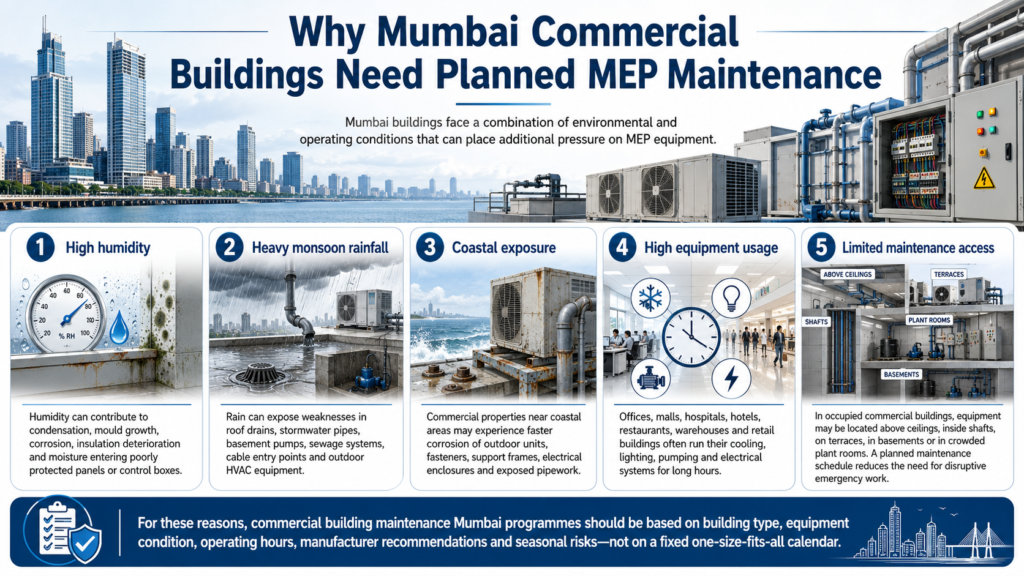
Mumbai buildings face a combination of environmental and operating conditions that can place additional pressure on MEP equipment.
1. High humidity
Humidity can contribute to condensation, mould growth, corrosion, insulation deterioration and moisture entering poorly protected panels or control boxes.
2. Heavy monsoon rainfall
Rain can expose weaknesses in roof drains, stormwater pipes, basement pumps, sewage systems, cable entry points and outdoor HVAC equipment. IMD’s southwest monsoon information explains that the monsoon advances across India during June and July, while Mumbai’s regional reports track substantial seasonal rainfall.
3. Coastal exposure
Commercial properties near coastal areas may experience faster corrosion of outdoor units, fasteners, support frames, electrical enclosures and exposed pipework.
4. High equipment usage
Offices, malls, hospitals, hotels, restaurants, warehouses and retail buildings often run their cooling, lighting, pumping and electrical systems for long hours.
5. Limited maintenance access
In occupied commercial buildings, equipment may be located above ceilings, inside shafts, on terraces, in basements or in crowded plant rooms. A planned maintenance schedule reduces the need for disruptive emergency work.
For these reasons, commercial building maintenance Mumbai programmes should be based on building type, equipment condition, operating hours, manufacturer recommendations and seasonal risks not on a fixed one-size-fits-all calendar.
Daily, Monthly, Quarterly and Annual MEP Checklist
The following schedule can be adapted for offices, retail properties, hotels, hospitals, commercial complexes and warehouses.
| Frequency | Recommended checks |
|---|---|
| Daily | Review alarms, temperatures, pressure, unusual noise, leakage, equipment status and critical pump operation |
| Weekly | Inspect filters, drain trays, panel rooms, pump rooms, visible pipelines and equipment housekeeping |
| Monthly | Test selected controls, inspect electrical panels, clean filters, review energy data and inspect drainage points |
| Quarterly | Service HVAC equipment, check electrical connections, test pumps, inspect valves and review BMS trends |
| Half-yearly | Conduct deeper cleaning, performance testing, thermography where required and pre/post-monsoon checks |
| Annually | Complete an asset condition review, safety tests, major servicing, calibration and maintenance-plan update |
This daily monthly quarterly and annual MEP checklist is a planning framework. Actual intervals should be confirmed using equipment manuals, applicable requirements, site conditions and professional assessment.
Commercial HVAC Maintenance Checklist
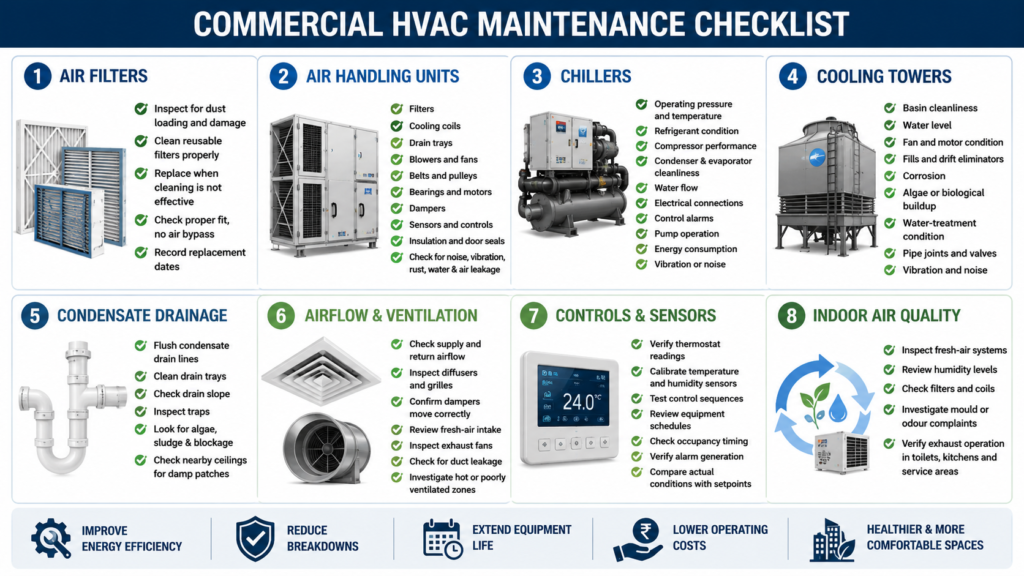
HVAC systems affect temperature, ventilation, humidity, indoor air quality and energy use. ASHRAE Standard 180 establishes minimum inspection and maintenance requirements intended to preserve thermal comfort, energy efficiency and indoor air quality in commercial building HVAC systems.
A professional commercial HVAC maintenance Mumbai programme should cover more than basic AC servicing.
1. Air filters
- Inspect filters for dust loading and damage.
- Clean reusable filters correctly.
- Replace filters when cleaning is no longer effective.
- Check that filters fit properly without air bypass.
- Record replacement dates.
Dirty filters reduce airflow and can increase pressure on fans and cooling coils.
2. Air Handling Units
Use an AHU maintenance checklist to inspect:
- Filters
- Cooling coils
- Drain trays
- Blowers and fans
- Belts and pulleys
- Bearings
- Motors
- Dampers
- Flexible connections
- Sensors and controls
- Internal insulation
- Door seals
Also check for unusual sound, vibration, rust, water accumulation and air leakage.
3. Chillers
A chiller maintenance checklist may include:
- Operating pressure and temperature
- Refrigerant condition
- Compressor performance
- Condenser and evaporator cleanliness
- Water flow
- Electrical connections
- Control alarms
- Pump operation
- Energy consumption
- Unusual vibration or noise
The exact procedure depends on whether the building uses an air-cooled or water-cooled system.
4. Cooling towers
Inspect:
- Basin cleanliness
- Water level
- Fan and motor condition
- Fills and drift eliminators
- Corrosion
- Algae or biological buildup
- Water-treatment condition
- Pipe joints and valves
- Vibration and noise
Regular cooling tower maintenance supports heat rejection and reduces avoidable stress on the chiller system.
5. Condensate drainage
- Flush condensate drain lines.
- Clean drain trays.
- Check drain slope.
- Inspect traps.
- Look for algae, sludge and blockage.
- Check nearby ceilings for damp patches.
Blocked condensate drains can cause leakage, ceiling damage, odour and mould.
6. Airflow and ventilation
- Check supply and return airflow.
- Inspect diffusers and grilles.
- Confirm dampers move correctly.
- Review fresh-air intake.
- Inspect exhaust fans.
- Check for duct leakage.
- Investigate hot or poorly ventilated zones.
7. Controls and sensors
- Verify thermostat readings.
- Calibrate temperature and humidity sensors.
- Test control sequences.
- Review equipment schedules.
- Check occupancy timing.
- Verify alarm generation.
- Compare actual conditions with setpoints.
8. Indoor air quality
- Inspect fresh-air systems.
- Review humidity levels.
- Check filters and coils.
- Investigate mould or odour complaints.
- Verify exhaust operation in toilets, kitchens and service areas.
Commercial HVAC checklist guidance commonly includes filter inspection, coil cleaning, refrigerant checks, electrical connections, controls, belts, motors and airflow verification.
How to prevent HVAC breakdowns in commercial buildings
The best approach is to combine cleaning, condition checks, operating-data review and timely repairs. Repeatedly resetting alarms without investigating their cause can turn a small issue into a larger failure.
Businesses comparing HVAC AMC services Mumbai should therefore ask whether the service includes readings, reports, alarm review, component inspection and root-cause analysis not only routine cleaning.
Electrical Preventive Maintenance Checklist
Commercial electrical systems must be inspected by competent professionals. BIS’s electrical installation committee scope includes standards relating to safety in the design, erection and maintenance of electrical installations.
The following electrical maintenance checklist for commercial buildings provides a useful starting point.
1. Electrical panels
Inspect:
- LT and HT panels, where applicable
- Main and sub-distribution boards
- MCC and APFC panels
- Breakers and protective devices
- Cable terminations
- Busbars
- Panel ventilation
- Door seals and locking
- Labelling
- Signs of moisture or corrosion
2. Warning signs requiring attention
- Burning smell
- Discolouration
- Repeated breaker trips
- Buzzing or crackling
- Excessive heat
- Loose cable terminations
- Rust or water marks
- Damaged insulation
- Unbalanced current
- Unusual power-factor readings
3. Electrical thermography
Electrical thermography can help identify abnormal heat patterns in connections, breakers, cables and busbars without waiting for visible failure.
Thermal findings should be interpreted by qualified personnel and followed by suitable corrective work.
4. Earthing and protection systems
- Inspect earthing connections.
- Test earth resistance at suitable intervals.
- Check lightning-protection components.
- Verify RCCB, ELCB or other protection-device operation where installed.
- Inspect surge-protection devices.
- Review panel and equipment bonding.
5. Power quality and load
- Check phase balance.
- Review voltage and current.
- Monitor power factor.
- Inspect capacitor-bank condition.
- Review harmonic concerns where sensitive equipment is used.
- Compare present load with system capacity.
6. Backup power
Include:
- Diesel-generator inspection
- Battery and charger checks
- Fuel-system checks
- Auto-start testing
- UPS condition
- Battery-bank health
- Changeover-panel testing
- Emergency-lighting checks
Providers offering electrical maintenance services Mumbai should maintain measurement records, test reports and clear recommendations. A visual inspection alone may not reveal overheating, insulation weakness, poor earthing or load imbalance.
Commercial Plumbing Maintenance Checklist
Plumbing problems can remain hidden until stains, low pressure, odour, flooding or unexpectedly high water use becomes noticeable.
A practical commercial plumbing maintenance checklist for buildings should cover the entire route from water storage and pumping to fixtures, drainage and sewage disposal.
1. Water-supply system
- Inspect exposed pipes for leakage and corrosion.
- Check valves for free movement.
- Inspect joints, flanges and supports.
- Review water pressure.
- Check water meters.
- Monitor unusual consumption.
- Inspect tank level controls.
- Check overflow arrangements.
- Verify float valves and sensors.
- Inspect booster and transfer-pump operation.
2. Toilets and fixtures
- Check taps, flush valves and cisterns.
- Inspect washbasin traps.
- Look for continuous leakage.
- Check water pressure.
- Inspect flexible connectors.
- Repair loose or damaged fittings.
3. Drainage system
A plumbing inspection checklist should include:
- Floor drains
- Toilet drainage
- Pantry and kitchen drainage
- Rainwater pipes
- Stormwater drains
- Inspection chambers
- Sewage lines
- Basement drain points
- Grease traps, where installed
4. Warning signs of drainage trouble
- Slow drainage
- Repeated blockage
- Gurgling sounds
- Bad smell
- Damp walls
- Overflow
- Water backing up
- Insect activity near drains
- Leakage from pipe joints
Scheduled drainage maintenance Mumbai is especially important before heavy rainfall. Partial blockages may not be obvious in dry weather but can become serious when stormwater flow increases.
Businesses looking for plumbing maintenance services Mumbai should confirm whether the contractor covers both water supply and drainage not only fixture repairs.
Pump Room Maintenance Checklist
Pumps support water transfer, pressure boosting, drainage, sewage handling, chilled water circulation and basement dewatering.
A pump room maintenance checklist for commercial buildings should include:
- Pump casing condition
- Motor temperature
- Bearing condition
- Coupling alignment
- Mechanical seals
- Leakage
- Vibration
- Noise
- Suction and discharge pressure
- Electrical current
- Control-panel condition
- Auto and manual operation
- Standby-pump changeover
- Non-return valves
- Isolation valves
- Level switches
- Float switches
- Housekeeping and ventilation
Standby pumps should not remain ignored simply because the main pump is working. They must be tested periodically so they are ready during an emergency.
IoT Monitoring for HVAC and MEP Systems
Traditional preventive maintenance works on a planned timetable. IoT-supported maintenance adds real-time visibility between scheduled visits.
- IoT monitoring for HVAC and MEP systems may track:
- Temperature
- Humidity
- Pressure
- Vibration
- Current
- Voltage
- Energy consumption
- Water level
- Flow
- Equipment runtime
- Pump status
- Alarm history
- Repeated trips
- Leakage alerts
2. How IoT helps prevent MEP breakdowns
IoT sensors cannot replace technicians, cleaning or physical inspection. However, they can show when operating conditions move outside a normal range.
For example:
- A rising motor current may indicate increasing mechanical resistance.
- Frequent pump starts may suggest a pressure, leakage or control problem.
- Increasing AHU vibration may indicate fan, bearing or alignment trouble.
- Abnormal temperature may indicate poor airflow or overheating.
- A water-level alert may warn of pump or drainage failure.
- Extended equipment runtime may indicate declining performance.
The U.S. Department of Energy explains that fault detection and diagnostic systems use operational data to identify faults and, in some cases, isolate their causes.
3. Smart MEP monitoring checklist
- Confirm every critical sensor is online.
- Check sensor calibration.
- Review communication failures.
- Verify alarm limits.
- Remove repeated nuisance alarms.
- Assign responsibility for responding to alerts.
- Review daily and weekly trends.
- Compare equipment performance over time.
- Link serious alerts to work orders.
- Protect login access and user permissions.
- Maintain device and gateway backups.
- Review data retention.
4. Building Management System and BMS monitoring
A Building Management System can centralise control and monitoring for HVAC, lighting, pumps and other building services. A BMS should itself be maintained.
Check:
- Controllers
- Sensors
- Actuators
- Control sequences
- Alarm routing
- Graphics and equipment labels
- Time schedules
- Trend logs
- User access
- Network communication
- Backup and restoration procedures
Advanced building controls can improve operating visibility and help reduce avoidable HVAC energy use when properly implemented and maintained.
Smart building monitoring Mumbai is most effective when data leads to action. A dashboard full of unresolved alerts does not create predictive maintenance.
MEP Maintenance Checklist Before Mumbai Monsoon
A focused MEP maintenance checklist before Mumbai monsoon should be completed early enough to correct problems before periods of heavy rain.
1. HVAC checks
- Clean filters and coils.
- Flush condensate drains.
- Inspect outdoor-unit supports.
- Repair damaged insulation.
- Check control enclosures.
- Review indoor humidity.
- Inspect terrace and rooftop equipment.
- Protect exposed cable entries.
2. Electrical checks
- Inspect panels for moisture entry.
- Seal unsafe cable openings.
- Check panel-room drainage.
- Review earthing.
- Conduct thermography where appropriate.
- Inspect outdoor junction boxes.
- Check generator and UPS readiness.
- Test emergency lighting.
3. Plumbing and drainage checks
- Clean roof drains.
- Clear stormwater lines.
- Inspect rainwater pipes.
- Clean basement drains.
- Test dewatering pumps.
- Inspect sewage pumps.
- Check water-level switches.
- Confirm standby pumps operate.
- Remove debris from drainage points.
4. IoT and monitoring checks
- Test water-level alerts.
- Check pump-failure notifications.
- Verify electrical-temperature alerts.
- Review communication backup.
- Test escalation messages.
- Confirm responsible team members receive alarms.
Drainage maintenance before Mumbai monsoon should not be left until waterlogging begins. Cleaning, pump testing and correcting damaged drainage lines require time.
Common MEP Problems in Commercial Buildings
The following issues frequently require investigation:
1. HVAC
- Weak cooling
- Uneven temperature
- Low airflow
- Dirty filters
- Blocked condensate drains
- High humidity
- Coil icing
- Refrigerant leakage
- Fan vibration
- Sensor error
- High energy use
2. Electrical
- Repeated tripping
- Loose connections
- Panel overheating
- Phase imbalance
- Low power factor
- Moisture entry
- Damaged insulation
- Backup-power failure
- Unlabelled circuits
- Overloaded distribution boards
3. Plumbing
- Hidden leakage
- Low pressure
- Corroded pipes
- Blocked drainage
- Bad odour
- Failed valves
- Overflowing tanks
- Pump seal leakage
- Water hammer
- High water use
4. IoT and BMS
- Offline sensors
- Incorrect readings
- Communication failure
- Alarm overload
- Poorly configured thresholds
- Unresolved alerts
- Missing trend data
- Weak access control
- No link between alerts and maintenance work
Recognising these common MEP problems in commercial buildings early reduces disruption and helps maintenance teams plan corrective work.
Preventive Versus Predictive MEP Maintenance
| Maintenance type | How it works | Example |
| Reactive | Work begins after failure | Repairing a failed pump |
| Preventive | Work follows a planned schedule | Quarterly AHU servicing |
| Condition-based | Work is triggered by measured condition | Replacing a bearing after high vibration is detected |
| Predictive | Trends are analysed to anticipate failure | Using current, vibration and runtime patterns to estimate developing pump trouble |
The difference between preventive versus predictive MEP maintenance is mainly the trigger.
Preventive maintenance is time-based or usage-based. Predictive maintenance uses condition and performance data to identify when intervention may be required.
The strongest programme often combines both. Filters still need physical inspection and cleaning, while sensors can help track equipment behaviour between visits.
How Often Should MEP Systems Be Inspected?
There is no single frequency suitable for every asset.
Inspection frequency depends on:
- Manufacturer recommendations
- Equipment age
- Operating hours
- Criticality
- Previous failures
- Environmental exposure
- Occupant load
- Legal and safety requirements
- Building usage
- Available standby systems
- Sensor data
- Maintenance history
Critical assets may need daily monitoring, while some performance tests may be monthly, quarterly, half-yearly or annual.
A good commercial building MEP maintenance schedule should identify every asset, its inspection frequency, maintenance procedure, responsible person and documentation requirement.
What Should Be Included in an MEP AMC?
Companies considering MEP AMC services Mumbai should review the scope carefully.
An AMC should clearly state:
- Equipment covered
- Equipment excluded
- Preventive-maintenance frequency
- Number of service visits
- Breakdown-support terms
- Response time
- Working hours
- Emergency-contact process
- Consumables included
- Spare parts included or excluded
- Testing responsibilities
- Maintenance reports
- Asset history
- Safety procedures
- Escalation process
- BMS and IoT monitoring scope
- Performance-review meetings
- Renewal and termination terms
A comprehensive AMC may include labour, preventive servicing and selected parts. A non-comprehensive AMC may cover labour and visits while charging separately for parts.
Ask for a site survey before accepting a generic proposal. MEP AMC services for Mumbai commercial properties should reflect the actual equipment inventory, condition and risk level.
Common Maintenance Mistakes to Avoid
1. Waiting for a breakdown
Reactive maintenance often creates more disruption and fewer repair options.
2. Servicing only visible equipment
Hidden drains, valves, panels, sensors, standby pumps and ceiling-mounted equipment also require attention.
3. Ignoring repeat alarms
An alarm that returns after reset may indicate an unresolved condition.
4. Using one schedule for every asset
A heavily used AHU and a rarely used standby pump require different maintenance strategies.
5. Failing to record readings
Without temperature, current, pressure, vibration, runtime or consumption data, it is difficult to identify deterioration.
6. Treating corrosion as cosmetic
Rust may weaken supports, damage enclosures and indicate water or moisture exposure.
7. Ignoring pre-monsoon work
Drain cleaning and pump testing should happen before heavy rainfall.
8. Keeping poor asset records
Buildings should maintain equipment lists, service history, warranties, drawings, manuals and major repair records.
How to Choose MEP Contractors in Mumbai
When deciding how to choose MEP contractors in Mumbai, assess more than price.
Look for:
- Relevant commercial-building experience
- Capability across HVAC, electrical and plumbing
- Clear preventive-maintenance procedures
- Qualified technical personnel
- Safety documentation
- Measurement and testing capability
- Detailed reporting
- Breakdown-response process
- Spare-parts transparency
- BMS and IoT knowledge
- Ability to identify root causes
- Experience with Mumbai monsoon conditions
- References or relevant project history
A dependable HVAC electrical and plumbing maintenance company should explain the condition of your systems in clear language and prioritise work by safety, operational risk and urgency.
Practical Example: Office Building Maintenance
Consider an office where occupants complain that one floor feels warm every afternoon.
A basic response may be to reduce the thermostat setpoint. A complete MEP investigation may instead check:
- Filter condition
- AHU airflow
- Damper position
- Coil cleanliness
- Chilled-water flow
- Sensor accuracy
- Occupancy increase
- Duct leakage
- Equipment schedule
- BMS trend data
The real problem may be a restricted filter, failed actuator or incorrect sensor rather than insufficient cooling capacity.
This is the value of integrated MEP maintenance for offices and retail buildings: one system should not be assessed in isolation when mechanical, electrical, plumbing and control systems affect each other.
Commercial MEP Maintenance Summary
A complete commercial MEP programme should:
- Maintain an updated asset list.
- Assign maintenance frequency by equipment risk.
- Inspect HVAC, electrical, plumbing and drainage systems.
- Test main and standby pumps.
- Record measurements and findings.
- Resolve repeated faults.
- Prepare before the Mumbai monsoon.
- Use BMS and IoT data where useful.
- Review energy and water consumption.
- Update the maintenance plan after failures or major changes.
Conclusion
Effective building maintenance is not simply a list of repair jobs. It is a structured process that combines inspection, cleaning, testing, condition monitoring, documentation and professional judgement.
For Mumbai commercial properties, the process should also address humidity, heavy rainfall, drainage capacity, corrosion, equipment access and long operating hours.
Urban Matrix provides integrated MEP Solutions in Mumbai for commercial buildings that need support across HVAC, electrical, plumbing and IoT monitoring. Our approach can include site assessment, preventive maintenance planning, system checks, fault investigation, AMC support and smart monitoring recommendations.
Whether you manage an office, retail space, commercial complex, hotel, warehouse or institutional property, a planned checklist can help you reduce avoidable downtime and make better maintenance decisions.
Looking for reliable MEP maintenance services in Mumbai?
Contact Urban Matrix to request a commercial MEP site assessment and discuss a practical maintenance plan for your HVAC, electrical, plumbing, pump and IoT systems.
Frequently Asked Questions
1. What is included in commercial MEP maintenance?
Commercial MEP maintenance generally includes inspections, cleaning, testing, servicing, monitoring and repairs for HVAC, electrical, plumbing, pumps, drainage and related building-control systems. The exact scope depends on the building and contract.
2. How often should MEP systems be inspected?
Critical equipment may require daily or weekly observation, while detailed maintenance may be monthly, quarterly, half-yearly or annual. The frequency should follow manufacturer guidance, equipment usage, risk and site conditions.
3. What is a commercial MEP maintenance checklist?
It is a structured list of tasks used to inspect and maintain mechanical, electrical and plumbing equipment. It also records findings, readings, repairs and future actions.
4. What are the benefits of preventive MEP maintenance?
Preventive maintenance can help detect developing problems, reduce unexpected downtime, support safety, maintain comfort and improve maintenance planning.
5. What is included in an HVAC maintenance checklist?
It may include filters, coils, fans, belts, motors, drains, refrigerant systems, airflow, controls, sensors, electrical connections, vibration and operating performance.
6. What is included in an electrical preventive maintenance checklist?
It may include panels, breakers, cables, terminations, earthing, protective devices, load balance, thermography, backup power, power factor and signs of overheating.
7. What is included in a plumbing inspection checklist?
It may include pipes, valves, fixtures, tanks, water pressure, meters, leakage, drainage lines, chambers, sewage systems and pump operation.
8. How does IoT help prevent MEP breakdowns?
IoT monitoring can identify abnormal temperature, vibration, energy use, pressure, current, water level or runtime. Alerts can prompt investigation before a serious failure occurs.
9. Is a Building Management System the same as IoT monitoring?
Not exactly. A BMS commonly controls and monitors building equipment through a central system. IoT solutions may add wireless sensors, cloud dashboards, remote alerts or specialised analytics. The two can also be integrated.
10. What should be included in an MEP AMC?
An MEP AMC should define equipment coverage, visit frequency, service tasks, response time, exclusions, spare-parts terms, reporting, emergency support and monitoring responsibilities.
11. Why is pre-monsoon MEP inspection important in Mumbai?
It helps identify blocked drains, failed pumps, unsafe cable entries, moisture risks, damaged outdoor equipment and drainage problems before heavy rainfall.
12. How do I select an MEP maintenance company in Mumbai?
Review the contractor’s commercial experience, technical scope, staff qualifications, safety practices, reporting system, response process, monitoring capability and familiarity with Mumbai conditions.