
A VRF or VRV AC system suddenly flashes an error code in the middle of a working day. What happens next? In many offices, someone resets the system, waits a few minutes and hopes the cooling comes back. Sometimes it does. But an error code is not simply an inconvenience. It is the system’s way of telling you that something needs attention. Depending on the equipment and fault, the issue could involve communication between units, sensors, electrical components, refrigerant conditions, drainage or another part of the system. This matters even more in commercial spaces where one outdoor unit may support multiple indoor zones. One unresolved problem can eventually affect cooling across several rooms. For businesses searching for commercial AC repair in Mumbai, India, especially offices in Malad and other commercial areas of Mumbai, proper VRF/VRV diagnosis is more useful than repeatedly resetting a fault. Urban Matrix provides commercial HVAC inspection, repair, AMC support and integrated HVAC MEP & IoT Solutions in Mumbai for buildings that need a more complete approach to HVAC performance. What Should You Do When a VRF/VRV AC Shows an Error Code? When a VRF or VRV AC displays an error code, avoid repeatedly resetting the system without identifying the cause. The fault may involve sensors, communication wiring, electrical components, refrigerant conditions or indoor and outdoor units. Professional diagnosis helps identify the problem before repair or component replacement begins. What Is a VRF/VRV AC Error Code? A VRF/VRV AC error code is a diagnostic code generated when the air-conditioning system detects an abnormal operating condition. The code helps technicians narrow down where the problem may be occurring. Depending on the manufacturer and model, it may point towards an indoor unit, outdoor unit, control system, sensor, refrigerant circuit or communication network. Daikin’s current VRV documentation, for example, states that when a malfunction code appears during testing, the abnormality should be corrected according to the relevant malfunction-code information before operation is retried. That is why an error code should be treated as diagnostic information, not simply as a message to clear from the controller. Why Does a VRF/VRV AC Show an Error Code? Several conditions can cause a VRF or VRV system to report a fault. Common areas that may need inspection include: The exact meaning of an error code depends on the manufacturer and model. A code should therefore be diagnosed using the correct technical documentation rather than guessed. How Does Professional VRF/VRV AC Error Diagnosis Work? Good VRV/VRF AC repair in Mumbai, India should begin with diagnosis. Replacing components before understanding the fault can increase repair costs without solving the actual issue. Step 1: Record the Error Code Before resetting anything, note the exact error code displayed on the wired controller, central controller or outdoor-unit display. A photograph can also help the technician see exactly what appeared. Step 2: Check the Affected Zones Is only one cabin warm? Are several indoor units offline? Has the entire floor stopped cooling? The pattern of failure provides useful clues. Step 3: Inspect Power and Electrical Conditions Technicians may check supply voltage, wiring connections, breakers, control boards and electrical protection devices. Commercial systems should be inspected carefully because repeated tripping may indicate a problem that should not simply be reset. Step 4: Check Communication and Controls VRF/VRV systems depend heavily on communication between indoor units, outdoor units and controllers. A technician may inspect communication wiring, addressing, sensors and controls before moving deeper into the refrigeration system. Step 5: Evaluate the Refrigeration Circuit If required, the system may be checked for refrigerant pressure, leaks, temperature behaviour and operating conditions. Simply adding refrigerant without determining why the level changed is not a complete diagnosis. Step 6: Inspect Indoor and Outdoor Units Fans, coils, filters, compressors, sensors, drain systems and other relevant components may be checked based on the fault. Step 7: Correct the Cause and Test Again After repair, the system should be tested to confirm that the fault has been corrected. Daikin’s VRV documentation similarly describes correcting the abnormal condition and then retrying operation rather than treating the reset itself as the repair. :A VRF/VRV error code is a starting point for diagnosis. The right process is code → inspection → root cause → repair → testing, not simply code → reset → wait. What Are the Benefits of Proper VRF/VRV AC Diagnosis? Professional diagnosis can help businesses: For an office, this matters because HVAC downtime affects more than temperature. Meeting rooms become uncomfortable, employees start shifting desks and customer-facing areas may become difficult to use. That is why office AC repair in Mumbai India should focus on complete system performance rather than a quick temporary reset. Resetting a VRF Error vs Professional Diagnosis: What Is the Difference? Approach Repeated Reset Professional Diagnosis Clears displayed fault temporarily Sometimes After correction when appropriate Identifies root cause No Yes Checks electrical system No Yes Checks communication faults No Yes Evaluates sensors and controls No Yes Checks refrigerant conditions No When required Reduces repeat-fault risk Limited Better approach Suitable for recurring errors No Yes Creates a maintenance record Usually no Can be documented A reset can be part of a manufacturer-approved troubleshooting process after a problem is corrected. It should not become the permanent solution to a recurring fault. Who Needs Professional VRF/VRV AC Repair? Professional commercial AC repair in Mumbai is especially relevant for buildings where cooling is important to day-to-day operations. This includes: Businesses in Malad Mumbai, Kandivali, Goregaon, Andheri, Bandra, BKC, Powai and other commercial areas may use VRF, VRV, central AC, ducted AC or AHU-based systems. Urban Matrix already supports commercial HVAC requirements across Mumbai and lists Malad among the areas where businesses may require HVAC support. If you are searching “commercial AC repair near me” or “VRF AC repair near me”, look beyond basic AC servicing. For a complex commercial system, technicians need to understand controls, electrical systems, refrigerant circuits and multi-zone operation. What Factors Affect VRF/VRV AC Repair Cost in Mumbai? There is no single fixed cost for

HVAC, MEP & IoT Solutions in Mumbai: What Should a Complete Building Systems Audit Include?
Managing a commercial building is rarely about fixing one machine at a time. A cooling issue may begin with an AHU, but the actual cause could be poor airflow, an electrical problem, incorrect controls or inadequate maintenance. A rise in electricity consumption may be linked to a chiller, pump, sensor or operating schedule. For commercial properties looking at HVAC, MEP & IoT solutions in Mumbai,India this broader approach can make it easier to understand what is working, what needs attention and where improvements should be prioritised. A complete building systems audit helps facility managers understand how HVAC, electrical, plumbing, controls and smart monitoring systems are performing together. More importantly, it helps identify small problems before they turn into expensive breakdowns, uncomfortable workplaces or unnecessary energy costs. For offices, hospitals, retail spaces, hotels, industrial facilities and commercial properties, a structured audit can provide a clearer roadmap for maintenance, upgrades and long-term system performance. What Is a Complete HVAC, MEP & IoT Building Systems Audit? A building systems audit is a detailed review of the major services that keep a commercial property running. It usually covers: The purpose is not simply to find faults. A good audit should help answer three practical questions: This wider approach is particularly useful when businesses are evaluating HVAC, MEP & IoT solutions in Mumbai for existing facilities, retrofits or new projects. Why Should Commercial Buildings Conduct a Systems Audit? Most building systems do not fail without warning. There are usually smaller signs first. You may notice that one office area is no longer cooling properly. Electricity bills may gradually increase. An AHU may start making more noise. A pump could require frequent repair. Employees may complain about inconsistent temperatures. These problems are easy to deal with individually, but repeated issues often suggest that a deeper technical review is needed. A building audit can help identify: Rather than waiting for a complete breakdown, facility teams can use these observations to plan maintenance more effectively. 1. Start With a Detailed HVAC System Inspection HVAC is one of the most important systems in any commercial facility, especially in Mumbai where cooling systems may operate for long hours throughout the year. An HVAC audit should look beyond whether the AC is simply “working.” The inspection may include: An experienced HVAC company in Mumbai should evaluate system performance as a whole rather than focusing only on visible faults. For businesses planning a new system, an experienced HVAC installation contractor in Mumbai should also consider the actual cooling requirement, equipment location, airflow distribution and future maintenance accessibility rather than focusing only on equipment capacity. Poor installation can create performance problems that continue for years. 2. Inspect AHUs Before Airflow Problems Become Serious Air Handling Units play a major role in circulating and conditioning air throughout commercial buildings. However, many AHUs receive attention only after cooling or airflow drops noticeably. Professional AHU maintenance services Mumbai should include checks such as: A simple issue such as a clogged filter may reduce airflow and force the system to work harder. Over time, this can affect comfort, equipment efficiency and electricity consumption. Regular inspection makes it easier to identify these issues early. 3. Review Chiller Performance, Not Just Chiller Operation In buildings with central air-conditioning systems, chillers often represent a major part of HVAC energy consumption. A chiller may continue operating even when its efficiency is gradually declining. That is why chiller maintenance services Mumbai should focus on performance rather than only servicing schedules. A chiller audit may evaluate: If a facility experiences recurring alarms, inconsistent cooling or increased electricity consumption, those patterns should be investigated instead of repeatedly resetting the equipment. 4. Check Electrical Systems Alongside HVAC HVAC systems rely heavily on the electrical infrastructure supporting them. Motors, chillers, AHUs, pumps and control systems all require reliable power. This is where coordinated MEP maintenance services in Mumbai become valuable. During an electrical audit, technicians may inspect: Sometimes what appears to be an HVAC problem is actually connected to an electrical issue. That is why integrated system inspection can be more effective than treating mechanical and electrical services separately. 5. Do Not Ignore Plumbing and Drainage Plumbing problems often begin quietly. A small leak may seem harmless until it damages ceilings, walls, equipment or occupied spaces. Routine plumbing maintenance services in Mumbai can be particularly important in commercial spaces where even a small issue may affect employees, tenants or daily operations. Commercial properties cannot afford to wait until a minor leak becomes an operational disruption. Plumbing should therefore form an important part of every MEP audit. 6. Review MEP Coordination Mechanical, electrical and plumbing systems operate in the same physical space. They often share: When these systems are not properly coordinated, maintenance becomes difficult. For example, an electrical cable tray may block access to an HVAC valve. A duct may interfere with plumbing routes. Equipment may be installed in a position that makes future servicing difficult. Professional MEP coordination services Mumbai can help prevent these conflicts. Businesses working with mep contractors in mumbai should therefore consider not only installation quality but also long-term accessibility and coordination. The same applies when selecting Mechanical electrical plumbing contractors Mumbai for new developments, refurbishments and retrofit projects. Good coordination during the project stage can prevent years of maintenance problems. 7. Review the Existing HVAC AMC Having an AMC does not automatically mean that a building is being maintained effectively. The quality of the maintenance programme matters. A reliable HVAC AMC contractor in Mumbai should maintain records and monitor recurring issues instead of simply performing routine visits. During an audit, facility teams should ask: The same applies when evaluating an office AC maintenance contract in Mumbai. The scope should match the type of AC system, operating hours, equipment condition and importance of the space. A server room, office floor and meeting area may all have different cooling priorities. Maintenance plans should reflect those differences. 8. Use IoT to Improve System Visibility Traditional maintenance depends on scheduled inspections and manual observations. IoT monitoring can provide another layer of information. Sensors
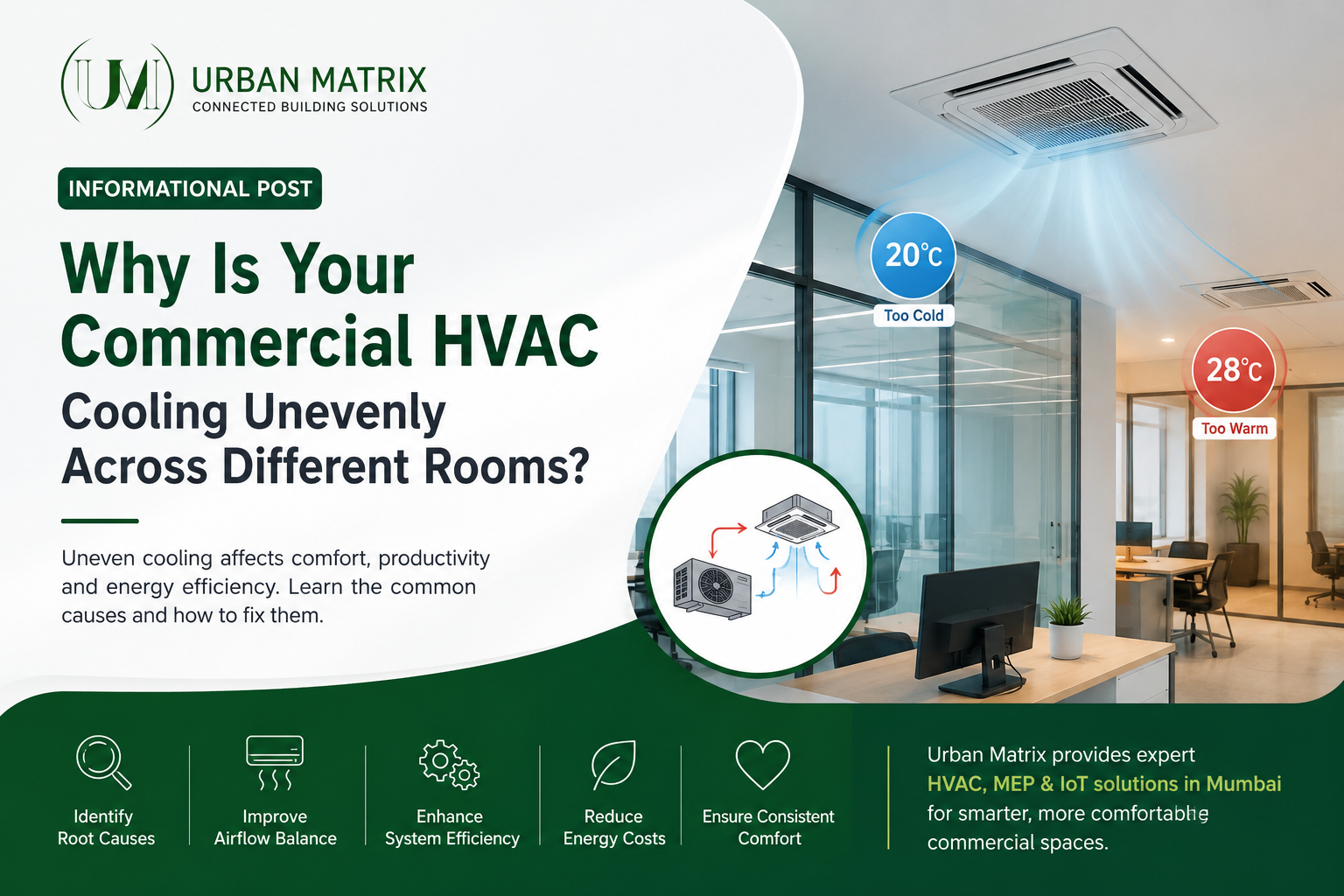
Why Is Your Commercial HVAC Cooling Unevenly Across Different Rooms?
One meeting room feels freezing while the cabin next door stays warm. Employees keep changing the thermostat but nothing feels right. Uneven cooling often means a commercial HVAC system is not distributing air correctly. The cause may be blocked vents, dirty filters, damaged ducts, poor zoning, incorrect equipment sizing or controls that no longer match how the building is used. In Mumbai, heat, humidity, dust and long operating hours place added pressure on office cooling systems. Ignoring hot and cold spots can lead to staff discomfort, customer complaints, higher energy use and avoidable equipment wear. Urban Matrix provides HVAC, MEP & IoT solutions in Mumbai to identify the real cause instead of lowering the thermostat. A proper inspection checks airflow, AHUs, ducts, controls, electrical supply and room conditions. Once the weak point is found, cooling can be restored efficiently. Why Does Commercial HVAC Cool Rooms Unevenly? Commercial HVAC cooling becomes uneven when different rooms receive unequal airflow or have different heat loads. Common causes include blocked vents, dirty filters, leaking ducts, incorrect thermostat placement, poor zoning, unbalanced dampers and undersized equipment. An airflow test and complete system inspection can identify the exact cause and guide the right repair. What Is Uneven Commercial HVAC Cooling? Uneven cooling means the HVAC system cannot maintain a similar comfortable temperature across occupied areas. One room may receive too much conditioned air while another receives too little. Sometimes the unit works properly but air distribution does not. Cooling demand may also change after adding workstations, glass partitions, machinery or new room uses. A bigger unit is not always the answer. An HVAC company in Mumbai should check airflow, cooling load, equipment condition and control logic before recommending replacement. What Causes Uneven Cooling Across Different Rooms? Common causes include: Dirty filters: Restricted filters reduce airflow. Testing, adjusting and balancing is a recognised process for correcting air and water distribution. ASHRAE maintains Standard 111-2024 for this work. Uneven cooling is usually a distribution problem rather than a thermostat problem. Check airflow, ducts, dampers, filters, zoning and controls before adding capacity. How Do Professionals Fix Uneven HVAC Cooling Step by Step? Step 1: Measure Room Conditions Technicians compare temperatures, occupancy, sunlight and equipment load across rooms. This helps them understand whether the problem comes from the HVAC system or from a higher cooling demand in a particular space. Step 2: Test Supply and Return Airflow Air volume is checked at supply and return vents. A room may stay warm because cooled air enters too slowly. In other cases, air enters the room but cannot return to the AHU properly. Step 3: Inspect Filters, Coils and Fans Professional AHU maintenance services Mumbai businesses use should cover filters, coil cleanliness, fans, belts, motors and condensate drainage. Even a thin layer of dust on a coil can affect heat transfer and reduce cooling performance. Step 4: Check Ducts and Dampers The team looks for duct leakage, damaged sections, missing insulation and incorrect damper positions. Once these issues are corrected, air balancing may be carried out to ensure each room receives the required airflow. Step 5: Review Cooling Loads A server room, crowded conference room and private cabin rarely have identical cooling needs. Experienced HVAC consultants in Mumbai may recalculate the cooling load before recommending changes to equipment or zoning. Step 6: Test Controls and Central Equipment Thermostats, sensors, VAV boxes, valves and operating schedules are tested. Chiller maintenance services Mumbai may also include checking water flow, pumps, valves and supply-return water temperatures. Step 7: Correct and Monitor the System The final solution may involve cleaning, duct repair, damper adjustment, sensor relocation, zoning changes or control upgrades. IoT sensors can then monitor room temperatures and identify recurring differences before they result in complaints. What Are the Benefits of Correcting Uneven Cooling? Correcting hot and cold spots can provide several practical benefits: Heating and cooling account for around 35% of building energy consumption according to the US Department of Energy. Although building conditions vary by country, the figure shows why HVAC performance deserves attention. Which Solution Is Better for Uneven Cooling? Approach Best For Main Limitation Lowering the thermostat Temporary comfort May increase energy use Portable AC units Short-term emergencies Adds electrical load and maintenance Vent cleaning Minor airflow blockages Cannot fix ducts, zoning or controls Air balancing Unequal airflow between rooms Requires professional testing Zoning upgrade Rooms with different cooling loads Needs design and control work IoT monitoring Recurring multi-zone issues Requires correct sensor placement Integrated HVAC and MEP inspection Complex commercial buildings Requires coordinated technical expertise For most offices, the best approach is a complete diagnosis followed by targeted repairs. Replacing the entire HVAC system should be considered only when testing confirms serious capacity, age or equipment-condition concerns. Who Needs an Uneven Cooling Inspection? An uneven cooling inspection is useful for: An office AC maintenance contract Mumbai businesses select should include airflow, filters, coils, controls and drainage checks rather than only emergency breakdown support. Properties that have recently added partitions, employees or heat-producing equipment should also schedule an inspection. The original HVAC design may no longer match the building’s current use. What Affects the Cost of Fixing Uneven HVAC Cooling? The cost depends on the actual cause of the problem. Important pricing factors include: A clear proposal should separate inspection charges, labour, repairs, replacement parts and optional upgrades. This helps businesses compare actual value instead of selecting a contractor based only on the lowest quotation. What Are the Commercial HVAC and MEP Trends in 2026? Smart Monitoring Across Commercial Buildings An IoT solutions company in Mumbai can use temperature, humidity, energy and equipment-status sensors to reveal patterns that may be missed during a one-time inspection. The US Department of Energy states that successful high-performance building controls have shown the potential to reduce commercial HVAC energy use by 30% in studied applications. Actual results depend on the building, installed controls and operating practices. Equipment-Level Energy Tracking Energy monitoring solutions Mumbai businesses adopt can compare the performance of chillers, AHUs, pumps and
What Is an Annual Maintenance Contract and Why Does Your Building Need One?
Managing a commercial building in Mumbai is not easy. Air-conditioning systems work for long hours, electrical panels carry changing loads, plumbing lines face daily pressure, and pumps, chillers and AHUs must perform without interruption.Businesses looking for reliable AMC solutions in Mumbai and professional AMC solutions in Mumbai can benefit from planned maintenance, faster technical support and better control over annual repair costs. A small problem can quickly become a major operational issue without timely AMC solutions in Mumbai. An unnoticed water leak may damage interiors, a dirty AHU filter may restrict airflow, and an overloaded electrical panel may cause repeated tripping. This is where an Annual Maintenance Contract, commonly called an AMC, becomes valuable. Instead of waiting for equipment to fail, an AMC creates a planned maintenance schedule for your building systems. It brings inspections, servicing, performance checks and breakdown support under one structured agreement. For businesses searching for reliable HVAC, MEP & IoT solutions in Mumbai, an AMC offers a practical way to reduce uncertainty. It helps facility managers stay ahead of problems, control maintenance expenses and keep essential systems working throughout the year. What is an Annual Maintenance Contract? An Annual Maintenance Contract is a service agreement between a building owner or business and a maintenance provider. It covers scheduled inspection, servicing, testing and repair support for equipment such as HVAC units, electrical panels, plumbing systems, pumps, chillers and AHUs over a fixed period, usually one year. The exact services depend on the contract. Some AMCs cover only labour and scheduled visits, while comprehensive plans may include selected spare parts, emergency support, performance reporting and IoT-based monitoring. An AMC may cover: Professional maintenance programmes are designed around defined inspection tasks, responsible personnel, system conditions and corrective actions. This structured approach is also reflected in recognised HVAC maintenance guidance. Why does your building need an Annual Maintenance Contract? Building equipment rarely fails without giving some warning. The warning may be higher electricity use, unusual noise, poor cooling, water leakage, weak airflow or frequent electrical tripping. The problem is that these early signs are often ignored during busy working days. An AMC helps identify such concerns before they become expensive emergencies. It helps prevent unexpected equipment failure Regular inspections allow technicians to identify loose connections, worn components, blocked filters, leakage and abnormal equipment readings. For example, a minor refrigerant leak may initially cause only slightly poor cooling. Left unresolved, it can increase compressor load and eventually lead to a major breakdown. It supports consistent indoor comfort Employees and customers notice when rooms feel too warm, humid or poorly ventilated. Routine servicing helps maintain airflow, cooling and indoor comfort across occupied spaces. Proper HVAC operation and maintenance are necessary for maintaining comfortable temperatures and acceptable indoor conditions. It improves safety Electrical panels, pumps, motors and mechanical equipment require regular checking. Loose terminals, overheating, leakage and damaged insulation can create avoidable safety risks. It makes maintenance expenses easier to plan Without an AMC, every complaint becomes a separate expense. Emergency visits, urgent repairs and last-minute part replacement can make maintenance costs unpredictable. An annual contract gives businesses a clearer maintenance schedule and a better view of expected expenses. It supports energy efficiency Dusty coils, blocked filters, incorrect controls and neglected equipment can make systems work harder than necessary. The U.S. Department of Energy estimates that well-managed operations and maintenance programmes can produce energy savings of approximately 5% to 20%, often without major capital investment. Actual results depend on the building, equipment condition and existing maintenance practices. It gives faster access to technical support An HVAC contractor in Mumbai already familiar with your site can often respond more effectively than a new technician seeing the system for the first time. How does an Annual Maintenance Contract work? A useful AMC should be based on the building’s actual systems, operating hours and maintenance risks. It should not be a generic document copied from another site. Step 1: Initial site survey The maintenance provider visits the property and reviews the installed systems. This may include: An experienced provider of HVAC consultancy in Mumbai can assess cooling loads, equipment condition, airflow requirements and maintenance risks during the site survey. The survey helps determine the number, capacity, age and present condition of the assets. Step 2: Equipment condition assessment Technicians inspect visible problems, service history and operating performance. A professional HVAC company in Mumbai may check cooling output, airflow, noise, temperature differences, filter condition, refrigerant pressure and electrical readings. For MEP systems, the assessment may cover panel loading, pump operation, water leakage, drainage flow and equipment coordination. Step 3: Scope and schedule creation The service provider prepares a maintenance plan based on the building’s needs. The scope should clearly state: Step 4: Preventive maintenance visits Technicians visit the building according to the agreed schedule. During these visits, they may clean filters, inspect coils, tighten electrical connections, check pumps, review leakage, test controls and record equipment readings. Businesses requiring AHU maintenance services Mumbai should make sure that filter inspection, belt checking, motor condition, drain-tray cleaning and airflow review are included. Step 5: Corrective maintenance When a fault is found, the maintenance team recommends or performs corrective work according to the contract. Minor concerns may be resolved immediately. Larger repairs may require approval, replacement parts or planned downtime. Step 6: Reporting and follow-up Each visit should produce a clear service report. The report may include: Step 7: Performance monitoring An IoT solutions company in Mumbai can add sensors and connected monitoring tools to track temperature, humidity, power use and equipment status. This allows maintenance teams to move from fixed servicing alone toward condition-based and predictive maintenance A good AMC follows a simple cycle: inspect, plan, service, monitor, report and improve. The objective is not only to repair equipment but to keep the entire building working reliably. What are the benefits of an AMC for your building? A properly designed AMC can provide several operational benefits: Facility managers seeking energy monitoring solutions Mumbai can also use AMC reports alongside

Which Are the Top 10 HVAC Contractors in Mumbai for Commercial Buildings in 2026?
Choosing among the many HVAC contractors in Mumbai can be difficult, especially when a commercial building depends on reliable cooling throughout the day. An office, hospital, hotel, retail store or industrial facility cannot afford repeated AC breakdowns, uneven cooling, water leakage, poor airflow or rising electricity bills. The problem becomes more serious when HVAC, electrical, plumbing and building automation systems are managed by different vendors. A capable HVAC contractor for commercial buildings in Mumbai should do more than repair air conditioners. The contractor should understand system design, heat-load requirements, ducting work, ventilation, AHU maintenance, chiller maintenance, electrical controls, preventive maintenance and energy performance. This guide explains how commercial property owners can evaluate the best HVAC contractors in Mumbai, compare their capabilities and choose the right service provider for installation, maintenance, AMC, MEP coordination and IoT-based monitoring. It also provides an editorial shortlist of ten HVAC and MEP service providers that businesses can evaluate in 2026. Featured Snippet: How Do You Choose an HVAC Contractor in Mumbai? Choose an HVAC contractor in Mumbai by checking its commercial project experience, technical team, equipment expertise, maintenance process, emergency support, safety practices and reporting system. The right contractor should inspect the complete HVAC system, explain the root cause of problems and offer installation, preventive maintenance, AMC and energy-performance support. What Are Commercial HVAC Services? Commercial HVAC services include the planning, installation, testing, commissioning, repair and maintenance of heating, ventilation and air-conditioning systems used in offices, hospitals, hotels, malls, factories and other large buildings. These services may cover: Unlike basic AC repair and servicing, commercial HVAC work requires proper coordination between equipment, airflow, electrical load, occupancy, controls and building usage. ASHRAE Standards 62.1 and 62.2 establish recognised requirements for ventilation design and acceptable indoor air quality. This makes ventilation planning, fresh-air balance and system maintenance important parts of professional HVAC work. Which Are the Top 10 HVAC Contractors in Mumbai to Evaluate in 2026? The following companies are listed for comparison based on their publicly stated HVAC, MEP, project execution or maintenance capabilities. Building owners should conduct their own technical and commercial evaluation before awarding a contract. 1. Urban Matrix Urban Matrix provides integrated HVAC, MEP & IoT Solutions for commercial and industrial buildings in Mumbai. Its service approach covers HVAC installation, maintenance, AMC support, electrical and plumbing coordination, building automation and IoT-based equipment monitoring. This integrated model can be useful for businesses that want fewer coordination gaps between multiple building systems. Suitable for: Commercial buildings seeking HVAC, MEP maintenance and smart monitoring through one service partner. 2. Voltas Voltas provides commercial air-conditioning, HVAC and MEP project solutions for large buildings and infrastructure projects. Its publicly listed capabilities include large HVAC installations, VRF systems, air-cooled and water-cooled chillers, operations and maintenance, annual maintenance and retrofit services. Suitable for: Large commercial, infrastructure and industrial cooling projects. 3. Blue Star Blue Star offers central air-conditioning products, commercial refrigeration and electro-mechanical project services. Its portfolio includes VRF systems, chillers, packaged air conditioners, ducted systems and MEP project execution. The company has also completed major air-conditioning and plumbing work at Mumbai’s Terminal Suitable for: Large central air-conditioning and integrated MEP projects. 4. Sterling and Wilson Sterling and Wilson provides turnkey HVAC and comprehensive MEP solutions. Its listed services include HVAC, electrical systems, plumbing, firefighting, integrated building management systems and operations and maintenance contracts. Its HVAC portfolio covers offices, hospitals, hotels, educational campuses, manufacturing facilities and infrastructure projects. Suitable for: Large and technically complex turnkey MEP projects. 5. HV Airconditioning Systems HV Airconditioning Systems states that it has worked in central air-conditioning, refrigeration, ventilation and process cooling since 1982. The company positions itself as a comprehensive MEP solutions provider serving multiple industries. Suitable for: Central air-conditioning, process cooling and ventilation projects. 6. Boscard Projects Boscard Projects offers HVAC design, supply, installation, testing, commissioning, service and maintenance. It also provides mechanical, electrical and plumbing services for commercial and industrial clients, making it relevant to businesses looking for HVAC and MEP contractors in Mumbai Suitable for: Turnkey HVAC and MEP contracting requirements. 7. Max Cool MEP System Max Cool MEP System provides HVAC project contracting and maintenance services in Mumbai. Its publicly listed services emphasise HVAC project management, design engineering and complete support for cooling-system requirements. Suitable for: Commercial HVAC projects requiring local project and maintenance support. 8. Complete MEP Solutions LLP Complete MEP Solutions LLP offers air-conditioning and ventilation design, supply, installation, testing, commissioning, maintenance and service support. Its stated capabilities include HVAC systems for commercial, industrial and clean-room environments Suitable for: HVAC installation and MEP services requiring end-to-end execution. 9. Cool Breeze HVAC Cool Breeze HVAC provides AC installation, AMC, repair and VRV or VRF system services in Mumbai. The company states that it has operated since 2012 and focuses on engineering services for different refrigeration and cooling requirements. Suitable for: Small and medium commercial HVAC installations and maintenance. 10. Star Engineering Co. Star Engineering Co. provides AC AMC, commercial HVAC work, VRV and VRF maintenance, chiller plant servicing and ductable AC support. Its listed AMC options include comprehensive and non-comprehensive plans for homes, offices, factories and commercial spaces. Suitable for: Commercial HVAC AMC, repair and equipment maintenance. The right contractor is not automatically the largest company. Select a provider whose technical capabilities, response system, project size, location coverage and maintenance process match your building. Why Do Commercial Buildings Need Professional HVAC Contractors? Commercial buildings operate for longer hours and often have changing occupancy, internal heat loads and cooling requirements. Professional HVAC maintenance is important because it can help identify: In May 2026, India’s peak electricity demand reached a record 270.73 GW as severe heat increased cooling requirements. This highlights why cooling efficiency and load management are becoming more important for commercial properties. How Does the Commercial HVAC Contracting Process Work? Step 1: Conduct a Technical Inspection The contractor should inspect the equipment, ducting, airflow, refrigerant circuit, electrical controls, drainage, insulation and ventilation system. A proper technical inspection should identify the source of the problem rather than only treating