
Imagine walking into your office on a busy Monday morning. Employees are settling in, meetings are about to begin, and suddenly, the air conditioning stops cooling properly. Some rooms feel warm, while others are freezing. Your facility team receives complaints, and the technician discovers that the problem had been developing for several days.
Could the issue have been identified earlier?
In many commercial buildings, HVAC problems begin with small changes in temperature, pressure, airflow, or equipment performance. These changes are not always noticeable during regular inspections.
This is where Internet of Things (IoT) solutions in Mumbai sensors can help.
Smart sensors continuously collect information about HVAC equipment and provide useful insights into system performance. They help facility managers identify unusual readings, investigate faults, and schedule maintenance before minor issues become serious.
For businesses searching for commercial AC repair in Mumbai, India, combining IoT monitoring with professional HVAC maintenance can be a practical approach to reducing unexpected downtime.
At Urban Matrix, HVAC engineering, MEP maintenance, and IoT-enabled monitoring come together to support commercial facilities across Mumbai.
How Do IoT Sensors Help Monitor Commercial HVAC Equipment?
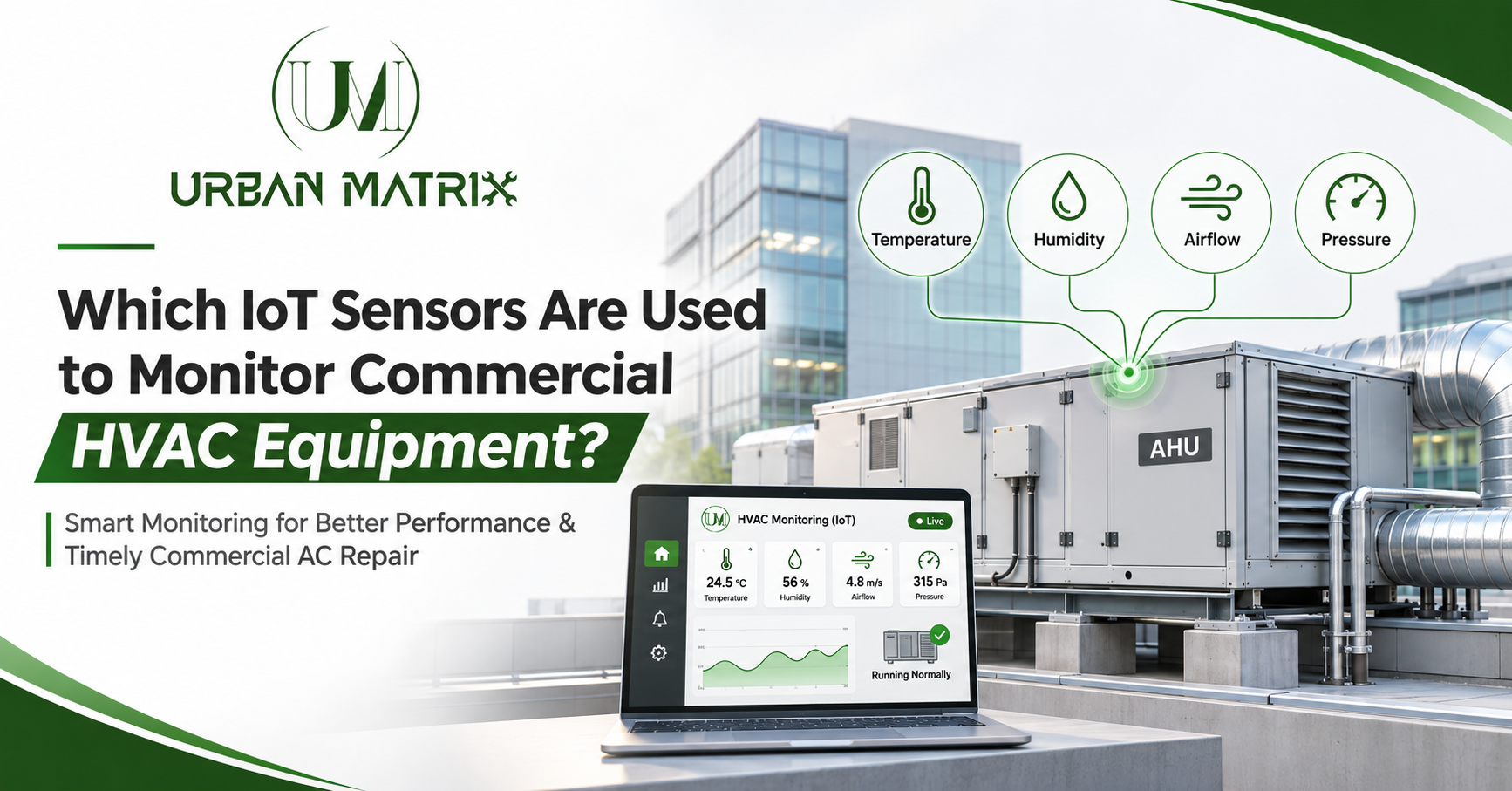
IoT sensors monitor commercial HVAC equipment by measuring temperature, humidity, pressure, airflow, vibration, and electrical consumption. These sensors send data to connected monitoring systems, allowing facility managers to identify abnormal operating conditions, receive alerts, and arrange timely maintenance. They support preventive servicing and help reduce the risk of unexpected commercial AC breakdowns.
What Are IoT Sensors in Commercial HVAC Systems?
IoT sensors are electronic devices that measure operating conditions and share information with connected software or building management systems.
In commercial HVAC systems, these sensors monitor equipment such as air handling units (AHUs) Repair in mumbai India , fan coil units (FCUs), chillers, pumps, cooling towers , and VRF/VRV air conditioning systems.
For example, a temperature sensor can identify when the supply air is warmer than expected. A pressure sensor can detect unusual changes in a chilled water circuit, while a vibration sensor may reveal developing problems in a motor or fan.
Instead of depending only on manual inspection, facility teams can review readings through monitoring dashboards.
However, sensors do not repair equipment themselves. They provide information that helps trained technicians investigate problems and decide what action is required.
This makes IoT monitoring a useful addition to regular HVAC inspections and maintenance.
Why Is IoT Monitoring Important for Commercial HVAC Equipment?
Commercial air conditioning systems often operate for long hours. In offices, hospitals, hotels, shopping centres, and industrial facilities, even a short cooling failure can disrupt daily activities.
Several common problems explain why continuous monitoring is useful:
- Unexpected temperature changes: Unstable cooling may indicate control faults, airflow restrictions, or other system problems.
- Poor airflow: Blocked filters, fan issues, or duct restrictions can reduce cooling performance.
- Abnormal equipment vibration: Changes in vibration patterns may point to bearing wear, misalignment, or mechanical imbalance.
- Pressure fluctuations: Unusual readings can suggest problems with pumps, filters, valves, or refrigerant circuits.
- Higher electricity consumption: Equipment may consume additional energy when operating inefficiently.
- Delayed fault identification: Without monitoring, some faults remain unnoticed until occupants complain.
For businesses considering office AC repair in Mumbai India, these warning signs can help determine when professional inspection is necessary.
A monitoring system cannot diagnose every issue, but it can provide useful early evidence.
Which IoT Sensors Are Used to Monitor Commercial HVAC Equipment?
Different sensors measure different operating conditions. Their selection depends on the equipment design, monitoring objectives, and existing control systems.
1. Temperature sensors
Temperature sensors measure supply air, return air, room temperature, chilled water temperature, and other relevant conditions.
They help facility managers identify uneven cooling and unusual temperature differences.
For example, if an AHU continuously supplies warmer air than its expected setpoint, a technician can investigate the cooling coil, chilled water flow, control valve, or airflow.
2. Humidity sensors
Humidity sensors measure moisture levels in indoor air.
They are useful in offices, healthcare facilities, and other buildings where humidity control matters.
Unusual humidity readings may indicate inadequate dehumidification, ventilation problems, or incorrect control settings.
3. Pressure sensors
Pressure sensors measure air, water, or refrigerant pressure, depending on the application.
Differential pressure sensors can also monitor pressure differences across filters or other components.
An increasing pressure drop across an AHU filter may indicate that the filter is becoming restricted.
4. Vibration sensors
Vibration sensors monitor movement in rotating equipment such as motors, fans, and pumps.
Unusual vibration can indicate mechanical problems, including looseness, imbalance, or bearing wear.
Monitoring trends helps maintenance teams investigate changes before equipment damage becomes severe.
5. Airflow sensors
Airflow sensors help measure air movement within ventilation and air conditioning systems.
They can support the identification of insufficient ventilation, airflow imbalance, and fan performance problems.
6. Electrical current and energy sensors
These sensors measure electrical consumption, current, and other relevant parameters.
They help identify abnormal equipment loads and support energy monitoring.
7. Indoor air quality sensors
Carbon dioxide (CO₂) and particulate matter sensors provide information about indoor air conditions.
CO₂ readings can help assess ventilation performance, although they do not directly measure every indoor air pollutant.
Quick summary: Which sensor monitors what?
| Sensor | Main monitoring purpose |
|---|---|
| Temperature | Cooling performance |
| Humidity | Indoor moisture levels |
| Pressure | Filters, water and system pressure |
| Vibration | Motor and fan condition |
| Airflow | Air distribution and ventilation |
| Energy | Electrical consumption |
| CO₂ / IAQ | Indoor air conditions |
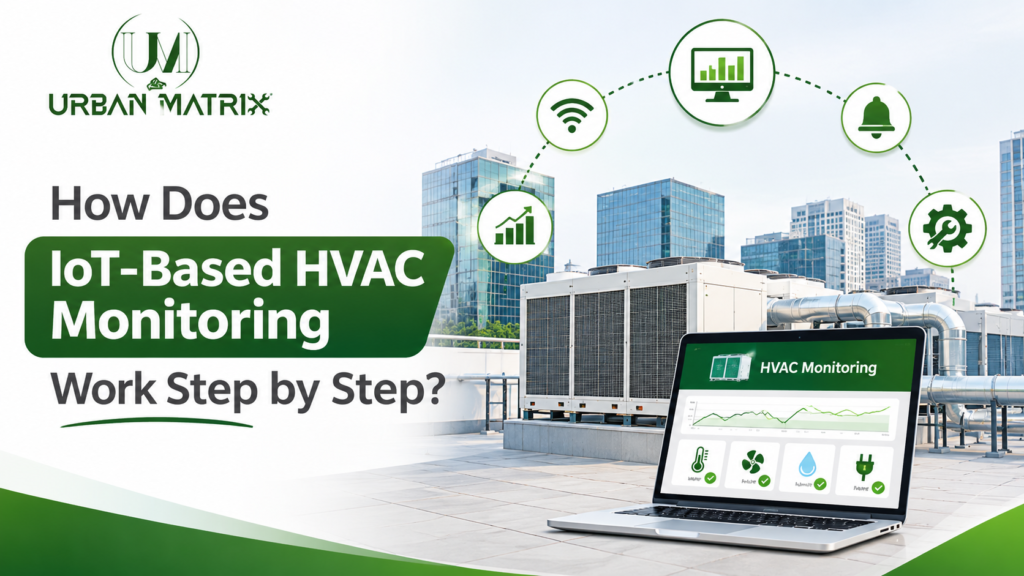
How Does IoT-Based HVAC Monitoring Work Step by Step?
A monitoring system becomes useful when the collected information leads to timely action.
Step 1: Install suitable sensors
Technicians assess the equipment and identify suitable monitoring points. Sensors are installed according to system requirements.
Step 2: Collect operating data
Sensors measure selected parameters at regular intervals or continuously, depending on the system.
Step 3: Transfer data to a monitoring platform
Readings are transmitted through supported networks, controllers, gateways, or building management systems.
Step 4: Compare readings with expected conditions
Monitoring software checks measurements against defined limits, operating patterns, or historical trends.
Step 5: Generate alerts
When readings cross configured thresholds, the system may notify the facility team.
Step 6: Inspect and correct the fault
Technicians verify the readings, inspect the equipment, identify the cause, and complete the required repairs.
For example, repeated high-temperature alerts from a VRF system may prompt professional VRV/VRF AC repair in Mumbai, India.
The actual cause still needs to be confirmed through technical diagnosis.
What Are the Benefits of IoT Sensors for Commercial HVAC Maintenance?
When sensors are installed and managed correctly, they can improve maintenance planning in several ways.
- Earlier fault detection: Unusual equipment readings can be investigated before complete failure.
- Reduced unexpected downtime: Teams can plan maintenance around identified risks.
- Better energy visibility: Energy monitoring helps identify inefficient operating patterns.
- Improved occupant comfort: Temperature and airflow monitoring support more consistent cooling.
- Remote equipment visibility: Facility managers can review supported equipment without visiting every location.
- More informed maintenance decisions: Historical data helps technicians understand recurring problems.
- Better AMC planning: Sensor trends can support preventive maintenance schedules.
These benefits are especially relevant for commercial facilities with several AHUs, chillers, or VRF systems operating across different floors.
Still, monitoring cannot guarantee that breakdowns will be prevented. Sensor accuracy, equipment condition, and technician response all affect the outcome.
IoT Monitoring vs Traditional HVAC Maintenance: What Is the Difference?
Traditional maintenance commonly relies on scheduled servicing and responding to equipment complaints. IoT monitoring adds continuous visibility between inspections.
| Factor | Traditional maintenance | IoT-enabled monitoring |
|---|---|---|
| Equipment checks | Periodic inspections | Ongoing sensor readings |
| Fault identification | During visits or after complaints | Automated alerts for monitored conditions |
| Performance records | Manual service reports | Digital trends and reports |
| Remote visibility | Limited | Available when connected |
| Maintenance planning | Time-based or reactive | Can be condition-based |
| Technician requirement | Essential | Still essential |
The strongest approach is often a combination of both methods.
IoT monitoring can highlight potential problems, while experienced HVAC technicians carry out inspections, testing, servicing, and repairs.
The National Institute of Standards and Technology (NIST) also identifies automated fault detection and diagnostics as an important approach to improving the operating performance of commercial building systems. NIST
Which Commercial Buildings Need IoT-Based HVAC Monitoring?
IoT monitoring can benefit any facility where cooling reliability, energy consumption, or environmental conditions are important.
Common applications include:
- Corporate offices: Monitoring temperature and cooling performance across multiple floors.
- Hospitals and healthcare facilities: Supporting environmental monitoring in areas with defined temperature or ventilation requirements.
- Shopping malls: Tracking HVAC performance across large public spaces.
- Hotels: Managing cooling comfort in different zones.
- Industrial facilities: Monitoring equipment conditions and operational requirements.
- Commercial towers: Coordinating multiple HVAC systems through central monitoring.
Buildings with repeated cooling complaints or complex equipment may benefit particularly from additional monitoring.
Facility managers searching online for commercial AC repair near me or VRF AC repair in mumbai should also consider whether recurring faults indicate a need for better system monitoring.
How Much Does IoT-Based HVAC Monitoring Cost in Mumbai?
The cost of installing an IoT monitoring system depends on the size of the facility, equipment type, and level of integration required.
Important pricing factors include:
- Number and type of sensors required
- Equipment size and monitoring points
- Wired or wireless connectivity
- Compatibility with existing BMS controllers
- Dashboard and software requirements
- Cloud subscriptions or data storage
- Installation, configuration, and calibration
- Ongoing technical support
A single AHU monitoring setup generally has different requirements from a multi-building system covering chillers, pumps, electrical panels, and VRF equipment.
Businesses reviewing Annual Maintenance Contract (AMC) in Mumbai can discuss integrating monitoring with regular service schedules.
An on-site technical assessment is the most reliable way to determine equipment needs and obtain an accurate quotation.
What Are the Latest IoT and HVAC Monitoring Trends in 2026?
In 2026, commercial building monitoring is moving towards connected systems that combine operating data, automated alerts, and maintenance planning.
Several developments are shaping this approach.
Predictive maintenance: Monitoring platforms increasingly use historical readings and analytics to identify patterns associated with developing faults.
Integrated building dashboards: HVAC, electrical, and energy information can be brought into common monitoring platforms.
Energy-focused monitoring: Building operators are using connected meters and sensors to better understand equipment consumption.
Indoor air quality monitoring: Temperature, humidity, and ventilation-related measurements are receiving greater attention.
Remote diagnostics: Connected equipment data helps technicians review operating conditions before a site visit.
A February 2026 industry report from Messe Frankfurt highlighted IoT connectivity, predictive maintenance, energy management, and data-driven HVAC services as important developments in commercial buildings. building-technologies.messefrankfurt.com
These developments do not mean every commercial building requires advanced artificial intelligence. In many facilities, reliable sensors, useful alerts, and regular maintenance provide a sensible starting point.
Why Choose Urban Matrix for HVAC, MEP and IoT Solutions in Mumbai?
Managing commercial HVAC equipment involves more than repairing an AC unit after it stops working.
Building owners need reliable cooling, properly maintained mechanical systems, and clear information about equipment performance.
Urban Matrix provides integrated HVAC, MEP and IoT solutions in Mumbai,India including HVAC projects, preventive maintenance, breakdown support, and smart equipment monitoring. Urban Matrix
Businesses searching for an HVAC contractor in Mumbai,India , HVAC contractors in Mumbai, or MEP contractors in Mumbai can benefit from coordinated support across connected building systems.
Urban Matrix’s services include:
- Commercial HVAC inspection and maintenance
- AHU, FCU, chiller, and ventilation support
- VRF/VRV system installation and service support
- Mechanical, electrical, and plumbing maintenance
- IoT-enabled monitoring and equipment alerts
- Preventive servicing and AMC planning
- HVAC system refurbishment and retrofitting
By combining engineering knowledge with IoT solutions in Mumbai, Urban Matrix helps facility teams work towards more reliable equipment performance and informed maintenance decisions.
Frequently Asked Questions About IoT Sensors and Commercial AC Repair
1. Which IoT sensors are commonly used in commercial HVAC systems?
Temperature, humidity, pressure, vibration, airflow, electrical energy, and indoor air quality sensors are commonly used. Each monitors specific equipment conditions and helps identify abnormal readings that may require professional inspection.
2. Can IoT sensors prevent commercial AC breakdowns?
IoT sensors cannot prevent every breakdown. However, they can identify unusual operating conditions and generate alerts. With timely inspections and maintenance, these warnings may help reduce the risk of unexpected equipment failure.
3. How do IoT sensors help with commercial AC repair in Mumbai, India?
IoT sensors provide information about cooling performance, equipment load, pressure, and other operating conditions. Technicians can use these readings alongside physical inspections to investigate faults and plan appropriate repairs.
4. Can IoT monitoring be installed in existing VRF or VRV AC systems?
Yes, many existing systems can be monitored through compatible controllers, gateways, sensors, or manufacturer-supported interfaces. The available functions depend on system age, model, communication protocols, and installation requirements.
5. Is IoT monitoring useful for small commercial offices?
Yes. Smaller offices can benefit from basic temperature, humidity, and energy monitoring. The right setup depends on the type of AC equipment, recurring problems, and maintenance budget.
Keep Your Commercial HVAC Equipment Running More Reliably with Urban Matrix
A commercial AC system rarely becomes inefficient overnight. Small operating changes may develop over time, even when the equipment appears to be working normally.
With the right sensors, monitoring tools, and professional maintenance, facility managers can identify warning signs earlier and make better decisions about system care.
If your office is experiencing uneven cooling, repeated breakdowns, abnormal energy consumption, or unreliable HVAC performance, Urban Matrix can help assess your requirements.
For commercial AC repair in Mumbai, India, office cooling maintenance, IoT monitoring, and integrated HVAC and MEP services, connect with Urban Matrix.
Urban Matrix – HVAC, MEP & IoT Solutions
+91 9821613457
info@urban-matrix.com
Kandivali West, Mumbai, Maharashtra
Schedule an HVAC system assessment with Urban Matrix and explore how smart monitoring can support better cooling performance, preventive maintenance, and reliable commercial building operations.