
What is IoT in HVAC Systems? And How Does It Actually Work?
Managing HVAC systems in commercial buildings isn’t as simple as it used to be. Rising energy costs, unexpected breakdowns, and inefficient maintenance are common challenges, especially in a fast-paced city like Mumbai.
Many building owners still rely on reactive maintenance. Something breaks, then it gets fixed. But this approach often leads to higher costs, downtime, and discomfort for occupants.
This is where HVAC, MEP & IoT SOLUTIONS are changing the game. Instead of guessing what’s happening inside your systems, you can now monitor everything in real time.
Imagine knowing about a potential failure before it happens. Imagine reducing energy bills without compromising comfort.
That’s exactly what IoT in HVAC systems makes possible. And if you’re working with experienced HVAC MEP contractors in Mumbai, this transformation becomes even more powerful.
IoT in HVAC systems refers to the use of connected sensors and smart devices that monitor, analyze, and control heating, ventilation, and air conditioning systems in real time. It enables predictive maintenance, energy optimization, and centralized control through a building management system, improving efficiency and reducing operational costs.
What is IoT in HVAC Systems?
IoT (Internet of Things) in HVAC systems means connecting your equipment, like chillers, AHUs, thermostats, and sensors to a digital network.
These devices continuously collect data such as temperature, humidity, airflow, and energy usage.
This data is then analyzed using software platforms, allowing facility managers to make smarter decisions.
In simple terms:
IoT turns traditional HVAC into a smart HVAC system that can think, analyze, and respond automatically.
It is a core part of modern building automation systems using IoT, especially in commercial buildings.
- Connects HVAC systems to the internet
- Enables real-time monitoring
- Helps automate operations
- Improves efficiency and performance
Why is IoT Important in HVAC & MEP Systems?
Let’s be honest traditional HVAC systems have limitations.
Key Challenges Without IoT:
- No visibility into system performance
- Unexpected breakdowns
- High energy consumption
- Manual monitoring and control
- Increased maintenance costs
Why IoT is Needed:
- Real-time monitoring in HVAC systems
- Predictive maintenance using IoT
- Centralized building management system (BMS)
- Better decision-making using data
In cities like Mumbai, where energy costs and system loads are high, IoT-based MEP maintenance solutions are no longer optional they’re essential.
- Prevents sudden failures
- Reduces operational costs
- Improves system reliability
- Enables smarter facility management
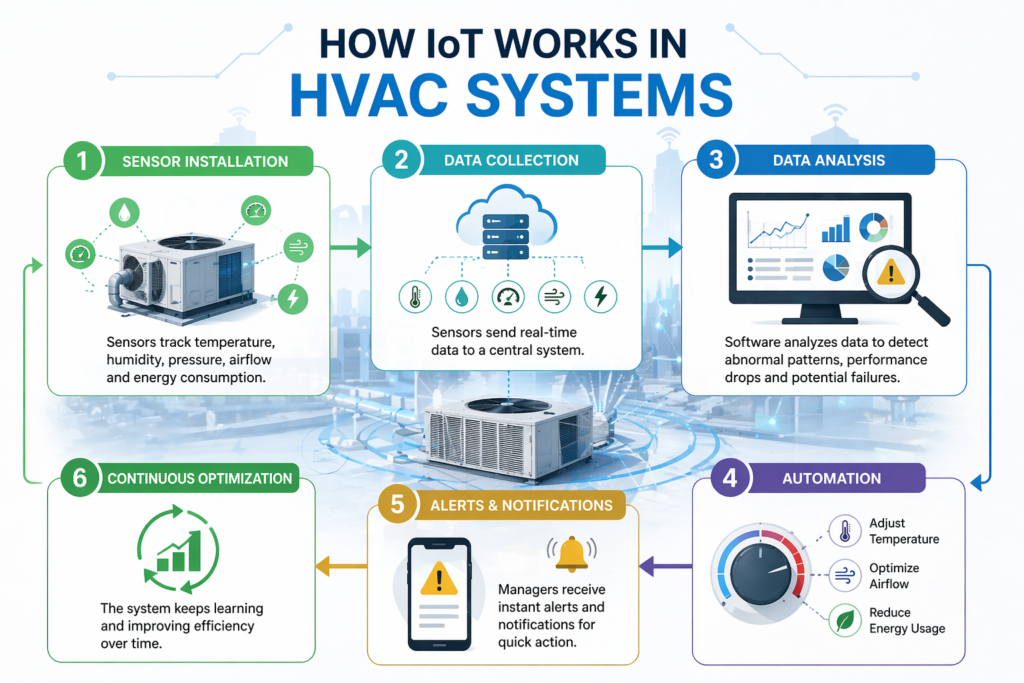
How IoT Works in HVAC Systems (Step-by-Step)
Let’s break this down in a simple way.
Step 1: Sensor Installation
Sensors are installed across HVAC components.
They track:
- Temperature
- Humidity
- Pressure
- Airflow
- Energy consumption
Step 2: Data Collection
These sensors continuously send data to a central system.
This happens in real time.
Step 3: Data Analysis
Software platforms analyze this data using algorithms.
They detect:
- Abnormal patterns
- Performance drops
- Potential failures
Step 4: Automation
Based on insights, the system can:
- Adjust temperature automatically
- Optimize airflow
- Reduce energy usage
Step 5: Alerts & Notifications
Facility managers receive alerts before issues become serious.
This enables quick action.
Step 6: Continuous Optimization
The system keeps learning and improving efficiency over time.
- Sensors → Data → Analysis → Action
- Real-time monitoring + automation
- Continuous improvement
Benefits of IoT in HVAC & MEP Solutions
Here’s where things get interesting.
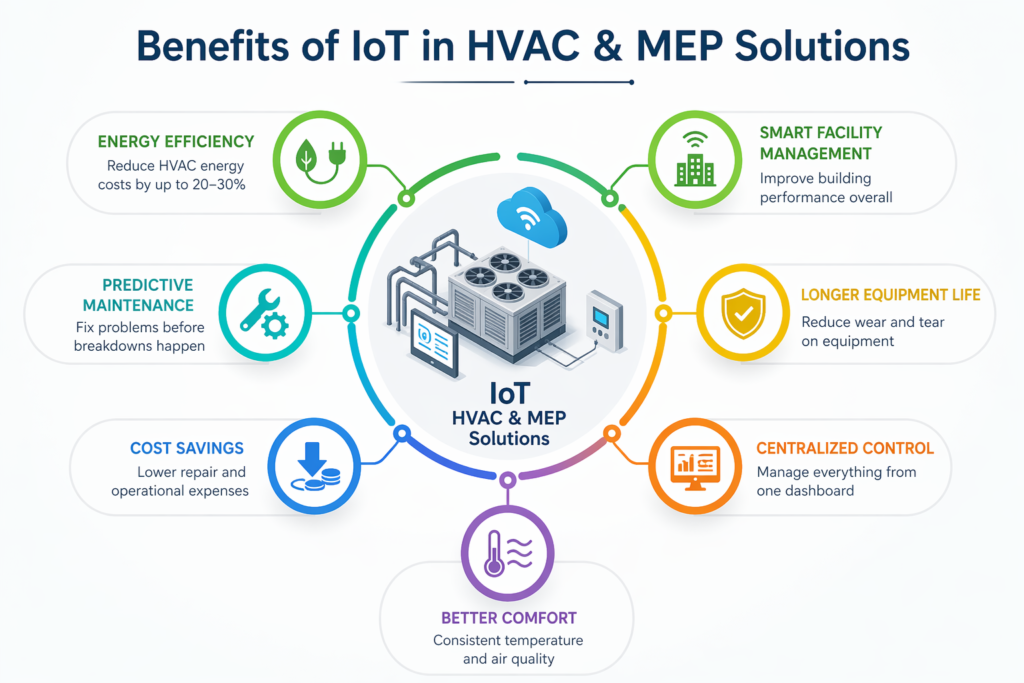
Key Advantages:
- Energy Efficiency
Reduce HVAC energy costs using IoT by up to 20–30% - Predictive Maintenance
Fix problems before breakdowns happen - Cost Savings
Lower repair and operational expenses - Better Comfort
Consistent temperature and air quality - Centralized Control
Manage everything from one dashboard - Longer Equipment Life
Reduce wear and tear - Smart Facility Management
Improve building performance overall
- Lower costs
- Better performance
- Higher comfort
- Longer system lifespan
IoT HVAC vs Traditional HVAC Systems
| Feature | Traditional HVAC | IoT-Based HVAC |
|---|---|---|
| Monitoring | Manual | Real-time |
| Maintenance | Reactive | Predictive |
| Energy Efficiency | Low | High |
| Control | Limited | Centralized (BMS) |
| Downtime | High | Minimal |
| Data Usage | None | Data-driven decisions |
IoT HVAC systems are smarter, faster, and more cost-efficient than traditional systems.
Who Needs IoT in HVAC & MEP Systems?
IoT is not just for large corporations it’s for anyone managing complex systems.
Ideal for:
- Commercial Building Owners
- Facility Managers
- Industrial Plants
- Hospitals & Hotels
- IT Parks & Corporate Offices
- Real Estate Developers
If you’re already investing in commercial HVAC maintenance Mumbai, adding IoT gives you a massive advantage.
- Best for large-scale operations
- Ideal for energy-intensive buildings
- Perfect for long-term cost savings
Cost / Pricing Factors of IoT in HVAC Systems
The cost depends on multiple factors.
Key Pricing Factors:
- Size of the building
- Number of HVAC units
- Type of sensors used
- Software platform integration
- Existing system compatibility
- Level of automation required
While initial investment may seem high, long-term savings in energy and maintenance make it highly cost-effective.
- Higher upfront cost
- Significant long-term savings
- ROI improves over time
Industry Trends in 2026
The HVAC industry is evolving fast.
What’s Trending:
- Smart HVAC systems for commercial buildings
- AI + IoT integration for predictive analytics
- Cloud-based building management systems
- Energy optimization driven by real-time data
- Increased adoption in Mumbai commercial spaces
Experts estimate that smart HVAC adoption will grow significantly as businesses focus on sustainability and cost control.
- IoT + AI = Future of HVAC
- Smart buildings are becoming standard
- Energy efficiency is top priority
Why Choose Urban matrix in Mumbai?
When it comes to implementing HVAC, MEP & IoT SOLUTIONS, execution matters more than technology.
At Urban matrix, we focus on:
What Makes Us Different:
- Customized solutions (not one-size-fits-all)
- Strong experience in Mumbai’s commercial sector
- Expertise in MEP maintenance services in Mumbai
- Integration of smart building automation solutions
- Focus on performance, not just installation
- Transparent communication and reporting
We don’t just install systems, we optimize them for real-world performance.
- Local expertise in Mumbai
- Smart + practical solutions
- Performance-driven approach
FAQs (People Also Ask)
1. What is IoT in HVAC systems in simple terms?
IoT in HVAC means connecting systems to smart sensors and software for real-time monitoring and automated control.
2. How does IoT improve HVAC efficiency?
It uses real-time data to optimize performance, reduce energy usage, and prevent breakdowns.
3. Is IoT in HVAC expensive?
Initial costs are higher, but long-term savings in energy and maintenance make it cost-effective.
4. Can IoT reduce HVAC energy costs?
Yes, IoT can reduce energy consumption by up to 20–30% through smart automation.
5. Who provides IoT HVAC solutions in Mumbai?
Experienced HVAC MEP contractors in Mumbai like Urban matrix offer complete IoT-integrated solutions.
If you’re still relying on traditional HVAC maintenance, you’re already behind.
Smart buildings are no longer the future they’re the present.
Upgrade to HVAC, MEP & IoT SOLUTIONS with Urban matrix
Reduce costs, improve efficiency, and prevent breakdowns
Get expert consultation for your building in Mumbai
Contact Urban matrix today and make your HVAC system smarter, not harder.