
A cooling tower can appear to be operating normally even when its performance has already started to drop.The fan may be running. Water may still be circulating. The chiller may continue to provide cooling. Yet inside the tower, water may not be reaching the fill media evenly.For commercial facilities, regular cooling tower maintenance in Mumbai should therefore focus not only on cleaning and servicing equipment but also on checking how effectively water is distributed throughout the tower.
This is where a small distribution problem can begin affecting the entire HVAC system.
Poor water distribution can create dry spots, reduce heat transfer, encourage scale buildup and increase the workload on connected equipment. Over time, this can lead to higher energy consumption, declining cooling performance and more frequent maintenance.
This guide explains why water distribution matters, what causes uneven flow and what facility teams should inspect to maintain efficient cooling tower performance.
What Is Water Distribution in a Cooling Tower?
A cooling tower helps remove heat from warm condenser water before that water returns to the chiller.
Warm water enters the tower and is distributed over the fill media. The fill increases the surface area available for contact between water and air, supporting the heat rejection process.
For the cooling tower to work efficiently, water should reach the fill as evenly as possible.
If one area receives too much water while another remains relatively dry, part of the available heat-transfer surface is not being used properly.
This is known as uneven or poor water distribution.
The cooling tower may continue running, but its ability to reject heat can gradually decline.
Why Does Even Water Distribution Matter?
Think of the cooling tower fill as a large surface designed to spread water across as much area as possible.
When water reaches the full surface, the tower can use its available heat-transfer capacity effectively.
When sections stay dry, that usable area becomes smaller.
Poor water distribution may contribute to:
- Reduced heat transfer
- Higher condenser-water temperature
- Increased chiller workload
- Longer HVAC operating hours
- Higher electricity consumption
- Uneven scale formation
- Reduced cooling efficiency
- Increased equipment stress
This is why facility teams should not look at cooling towers and chillers as completely separate pieces of equipment.
Their performance is closely connected.
What Causes Poor Water Distribution in Cooling Towers?
Several mechanical and water-related issues can affect distribution.
1. Clogged Spray Nozzles
Spray nozzles help distribute water over different sections of the cooling tower.
Over time, they may become partially blocked by:
- Scale
- Dirt
- Sediment
- Mineral deposits
- Biological buildup
When a nozzle becomes restricted, the amount of water reaching that section of the fill decreases.
If several nozzles are affected, larger dry areas may develop.
Inspecting and cleaning nozzles should therefore be an important part of preventive cooling tower maintenance in Mumbai.
2. Damaged or Misaligned Nozzles
A nozzle does not need to be fully blocked to affect performance.
If it becomes damaged, loose or incorrectly positioned, its spray pattern may change.
One section may receive excessive water while another receives very little.
This reduces the effective use of the fill media and can affect overall cooling performance.
3. Insufficient Circulating Water Flow
Poor distribution may also occur when the system is not circulating enough water.
Possible causes include:
- Pump performance issues
- Partially closed valves
- Blocked strainers
- Pipeline restrictions
- Incorrect balancing
- Scale inside piping
An experienced HVAC company in Mumbai should therefore evaluate the entire condenser-water circuit rather than examining only the cooling tower itself.
4. Scale Inside Distribution Pipes
Mineral deposits can gradually build up inside pipes.
As the internal opening becomes smaller, both water flow and pressure can change.
This may cause some areas of the tower to receive sufficient water while others receive less.
Over time, the imbalance can affect cooling tower performance.
5. Incorrect Water Pressure
Cooling tower nozzles are designed to operate within specific flow and pressure conditions.
If pressure is too low, water may not reach the intended coverage area.
Simply seeing water coming from the nozzle does not mean the distribution pattern is correct.
The amount, direction and coverage of water all matter.
How Does Poor Water Distribution Affect Heat Transfer?
The main job of the cooling tower is to reject heat from the condenser-water system.
To do this effectively, water and air need enough contact across the fill surface.
When certain areas remain dry, less surface is available for effective heat transfer.
As a result, the cooling tower may send warmer condenser water back to the chiller.
The chiller then has to work harder to achieve the required cooling.
Facility teams may begin to notice:
- Longer chiller runtimes
- Higher energy consumption
- Reduced cooling performance
- Increased compressor workload
- More frequent maintenance requirements
For this reason, chiller maintenance services Mumbai should sometimes include a wider assessment of the cooling tower and condenser-water system.
The chiller may be working correctly, while the actual performance issue begins elsewhere.
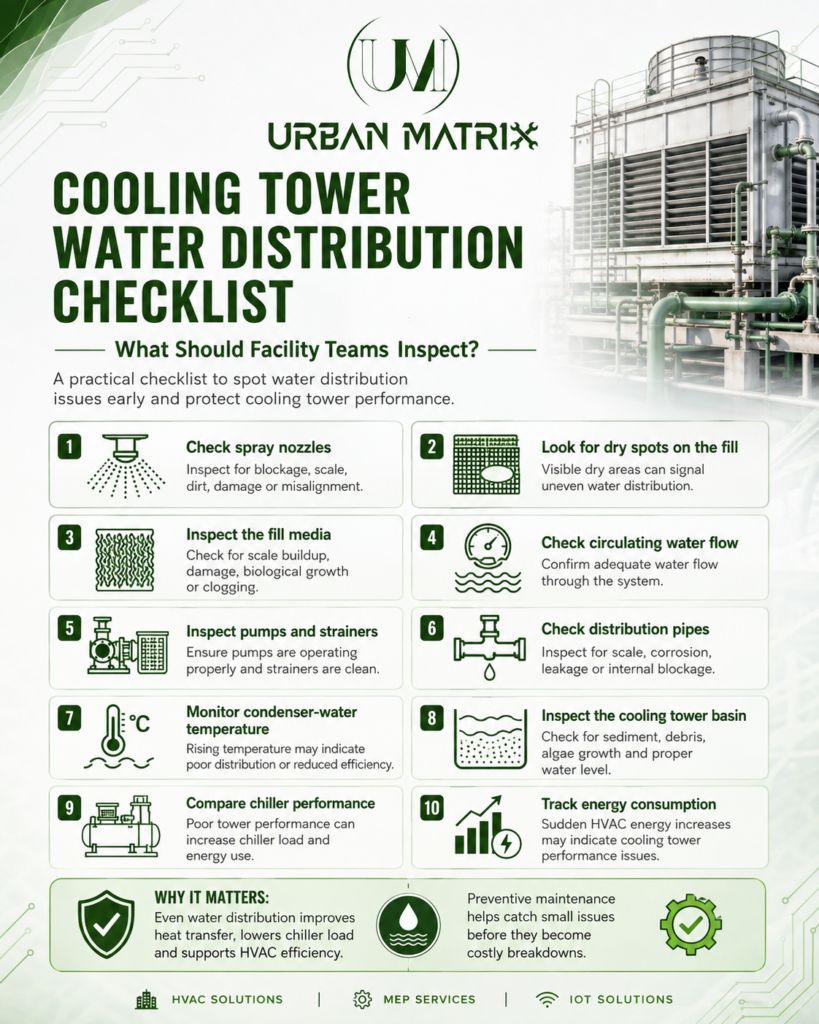
Cooling Tower Water Distribution Checklist: What Should Facility Teams Inspect?
A practical inspection checklist can help identify problems before they affect the complete HVAC system.
1. Check Spray Nozzles
Inspect the nozzles for:
- Blockage
- Scale
- Dirt
- Damage
- Misalignment
- Uneven spray patterns
Water should be reaching the intended fill areas consistently.
Weak or irregular spray should be investigated.
2. Look for Dry Spots on the Fill
Visible dry areas can be one of the clearest signs of uneven distribution.
Where accessible and safe to inspect, facility teams should check whether the fill appears to be receiving water consistently across its surface.
Repeated dry sections may point to problems with nozzles, water flow or distribution piping.
3. Inspect the Fill Media
The fill should be checked for:
- Scale accumulation
- Dirt
- Biological buildup
- Clogging
- Physical damage
- Uneven wetting
Dirty or clogged fill can reduce both water flow and airflow, further affecting heat rejection.
4. Check Circulating Water Flow
Confirm that sufficient water is moving through the condenser-water system.
Inspect:
- Pumps
- Valves
- Strainers
- Distribution piping
- Visible flow conditions
Low circulation can reduce the amount of water reaching different sections of the cooling tower.
5. Inspect Pumps and Strainers
Even clean nozzles may perform poorly if the pump is not delivering sufficient flow.
Strainers should also be checked for blockage.
Restrictions upstream can affect water distribution throughout the tower.
6. Inspect Distribution Pipes
Look for:
- Scale
- Corrosion
- Leakage
- Blockages
- Damaged connections
Restrictions inside distribution piping can reduce water flow to certain areas.
7. Monitor Condenser-Water Temperature
Temperature trends can provide useful clues about cooling tower performance.
If condenser water leaving the tower is consistently warmer than expected under similar conditions, the heat rejection system may need investigation.
Poor water distribution can be one possible cause.
8. Inspect the Cooling Tower Basin
The basin should be checked for:
- Sediment
- Dirt
- Debris
- Biological buildup
- Incorrect water level
- Signs of corrosion
Debris from the basin may eventually reach strainers, pumps or nozzles and interfere with circulation.
9. Compare Chiller Performance
Cooling tower and chiller performance should be reviewed together.
If the chiller is operating for longer periods or consuming more energy under similar building conditions, the condenser-water system should also be examined.
10. Track Energy Consumption
Unexpected changes in energy use can sometimes provide an early warning.
Energy monitoring solutions Mumbai can help facility teams compare operating trends and identify when HVAC consumption starts increasing without an obvious change in demand.
This may provide a useful reason to inspect cooling tower and chiller performance.
5 Warning Signs of a Water Distribution Problem
Facility teams should pay attention to these common indicators:
1. Dry Areas on the Fill
Some sections remain noticeably drier than others.
2. Irregular Nozzle Spray
Certain nozzles produce a strong spray while others provide weak or inconsistent coverage.
3. Higher Condenser-Water Temperature
The cooling tower is no longer reducing water temperature as effectively as before.
4. Uneven Scale Formation
Heavy deposits in selected areas may indicate inconsistent water flow.
5. Increasing Chiller Energy Consumption
The chiller begins operating under greater load even though cooling demand has not changed significantly.
These signs do not always confirm a water distribution issue on their own, but they are strong reasons to inspect the system more closely.
How Does Cooling Tower Performance Affect Chiller Efficiency?
The cooling tower and chiller are part of the same heat-rejection process.
The chiller removes heat from the building.
The cooling tower helps reject that heat into the outdoor environment.
If the cooling tower does not perform efficiently, warmer condenser water may return to the chiller.
This can contribute to:
- Greater compressor workload
- Longer operating hours
- Higher electricity consumption
- Reduced HVAC efficiency
- Increased mechanical stress
That is why experienced HVAC contractors in Mumbai should evaluate how the complete cooling system is performing instead of focusing only on one component.
Can Poor Water Distribution Increase Energy Costs?
Yes, although the effect is usually indirect.
Poor water distribution reduces the cooling tower’s ability to reject heat efficiently.
As a result, the chiller may need to work harder.
Pumps and fans may also operate for longer periods depending on the system.
Over time, this can contribute to higher HVAC energy consumption.
This is where energy monitoring solutions Mumbai can support facility teams.
If operating hours remain similar but HVAC electricity use begins increasing, energy data can provide a useful signal that system performance needs to be investigated.
Why Preventive Cooling Tower Maintenance Matters
Cooling towers operate in demanding conditions involving water, outdoor air, heat and continuous circulation.
Regular preventive inspection can help identify small issues before they develop into costly problems.
A preventive maintenance programme may include checking:
- Spray nozzles
- Fill media
- Distribution piping
- Basin condition
- Pumps
- Strainers
- Fans
- Motors
- Water levels
- Scale
- Corrosion
- Noise
- Vibration
- Water treatment
- Condenser-water temperatures
A reliable HVAC AMC contractor in Mumbai should look at how the cooling tower interacts with the chiller and the overall HVAC system.
The objective is not simply to keep the equipment running.
It is to help the system operate efficiently and reliably.
Can IoT Monitoring Help Improve Cooling Tower Maintenance?
Scheduled inspections remain important, but smart monitoring can provide additional visibility between service visits.
Depending on the facility and monitoring setup, IoT systems may help track:
- Water temperature
- Pump operating status
- Equipment runtime
- Energy consumption
- Selected operating conditions
- System alerts
For businesses exploring HVAC, MEP & IoT solutions in Mumbai, monitoring can complement regular maintenance by helping facility teams recognise changes in operating behaviour earlier.
For example, an unexpected increase in condenser-water temperature or energy consumption may indicate that the system needs inspection.
A capable IoT solutions company in Mumbai should focus on collecting information that supports practical maintenance decisions rather than simply generating more data.
Why Should the Complete HVAC System Be Considered?
Cooling tower issues rarely remain isolated.
Consider this sequence:
Reduced pump flow → weaker water distribution → dry areas on the fill → reduced heat rejection → warmer condenser water → higher chiller workload → increased energy consumption
A problem that starts with a relatively small component can eventually affect the performance of the complete HVAC system.
This is why integrated HVAC, MEP & IoT solutions in Mumbai can be useful for commercial buildings.
Rather than treating each component independently, facility teams can understand how chillers, cooling towers, pumps, controls and energy consumption affect one another.
How Urban Matrix Supports Cooling Tower and HVAC Performance
Urban Matrix provides HVAC, AMC, MEP, retrofitting and IoT-based solutions for commercial facilities.
When cooling tower performance begins to decline, the first step should be identifying the actual cause rather than treating only the most visible symptom.
A technical assessment can help evaluate areas such as:
- Water distribution
- Spray nozzles
- Fill condition
- Pumps
- Water circulation
- Chiller operation
- Controls
- Maintenance requirements
Depending on the findings, corrective action may include cleaning, adjustment, repair, improved maintenance planning or closer performance monitoring.
Final Thoughts
A cooling tower does not need to stop working before it begins losing efficiency.
The fan may still run.
Water may still circulate.
The chiller may still cool the building.
But if water is not spreading evenly across the fill, part of the cooling tower’s available heat-transfer capacity may already be going unused.
Over time, poor water distribution can contribute to reduced heat rejection, higher chiller workload, increased energy consumption and more maintenance.
That is why regular Cooling tower maintenance in Mumbai should include inspection of spray nozzles, fill media, pumps, distribution piping, basin condition and condenser-water temperatures.
Instead of asking only:
“Is the cooling tower running?”
Facility teams should also ask:
“Is the cooling tower operating efficiently?”
A practical water distribution checklist, preventive maintenance and smarter performance monitoring can help answer that question before small problems become expensive ones.
Frequently Asked Questions
What causes poor water distribution in a cooling tower?
Common causes include clogged or damaged spray nozzles, insufficient water flow, blocked strainers, pump issues, incorrect pressure and scaling inside distribution pipes.
What should facility teams inspect during cooling tower maintenance?
Teams should check spray nozzles, fill media, circulating water flow, pumps, strainers, distribution pipes, basin condition, condenser-water temperature and chiller performance.
Can cooling tower problems increase chiller energy consumption?
Yes. If a cooling tower does not reject heat efficiently, warmer condenser water may return to the chiller, causing it to operate under greater load.
Why are dry spots on cooling tower fill important?
Dry spots can indicate that water is not reaching the fill evenly. This reduces the effective heat-transfer area and may affect cooling tower performance.
Can IoT monitoring help with cooling tower maintenance?
IoT monitoring may help track selected parameters such as water temperature, pump status, equipment runtime and energy consumption. These trends can support earlier investigation of abnormal system performance.
Why should the cooling tower and chiller be inspected together?
Cooling tower performance directly affects condenser-water conditions entering the chiller. Inspecting both systems can help facility teams identify the actual source of recurring cooling or energy-efficiency problems.