
Every year as summer approaches the same issue quietly repeats itself across commercial buildings hospitals malls IT parks and large residential complexes.
HVAC systems that seemed to operate smoothly during winter suddenly begin to fail.
What makes this situation more frustrating is that these failures rarely occur during the peak summer months of May or June. In most cases they happen much earlier during the first few weeks of summer when cooling demand begins to rise.
This early phase of the season is when HVAC systems are tested the hardest. Small weaknesses that remained hidden during cooler months suddenly surface under increased load.
This guide explains why HVAC failures are most common at the start of summer what most buildings overlook and how HVAC MEP IoT Solution based systems are helping facilities across India reduce breakdowns downtime and energy losses.
What Is an HVAC MEP IoT Solution
An HVAC MEP IoT Solution is an integrated approach that connects heating ventilation and air conditioning systems with mechanical electrical and plumbing infrastructure using smart technology.
These systems rely on sensors automation and real time monitoring rather than manual checks or reactive maintenance.
Key elements typically include smart sensors predictive alerts automated controls and centralized dashboards.
Together these tools allow facility teams to identify stress inefficiencies and early warning signs before they escalate into system failures.
In simple terms traditional HVAC systems respond after a breakdown occurs.
IoT enabled HVAC systems work proactively to prevent failures before they disrupt operations.
Why HVAC Reliability Matters Most at the Start of Summer
The beginning of summer is the most demanding transition period for HVAC systems.
During this time cooling requirements increase rapidly systems shift from low load to continuous operation and previously dormant issues begin to surface. At the same time occupants expect immediate comfort as temperatures rise.
For commercial buildings this goes far beyond comfort.
HVAC failures directly affect business continuity patient safety in healthcare facilities tenant satisfaction operational costs and overall brand perception.
A single HVAC failure at the wrong time can result in hours of downtime uncomfortable indoor conditions and significant financial losses.
How HVAC Systems Behave During Seasonal Change
To understand why failures peak early in summer it is important to understand how HVAC systems behave across different seasons.
Operation During Winter and Mild Weather
During cooler months HVAC systems typically run at partial load. Compressors cycle less frequently chillers operate below their rated capacity and overall system stress remains low. Minor defects exist but often go unnoticed.
Operation During Early Summer
As temperatures rise cooling demand increases sharply. Compressors begin running for longer durations electrical loads increase and control systems operate closer to their limits.
This sudden change exposes weak components that survived winter but are unable to handle sustained summer operation.
Key Reasons HVAC Failures Peak at the Start of Summer
Hidden Wear From Previous Seasons
Many HVAC components degrade gradually over time. Bearings belts electrical contacts sensors and valves often show no visible signs of failure during winter.
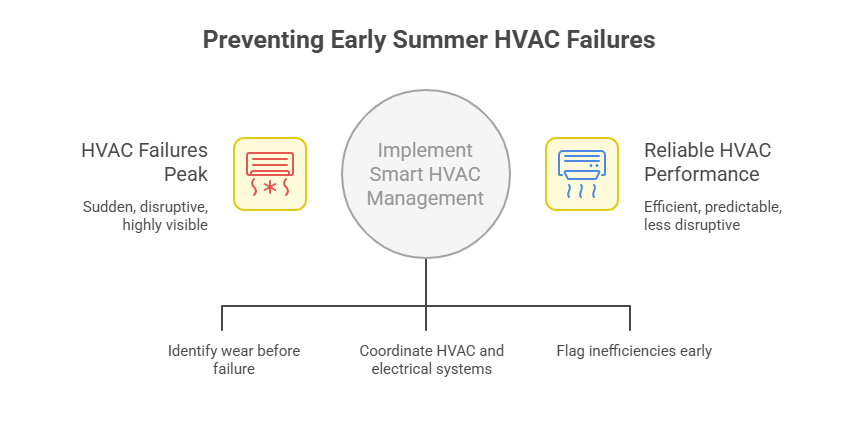
Once summer begins these components are pushed beyond their comfort zone. Without a smart HVAC management system this wear remains undetected until a breakdown occurs.
Reactive Maintenance Practices
One of the most common reasons HVAC systems fail early in summer is the way maintenance is handled.
Many buildings still depend on breakdown driven maintenance manual inspections or fixed calendar based servicing.
The assumption is simple. If the system is running it does not need attention.
This approach fails during summer because HVAC breakdowns tend to be sudden disruptive and highly visible especially in commercial environments.
Electrical Load Stress on MEP Systems
HVAC systems are closely tied to electrical infrastructure. When summer begins overall electrical demand increases panel loads rise voltage fluctuations become more frequent and backup systems are tested.
Without proper MEP automation solutions for commercial buildings coordination between HVAC and electrical systems becomes weak leading to tripped breakers damaged components and control failures.
Airflow and Heat Rejection Problems
Early summer often exposes airflow and heat rejection issues such as dirty coils restricted air paths inefficient cooling towers and poor condenser performance.
These conditions reduce efficiency and significantly increase compressor stress. An IoT based building management system can detect these problems early by tracking performance data and temperature variations.
Lack of Real Time Monitoring
Most HVAC failures are not truly sudden. They are the result of ignored warning signs.
Without continuous monitoring temperature drift energy spikes and abnormal operating patterns go unnoticed. By the time alarms activate the damage has already occurred.
How HVAC MEP IoT Solutions Prevent Early Summer Failures
Smart systems fundamentally change how HVAC performance is managed.
Continuous Performance Monitoring
IoT sensors track temperature pressure energy consumption and equipment runtime in real time. This data highlights stress patterns long before a failure takes place.
Predictive Alerts
Instead of relying on manual inspections smart HVAC systems generate alerts for abnormal loads overheating components and efficiency losses. Maintenance teams can intervene early and avoid breakdowns.
Automated Load Management
MEP automation solutions balance cooling demand electrical load and equipment sequencing. This prevents overloads during sudden temperature spikes and improves system stability.
Data Driven Maintenance Planning
Maintenance schedules are no longer fixed or reactive. They are planned based on actual equipment health usage trends and seasonal demand forecasts resulting in fewer failures and longer equipment life.
Common HVAC Mistakes Buildings Make Before Summer
Many buildings repeat the same mistakes year after year.
Waiting until peak summer to act leaves little room for preventive measures. Treating HVAC and MEP systems as separate entities causes root issues to be missed. Ignoring energy consumption trends eliminates an important early warning signal. Relying solely on manual inspections fails to capture real time system behavior under load.
Why Smart HVAC Management Is Becoming the Industry Standard
Modern commercial buildings are evaluated not only by architecture or amenities but by comfort consistency energy efficiency and operational reliability.
Smart HVAC systems help facilities reduce breakdowns control operating costs extend equipment lifespan and deliver a better experience for occupants.
This is why HVAC MEP IoT Solution adoption is increasing rapidly across India especially in large scale commercial infrastructure.
Frequently Asked Questions
Why do HVAC systems fail more often at the start of summer
Because systems shift suddenly from low load to continuous operation exposing hidden wear electrical stress and airflow issues.
Can HVAC failures be prevented before summer begins
Yes predictive maintenance supported by IoT monitoring can identify risks weeks in advance.
Is reactive maintenance enough for commercial HVAC systems
No reactive maintenance increases downtime repair costs and tenant dissatisfaction.
How does an IoT based building management system help
It provides real time visibility predictive alerts and automated controls that prevent overloads and inefficiencies.
Are HVAC and MEP systems interconnected
Yes electrical mechanical and control systems directly influence HVAC reliability.
Final Thoughts
HVAC failures at the start of summer are not random events. They follow clear and repeatable patterns.
Buildings that continue to rely on reactive maintenance will face the same disruptions year after year. Facilities that adopt HVAC MEP IoT Solution driven strategies shift from constant firefighting to proactive control.