

February is a quiet but critical month for commercial buildings. On the surface, everything seems stable. Cooling demand has not peaked. Electricity bills look manageable. Equipment appears to be running fine. But for facility managers, developers, and operations teams, February is when the first warning signs of HVAC failure begin to appear. These are not dramatic breakdowns. They are subtle inefficiencies that quietly build up and turn into expensive failures by March or April. This is why forward-thinking organisations are shifting toward HVAC and MEP IoT Solution–driven systems, especially in cities like Mumbai where climate stress, occupancy density, and energy costs are rising every year.
This blog explains:
- What problems start appearing in February
- Why they matter more than most people realise
- How smart HVAC and MEP solutions in Mumbai are preventing these issues before peak summer
What Is an HVAC and MEP IoT Solution?
An HVAC and MEP IoT Solution is an integrated building management approach where HVAC, electrical, plumbing, and mechanical systems are connected through sensors, automation, and real-time data platforms.
Instead of reacting to failures, the system:
- Continuously monitors performance
- Detects inefficiencies early
- Optimises energy usage automatically
- Alerts teams before breakdowns occur
For commercial buildings in Mumbai, this approach is no longer optional. It is becoming a necessity.
Why February Is a Critical Month for HVAC Systems
February acts as a transition period.
- Winter load patterns are ending
- Equipment starts shifting toward cooling mode
- Dormant issues from previous seasons resurface
- Dust, humidity, and partial load operation stress systems unevenly
Most HVAC failures seen in April or May actually begin forming in February. Buildings that ignore this window often pay a much higher price later.
Top 5 HVAC Problems That Start Showing Up in Commercial Buildings Every February
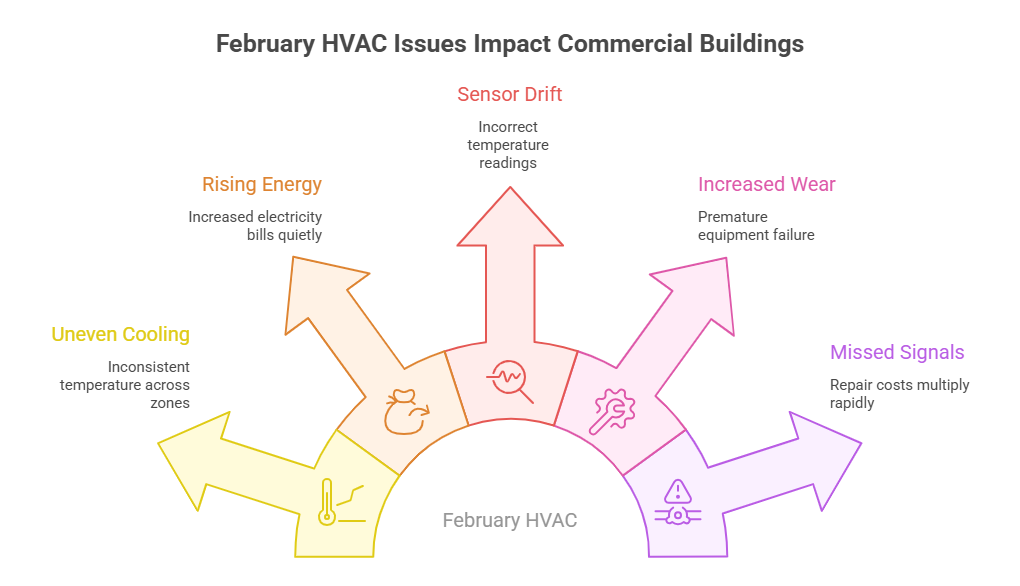
1. Uneven Cooling and Temperature Fluctuations
One of the earliest signs of HVAC trouble is inconsistent temperature across floors or zones.
In February, systems operate at partial load. This exposes:
- Poor balancing
- Faulty dampers
- Sensor calibration issues
- Airflow restrictions
Employees may complain of hot spots or cold pockets, but these complaints are often dismissed.
Why it matters:
Uneven cooling increases energy consumption and signals deeper mechanical inefficiencies.
How IoT helps:
IoT based HVAC monitoring for commercial buildings in Mumbai tracks zone-wise temperature and airflow in real time, allowing corrective action before comfort issues escalate.
2. Rising Energy Consumption Without Clear Reason
February electricity bills often increase quietly.
Not enough to cause alarm.
But enough to indicate inefficiency.
Common causes include:
- Overworked compressors
- Poor heat exchange
- Incorrect control logic
- Simultaneous heating and cooling in different zones
Why it matters:
These inefficiencies compound rapidly once summer arrives.
How smart systems fix it:
MEP automation and HVAC optimisation services in Mumbai use data analytics to identify abnormal consumption patterns early and fine-tune system performance automatically.
3. Sensor Drift and Control System Errors
Sensors that performed well in winter often start drifting as humidity and temperature change.
This leads to:
- Incorrect temperature readings
- Delayed system response
- Equipment short cycling
Manual checks rarely catch this early.
Why it matters:
Faulty data leads to faulty decisions. Automation without accurate sensing becomes unreliable.
How IoT solves this:
Smart HVAC and MEP solutions in Mumbai continuously validate sensor data and flag anomalies before they affect operations.
4. Increased Wear on Equipment at Partial Load
February is when HVAC equipment operates in an inefficient middle zone.
Compressors, pumps, and fans are:
- Running longer than needed
- Starting and stopping more frequently
- Operating outside optimal efficiency curves
Why it matters:
Partial load stress is one of the biggest causes of premature equipment failure.
How IoT helps:
An HVAC and MEP IoT Solution optimises run cycles and load distribution, extending equipment life and reducing maintenance costs.
5. Missed Preventive Maintenance Signals
Most maintenance schedules are calendar-based, not condition-based.
In February, early warning signs like:
- Vibration changes
- Pressure drops
- Abnormal noise patterns
are often missed.
Why it matters:
By the time visible failure occurs, repair costs multiply.
How IoT prevents this:
IoT based HVAC monitoring for commercial buildings Mumbai enables predictive maintenance instead of reactive repairs.
Why These February HVAC Issues Are Often Ignored
- Systems still appear functional
- Complaints are inconsistent
- Budgets are focused on peak season
- Data visibility is limited
This is exactly why buildings without an HVAC and MEP IoT Solution face higher breakdown rates in summer.
How an HVAC and MEP IoT Solution Works (Step-by-Step)
Step 1: Real-Time Data Collection
Sensors track temperature, humidity, pressure, vibration, and energy usage.
Step 2: Centralised Monitoring
All data flows into a single dashboard accessible to facility teams.
Step 3: Pattern Analysis
The system identifies deviations from normal performance.
Step 4: Automated Optimisation
Control systems adjust airflow, load, and schedules automatically.
Step 5: Predictive Alerts
Teams receive alerts before failures occur.
Common Mistakes Commercial Buildings Make in February
- Ignoring minor complaints
- Delaying audits until summer
- Relying only on manual inspections
- Treating HVAC and MEP as separate systems
- Avoiding automation due to perceived cost
These decisions often cost far more in the long run.
Why Mumbai Commercial Buildings Need Smart HVAC and MEP Solutions
Mumbai’s climate presents unique challenges:
- High humidity
- Dense occupancy
- Long operating hours
- Rising electricity tariffs
Smart HVAC and MEP solutions in Mumbai help buildings:
- Reduce energy bills
- Improve occupant comfort
- Extend equipment life
- Stay compliant with evolving standards
FAQs (AEO & Voice Search Friendly)
1. What are the most common HVAC problems in February?
Uneven cooling, rising energy consumption, sensor errors, partial load stress, and missed maintenance signals.
2. Why do HVAC failures usually happen after February?
Because early warning signs are ignored during transition months and escalate during peak summer demand.
3. How does IoT based HVAC monitoring help commercial buildings?
It provides real-time insights, predictive maintenance alerts, and automated optimisation to prevent failures.
4. Is an HVAC and MEP IoT Solution expensive?
The upfront cost is often offset by reduced energy bills, fewer breakdowns, and longer equipment life.
5. Is IoT suitable for existing commercial buildings in Mumbai?
Yes. Most IoT solutions can be retrofitted without major system replacement.
Final Thought
February is not a quiet month for HVAC systems.
It is a decision month.
Commercial buildings that act early with an HVAC and MEP IoT Solution enter summer prepared.
Those that wait often pay in breakdowns, discomfort, and rising costs.
If your building operates in Mumbai, February is the smartest time to invest in visibility, automation, and optimisation.