

HVAC AMC Gaps We Commonly Find.
In Mumbai’s fast moving commercial landscape, air conditioning systems are not just comfort equipment. They are part of the core infrastructure that keeps offices functioning. Whether it is a corporate office in BKC, an IT park in Andheri, or a commercial tower in Lower Parel, HVAC downtime directly impacts employee productivity, tenant satisfaction, and overall business continuity.
Over the years, while reviewing multiple Annual Maintenance Contracts across commercial properties in Mumbai, we have noticed a consistent pattern. Most buildings have an AMC in place. Yet many of those contracts leave critical gaps that only become visible when a major breakdown occurs.
This guide explains what HVAC AMC truly means, why these gaps become expensive, how professional HVAC, MEP & IoT SOLUTIONS should function in modern buildings, the common mistakes companies make, and the key questions facility managers frequently ask.
What Is an HVAC AMC
HVAC AMC refers to an Annual Maintenance Contract for heating, ventilation, and air conditioning systems. In commercial buildings, this typically includes chillers, VRF systems, air handling units, fan coil units, ventilation systems, and control panels.
On paper, an AMC appears straightforward. A service team visits periodically, inspects equipment, performs cleaning, and addresses minor issues. However, when integrated into structured HVAC, MEP & IoT SOLUTIONS, an AMC becomes much more than routine servicing. It becomes a preventive strategy designed to reduce risk, extend equipment life, and ensure uninterrupted operations.
In a city like Mumbai, where humidity levels are high and systems operate for long hours throughout the year, the quality of your AMC directly influences how often your HVAC system fails.
Why HVAC AMC Is Critical for Commercial Buildings in Mumbai
Mumbai’s environment creates unique challenges for HVAC systems. High humidity increases the risk of corrosion. Coastal air accelerates wear and tear. Long operating hours create mechanical fatigue. Poor duct maintenance affects indoor air quality and employee comfort.
Without structured monitoring and preventive attention, minor technical concerns can escalate into sudden shutdowns. This is why Commercial HVAC Services in Mumbai must go beyond basic servicing. A superficial approach may appear cost effective initially, but in reality, it leads to higher operational expenses and emergency repairs.
A weak AMC often costs more in the long run than having no structured strategy at all.
HVAC AMC Gaps We Commonly Find
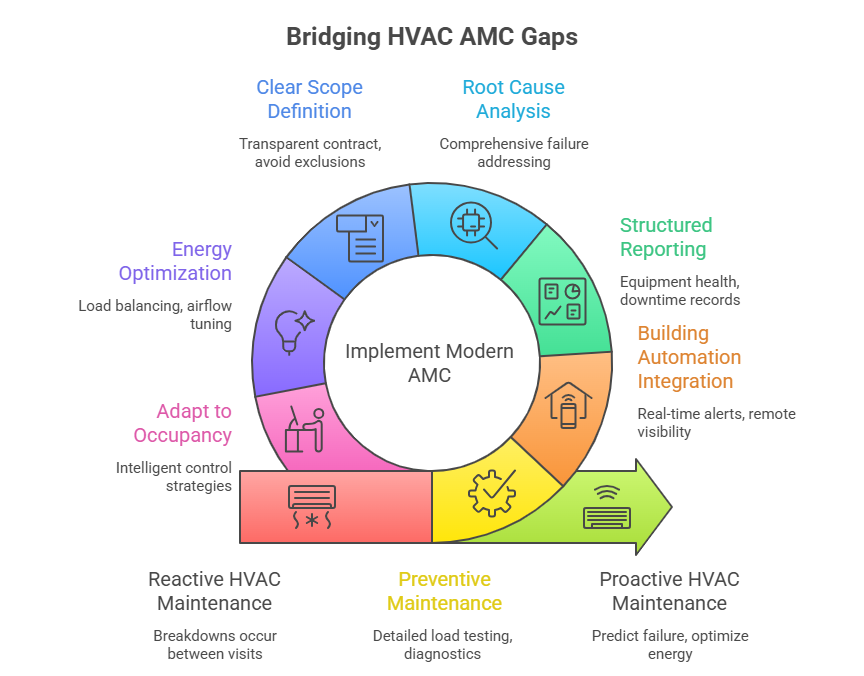
After auditing several commercial sites across Mumbai, we repeatedly encounter the following gaps.
Reactive Instead of Preventive Maintenance
Many AMCs promise quarterly servicing. In practice, this often means cleaning filters and checking basic parameters. What is missing is detailed load testing, performance benchmarking, predictive diagnostics, and lifecycle tracking of critical components.
As a result, deeper system health remains unexamined. Breakdowns occur between service visits, leading to disruption and tenant complaints. Modern HVAC, MEP & IoT SOLUTIONS rely on data and trend analysis to predict failure before it happens, not after.
No Integration with Building Automation
Today’s commercial buildings are interconnected ecosystems. HVAC systems interact with electrical infrastructure, fire safety mechanisms, access control, and energy management platforms.
However, many maintenance contracts ignore integration with Smart Building Automation Solutions in Mumbai. Without IoT enabled monitoring, inefficiencies remain hidden. Energy leaks go unnoticed. Chiller performance may decline gradually, increasing electricity bills. Temperature inconsistencies affect comfort and productivity.
Smart automation provides real time alerts, remote visibility, performance dashboards, and energy optimization insights. Without this layer of intelligence, the AMC remains outdated.
Weak Documentation and Reporting
One of the most overlooked gaps is documentation. In many cases, service records are handwritten. There are no digital logs, no key performance indicators, and no historical trend analysis.
A professional HVAC AMC should include equipment wise health reports, downtime records, energy consumption tracking, and predictive maintenance schedules. Without structured reporting, facility managers cannot make informed decisions. Maintenance becomes reactive rather than strategic.
No Root Cause Analysis
When breakdowns occur, vendors often focus on restoring operations quickly. While speed is important, identifying the root cause is equally critical.
If a compressor fails, was it due to voltage instability, airflow blockage, overloading, or poor maintenance of condenser coils. Without identifying the underlying issue, the same problem is likely to repeat.
This is where experienced MEP Contractors in Mumbai for Office Buildings play an important role. A coordinated mechanical, electrical, and automation approach ensures that failures are addressed comprehensively rather than temporarily.
Incomplete Scope of Work
Another frequent issue is unclear contract scope. Many AMCs exclude spare parts, electrical panels, control systems, drain lines, and duct cleaning. Facility managers may assume full coverage, only to discover exclusions during peak summer when breakdowns are most disruptive.
Clear documentation and transparent scope definitions are essential to avoid unexpected costs.
No Focus on Energy Optimization
Electricity expenses in commercial buildings are significant. Yet many maintenance contracts focus only on breakdown prevention and ignore energy efficiency.
Load balancing, sensor calibration, airflow optimization, and performance tuning are rarely addressed. When HVAC, MEP & IoT SOLUTIONS are properly integrated, measurable reductions in energy consumption become possible.
Energy intelligence is no longer optional. It is a competitive advantage.
No Adaptation to Changing Occupancy
Work patterns have evolved. Many offices now operate on hybrid models. However, HVAC settings often remain static, running at full capacity regardless of occupancy levels.
Modern systems should respond to peak hours, weekend load reduction, zoned cooling strategies, and seasonal adjustments. Without intelligent control strategies, buildings waste energy daily.
How a Professional HVAC AMC Should Work
A structured approach ensures reliability and long term cost savings.
1.Site Audit and Equipment Mapping
Every asset must be documented with its age, capacity, serial number, and service history. Without this mapping, preventive planning is incomplete.
2.Performance Benchmarking
Baseline parameters such as cooling efficiency, power consumption, airflow levels, and temperature differentials should be recorded. These benchmarks help detect performance decline early.
3.Preventive Scheduling
Maintenance frequency should be aligned with operating hours, seasonal demand, and manufacturer recommendations rather than fixed generic timelines.
4.IoT Monitoring and Integration
Through Smart Building Automation Solutions in Mumbai, real time alerts, analytics dashboards, and predictive insights provide visibility across systems.
5.Reporting and Continuous Optimization
Monthly reports should highlight downtime patterns, performance comparisons, risk indicators, and energy saving opportunities. This structured process defines modern HVAC, MEP & IoT SOLUTIONS.
Common Mistakes Businesses Make
Many companies select an AMC based solely on cost. Others ignore IoT based monitoring or fail to review service reports carefully. Some sign contracts with vague terms, while others delay replacing aging components to reduce short term expenses.
In Mumbai’s competitive commercial environment, downtime costs far exceed the investment required for a well structured maintenance strategy.
Frequently Asked Questions
1.What does an HVAC AMC usually include
It typically covers preventive servicing, inspection, minor repairs, and routine monitoring. However, inclusions and exclusions vary. Reviewing scope clarity is essential.
2.Why do systems fail even with an AMC
Because many contracts focus on reactive maintenance. Without predictive diagnostics and IoT monitoring, early warning signs are missed.
3.Is IoT monitoring necessary for office HVAC systems
Yes. In large commercial environments, IoT enables early fault detection, energy optimization, and remote oversight.
4.How often should HVAC systems be serviced in Mumbai
Given local climate conditions, monthly inspections combined with periodic deep servicing are recommended, depending on system type and load.
5.How can I choose the right partner
Look for experience in Commercial HVAC Services in Mumbai, expertise as MEP Contractors in Mumbai for Office Buildings, and strong capabilities in Smart Building Automation Solutions in Mumbai. Transparent reporting and clearly defined scope are equally important.
Final Thoughts
In 2026 and beyond, HVAC maintenance cannot remain manual and reactive. Commercial buildings in Mumbai require structured, data driven HVAC, MEP & IoT SOLUTIONS that combine preventive maintenance, automation intelligence, and energy optimization.
If your AMC does not include predictive diagnostics, integrated monitoring, detailed reporting, and energy efficiency strategies, it may only be addressing surface level issues.
The real question is not whether you have an AMC in place. The real question is whether your AMC is truly protecting your building and your business continuity.