
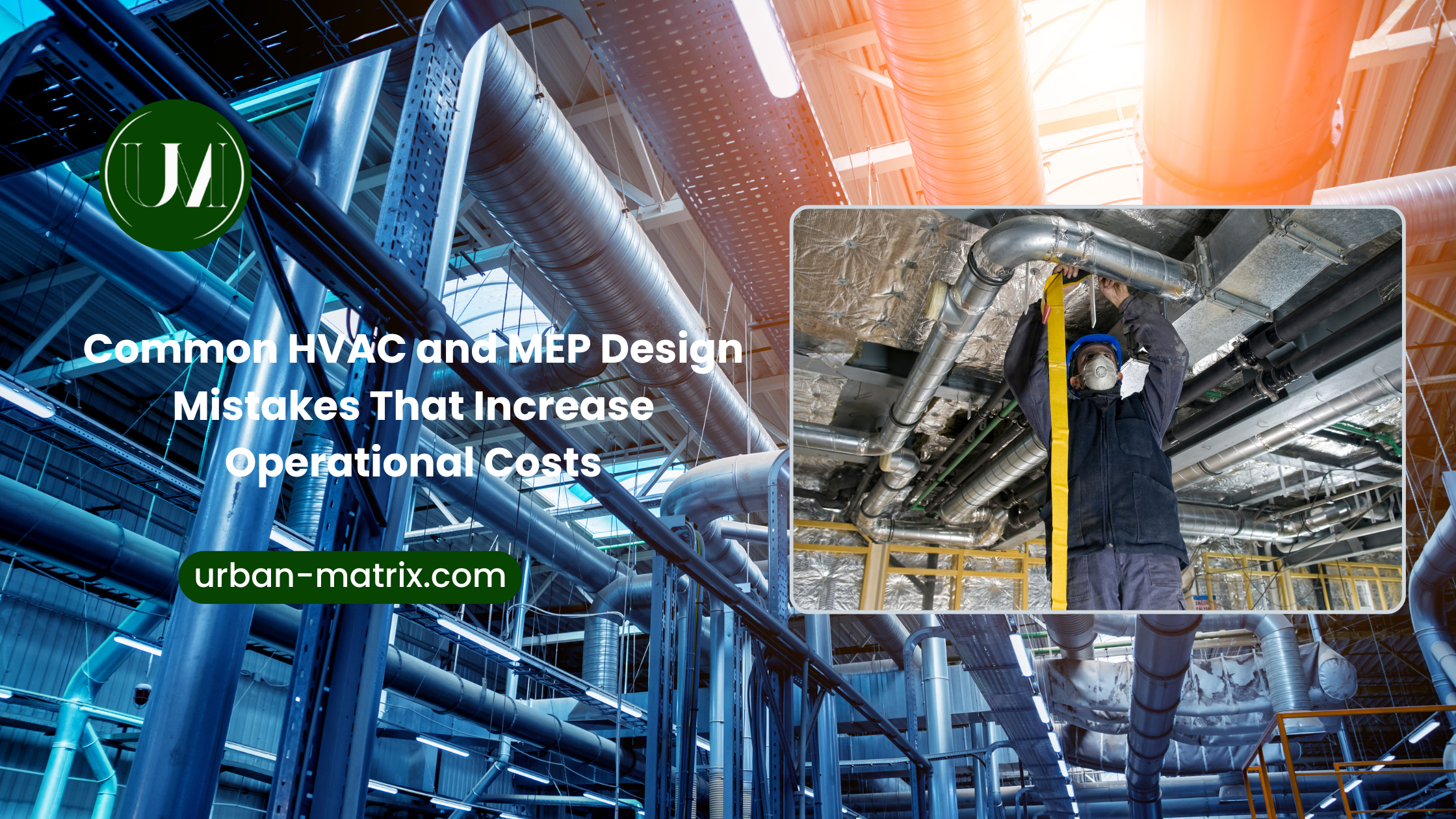
When a building starts facing high electricity bills frequent equipment failures or uneven indoor comfort the issue rarely begins with day to day operations. In most cases the root cause lies much earlier at the design stage.
At Urban Matrix we have worked across offices hospitals malls hotels and industrial facilities and one pattern appears repeatedly. Small HVAC and MEP design oversights made during planning quietly turn into long term operational losses.
This article explains the most common HVAC and MEP design mistakes that increase operational costs and how well planned HVAC and MEP solutions can help avoid them.
Why HVAC and MEP Design Matters More Than Most People Realize
HVAC and MEP systems are not just background utilities. They directly influence how efficiently a building runs and how much it costs to operate over time.
They affect energy consumption equipment lifespan maintenance budgets occupant comfort and even long term asset value.
When these systems are designed correctly they operate quietly and efficiently. When they are not they become a constant financial drain.
Designing for Ideal Conditions Instead of Real World Usage
Many HVAC designs are created based on assumptions such as fixed occupancy standard working hours and stable heat loads.
In reality buildings evolve. Offices extend operating hours hospitals add new medical equipment retail spaces experience fluctuating footfall and data loads continue to rise.
If HVAC systems are not designed with flexibility in mind the equipment is forced to operate under continuous stress.
This leads to higher energy consumption faster wear and tear and a shorter system lifespan.
Poor Coordination Between HVAC and Other MEP Services
One of the most expensive design mistakes is a lack of coordination between HVAC electrical plumbing and fire systems.
This often shows up as ducts clashing with beams cable trays blocking airflow or last minute routing changes during execution.
Even if installation looks complete these coordination issues reduce system efficiency from day one.
The result is airflow imbalance uneven cooling pressure losses and higher operating costs throughout the building’s life.
Incorrect Equipment Sizing
Many people assume bigger equipment delivers better performance. In reality both oversizing and undersizing create serious problems.
Oversized systems cycle on and off frequently which wastes energy. Undersized systems run continuously and overheat critical components.
Both scenarios increase breakdowns maintenance frequency and unexpected shutdowns.
Over time this translates into higher annual maintenance costs and unpredictable repair expenses.
Ignoring Energy Efficient Design Principles
Reducing upfront project cost by cutting energy efficiency features may look attractive during construction but it significantly increases long term expenses.
Common mistakes include lack of zoning using a single thermostat for large areas and avoiding variable speed drives or smart controls.
In cities like Mumbai where HVAC systems run for most of the year these design gaps compound operational costs month after month.
The outcome is consistently high electricity bills with very little control over consumption.
Poor Planning for Maintenance Access
Maintenance is often treated as an afterthought during design.
This results in air handling units placed in hard to reach areas valves hidden above false ceilings and insufficient clearance around electrical panels.
Even routine servicing becomes time consuming risky and disruptive.
Over time higher labour costs longer downtime and safety concerns become unavoidable.
No Focus on Lifecycle Costs
Many projects focus only on initial capital expenditure while ignoring operating expenses.
A strong HVAC and MEP design considers energy costs over ten to fifteen years maintenance frequency and equipment replacement cycles.
When lifecycle costing is ignored systems may be cheap to install but expensive to operate.
This leads to unplanned capital expenses budget overruns and financial stress later in the building’s life.
Lack of Smart Monitoring and Automation
Without proper monitoring systems energy leakages remain invisible performance degradation goes unnoticed and faults are detected only after failures occur.
Modern HVAC and MEP solutions rely on sensors automation and data driven insights to optimise performance continuously.
Without these tools maintenance becomes reactive instead of predictive increasing both cost and risk.
How the Right HVAC and MEP Solutions Control Operational Costs
Effective HVAC and MEP solutions are not about adding complexity. They are about smarter planning.
They are built around real usage patterns future scalability energy efficiency coordinated system design and easy maintenance access.
When done right the benefits are clear. Lower energy consumption longer equipment life fewer breakdowns and predictable maintenance budgets.
Why Experience Matters in HVAC and MEP Design
Designing cost efficient HVAC and MEP systems requires technical expertise operational understanding and practical experience.
At Urban Matrix, systems are designed by engineers who understand how buildings actually operate not just how they look on drawings.
This approach ensures
Design decisions are practical
Future operational challenges are anticipated
Costs are controlled over the full lifecycle
Experience bridges the gap between design intent and operational reality.
How the Right HVAC and MEP Solutions Reduce Operational Costs
Effective HVAC and MEP solutions focus on long term performance rather than short term savings.
A strong design approach includes
Realistic load assessment
Future ready system capacity
Integrated HVAC and MEP coordination
Energy efficient equipment selection
Maintenance friendly layouts
Lifecycle cost evaluation
The result is
Lower energy consumption
Fewer breakdowns
Extended equipment lifespan
Stable operating budgets
Operational efficiency is designed not achieved by chance.
Conculsion:-
HVAC and MEP design mistakes rarely cause immediate failure. Instead they quietly increase monthly expenses through inefficiency energy loss and excessive maintenance.
For commercial buildings hospitals hotels and industrial facilities investing in well planned HVAC and MEP solutions in Mumbai is not an added cost. It is a strategic decision that protects long term performance reliability and operating budgets.
Frequently Asked Questions
1.What is the biggest HVAC design mistake that increases operating cost
Designing systems based on ideal assumptions instead of real usage patterns leads to continuous equipment stress and higher energy consumption.
2.How does HVAC MEP coordination affect energy efficiency
Poor coordination causes airflow obstructions pressure losses and uneven cooling which increases power usage and reduces comfort.
3.Is oversized HVAC equipment better for safety
No oversized systems waste energy short cycle and experience faster component wear increasing maintenance costs.
4.Why is lifecycle costing important in HVAC design
Lifecycle costing accounts for energy maintenance and replacement expenses over time preventing future budget overruns.
5.Can operational issues be fixed after construction
Some issues can be improved but design mistakes are costly and difficult to fully correct once the building is operational.
6.How do smart controls reduce HVAC operating costs
Smart controls detect inefficiencies early optimize system performance and enable predictive maintenance reducing energy and repair costs.