
1.Why Does Your Office Feel Too Cold in One Area and Too Warm in Another?
Imagine walking into your office on a warm Mumbai afternoon. One meeting room feels freezing, while the employees sitting near the windows are still uncomfortable. The air conditioning system is running, yet the temperature never seems right.
Sound familiar?
The problem may not always be a faulty AC unit. In many commercial buildings, uneven cooling happens because conditioned air is not distributed properly. Some rooms receive too much airflow, while others do not get enough. This can affect employee comfort, increase the workload on HVAC equipment and lead to repeated cooling complaints.
This is where HVAC air balancing becomes important. It helps identify airflow problems and ensures that different areas receive the amount of air they need.
For businesses looking for reliable HVAC solutions in Mumbai, proper airflow distribution is an important part of maintaining a comfortable and efficient workplace.
Urban Matrix provides HVAC, MEP and IoT solutions for commercial facilities. With suitable system inspections, maintenance and monitoring, businesses can better understand their HVAC performance and address recurring issues.
But what exactly is air balancing, and when should a commercial building consider it?
2. What Is HVAC Air Balancing?
HVAC air balancing is the process of measuring, adjusting and verifying airflow throughout a building so that each room receives the amount of conditioned air it needs. It involves checking air vents, ducts, dampers, fans and related controls to improve temperature consistency, indoor comfort and HVAC performance.
3. What Is HVAC Air Balancing?
HVAC air balancing helps distribute conditioned air according to the cooling requirements of different rooms and zones.
An HVAC system may have been installed correctly but develop airflow problems over time. Dirty filters, blocked ducts, incorrect damper settings, equipment wear and changes in office layouts can all affect how air moves through a building.
For example, a company may renovate its office and add new cabins or meeting rooms. The existing air distribution system may no longer suit the new layout, leaving some spaces warmer than others.
Air balancing involves measuring airflow at suitable points, comparing the readings with the required values and making adjustments where necessary.
For commercial properties, working with experienced HVAC MEP contractors in Mumbai can help ensure that airflow concerns are considered alongside equipment condition, controls and the wider building system.
4. Why Do Commercial Buildings Need Proper Airflow Distribution?
Poor airflow can affect more than indoor comfort. It may also create maintenance challenges and reduce the effectiveness of the existing HVAC system.
Common reasons to investigate air balancing include:
- Uneven temperatures: Some rooms feel too cold while others remain warm.
- Weak airflow: Certain vents deliver less air than expected.
- Recurring cooling complaints: Employees continue adjusting thermostats without achieving comfortable conditions.
- Higher energy use: Poor distribution or related equipment faults may cause longer operating periods.
- Changes to office layouts: New partitions and cabins can alter airflow requirements.
- Inconsistent system performance: Different zones may not respond as expected to cooling controls.
These symptoms do not always mean air balancing is the only solution. Dirty filters, faulty sensors, refrigerant issues and chilled water problems may also require attention.
A proper inspection helps establish what is actually causing the problem.
If your HVAC system is running but some areas remain uncomfortable, investigate airflow distribution before assuming that the entire AC unit needs replacement.
5. How Does HVAC Air Balancing Work? A Step-by-Step Process
Professional air balancing involves measurements and adjustments rather than guesswork.
Step 1: Inspect the HVAC System
The technician reviews the building’s HVAC layout and checks relevant components such as air handling units, filters, ducts, diffusers, dampers and controls.
Reported cooling problems and recent changes to the building layout should also be considered.
Step 2: Measure Airflow
Airflow is measured at suitable supply outlets and other relevant points using appropriate testing instruments.
These readings help establish whether different rooms are receiving the required quantity of air.
Step 3: Identify the Problem
The inspection may reveal restricted filters, incorrect damper settings, duct leakage, fan issues or other factors affecting airflow.
If equipment is faulty, repairs may be necessary before the balancing process can be completed.
Step 4: Adjust Air Distribution
Depending on the findings, the technician may adjust dampers, address airflow restrictions or recommend duct corrections.
The aim is to distribute conditioned air according to the design requirements and actual needs of each area.
Step 5: Verify the Results
Airflow is measured again to check whether the adjustments have improved distribution.
The technician may also review temperature conditions and system operation to understand whether further corrections are required.
For larger facilities, air balancing may form part of HVAC commissioning or wider building performance assessments.
6. What Are the Benefits of HVAC Air Balancing?
Proper airflow distribution can make a noticeable difference to commercial building operations.
Key benefits include:
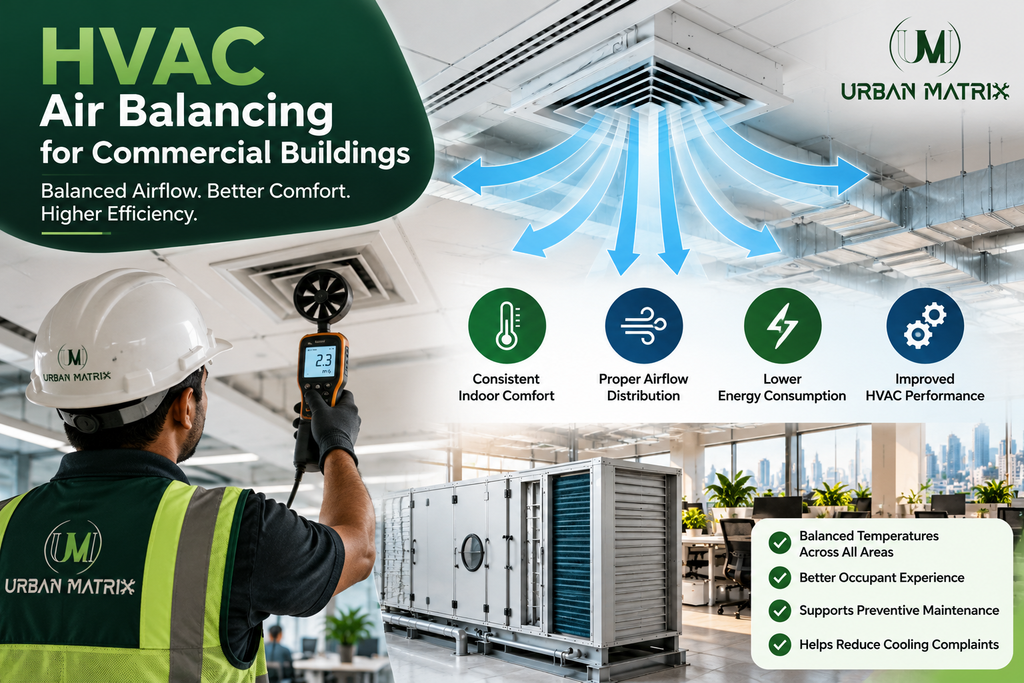
- More consistent comfort: Helps reduce unwanted temperature differences between rooms.
- Better airflow distribution: Supports delivery of conditioned air according to zone requirements.
- Improved HVAC performance: Helps identify restrictions and distribution problems.
- Potential energy savings: Correcting airflow issues may reduce avoidable energy consumption, depending on the system and underlying problem.
- Fewer recurring complaints: Helps facility teams investigate the causes of uneven cooling.
- Better maintenance planning: Airflow measurements can reveal issues that require further inspection.
- Improved facility management: Documented readings help teams understand system performance.
Air balancing does not automatically guarantee lower electricity bills. Results depend on the building, HVAC design and corrective work carried out.
It works best alongside proper equipment maintenance and suitable system controls.
7. HVAC Air Balancing vs. AC Repair: What Is the Difference?
Air balancing and AC repair solve different problems. Knowing the difference helps facility managers choose the right service.
| Service | Main purpose | When it may be required |
|---|---|---|
| HVAC air balancing | Measures and adjusts airflow distribution | Different rooms receive uneven airflow |
| Commercial AC repair | Diagnoses and fixes equipment faults | The AC stops cooling or develops a fault |
| HVAC maintenance | Keeps equipment in suitable working condition | Routine servicing and preventive checks |
| HVAC commissioning | Checks system operation against design requirements | New installations or major system changes |
| HVAC controls inspection | Checks sensors, controllers and operating settings | Incorrect temperature readings or control issues |
Businesses searching for a Commercial AC repair service in Mumbai should describe their cooling symptoms clearly. This helps determine whether the issue involves airflow, equipment performance or both.
For example, if only one meeting room receives weak airflow, an air distribution problem may be worth investigating. If the entire office receives warm air, a broader HVAC inspection may be needed.
Similarly, businesses searching for commercial AC repair near me should look for service providers who can assess the underlying issue rather than assume every cooling problem has the same cause.
Quick summary: Air balancing focuses on airflow distribution, while AC repair addresses equipment faults. Some commercial buildings may need both.
8. Who Needs HVAC Air Balancing Services?
Air balancing may be useful wherever commercial buildings depend on consistent indoor temperatures and planned airflow distribution.
Typical examples include:
- Corporate offices: To investigate warm meeting rooms, cold workstations and uneven airflow.
- Commercial buildings: To assess airflow across different floors and occupied areas.
- Hospitals: To review airflow distribution while respecting the specific ventilation requirements of clinical spaces.
- Hotels: To support comfortable conditions across guest rooms and common areas.
- Retail stores and showrooms: To investigate temperature differences affecting customers and staff.
- Data centres: To assess airflow distribution in spaces with critical equipment cooling requirements.
- Renovated offices: To check whether the HVAC system still suits the updated layout.
Businesses working with MEP consultants in Mumbai can include airflow distribution in wider building system assessments.
If cooling problems continue after routine servicing, an HVAC professional can help determine whether air balancing, repairs or other corrective work is appropriate.
9. What Factors Affect the Cost of HVAC Air Balancing in Mumbai?
The cost of air balancing depends on the building’s size, system design and the amount of work required. There is no single price suitable for every commercial property.
Important factors include:
- Building size: Larger properties may require more measurements and adjustments.
- Number of air outlets: More diffusers, grilles and zones can increase the work involved.
- HVAC system complexity: Multiple AHUs and complex duct networks may need additional assessment.
- Accessibility: Difficult-to-reach ducts and ceiling spaces can affect labour requirements.
- Existing faults: Damaged dampers, duct leakage or fan problems may need repair first.
- Testing requirements: Detailed measurements and verification affect the scope of work.
- Additional services: Commissioning, controls adjustments and equipment repairs may be quoted separately.
When requesting a quotation, ask whether the scope includes inspection, airflow measurements, adjustments and final verification.
If the problem is related to equipment failure, commercial AC repair in Mumbai, India, may be more appropriate than air balancing alone.
For offices experiencing wider cooling issues, office AC repair in Mumbai, India, may also be required depending on the inspection findings.
10. What Are the HVAC Industry Trends to Watch in 2026?
Commercial HVAC management continues to place importance on energy performance, monitoring and planned maintenance. Several developments are relevant to air balancing.
Smart HVAC Monitoring
Monitoring systems can help facility teams track temperatures, equipment status and selected operating parameters. Unusual readings may indicate that an area requires further investigation.
IoT-Based System Monitoring
With suitable sensors and controls, IoT solutions in Mumbai can help businesses gain better visibility into HVAC operation.
Depending on the installed system, monitoring may help identify changing temperatures, unusual operating patterns or equipment conditions that require attention.
Demand-Controlled Ventilation
Where appropriate, demand-controlled ventilation adjusts outdoor airflow according to factors such as occupancy or indoor air quality measurements.
Correct design and commissioning are essential to ensure that required ventilation levels are maintained.
Preventive and Predictive Maintenance
Facility teams are increasingly interested in identifying problems before they cause major disruption.
Combining inspection records, operating data and planned servicing can support a more preventive maintenance approach.
For buildings using MEP system monitoring in Mumbai, monitoring technologies can complement physical inspections and airflow testing. They do not replace professional air balancing or equipment diagnosis.
11. Why Choose Urban Matrix for HVAC Solutions in Mumbai?
Commercial HVAC systems involve interconnected equipment, controls and building services. When cooling complaints keep returning, it helps to understand how these components work together.
Urban Matrix provides HVAC MEP & IoT Solutions in Mumbai for commercial buildings and business facilities.
Our service areas include:
- HVAC installation and maintenance
- Commercial air conditioning repair
- HVAC system inspection and troubleshooting
- MEP services in Mumbai
- Preventive maintenance services in Mumbai
- HVAC AMC services in Mumbai
- IoT-based monitoring solutions
- Support for connected HVAC and building systems
Businesses looking for HVAC and MEP solutions Mumbai, MEP solutions in Mumbai or MEP contractors in Mumbai can explore service options according to their building requirements.
Our broader solutions also cover the needs of facilities looking for an HVAC company in Mumbai, HVAC installation services Mumbai and commercial HVAC services Mumbai.
For businesses requiring planned servicing, Annual Maintenance Contract (AMC) solutions in Mumbai, including MEP AMC services in Mumbai, can help establish a maintenance schedule for relevant equipment and building systems.
The scope may include HVAC AMC services in Mumbai and other preventive maintenance services in Mumbai, depending on the agreement and the facility’s requirements.
Urban Matrix also supports IoT services in Mumbai and MEP system monitoring in Mumbai for facilities exploring connected building technologies. Businesses searching for IoT services near me should assess whether the provider can support their equipment, monitoring requirements and existing infrastructure.
Where a cooling problem involves connected VRV or VRF equipment, the required service may differ from air balancing. Businesses needing VRV/VRF AC repair in Mumbai, India, or searching for VRF AC repair near me, should arrange a suitable system inspection.
The aim is to identify the actual issue and determine the right next step, whether that involves maintenance, equipment repair, airflow adjustments or a wider system assessment.
12. Frequently Asked Questions About HVAC Air Balancing
1. What is HVAC air balancing in commercial buildings?
HVAC air balancing involves measuring and adjusting airflow so that different rooms and zones receive the quantity of conditioned air required by the system design.
2. How do I know if my office needs air balancing?
Common signs include uneven room temperatures, weak airflow from certain vents and recurring cooling complaints. An HVAC inspection can help determine whether air balancing is appropriate.
3. Can HVAC air balancing reduce electricity consumption?
It may help reduce avoidable energy use when airflow problems contribute to inefficient operation. Actual savings depend on the HVAC system, the underlying issue and the corrective work performed.
4. How often should commercial HVAC air balancing be checked?
There is no universal interval for every building. Consider reassessment after major HVAC changes, office renovations or persistent airflow problems. Routine maintenance can help identify when another assessment may be needed.
5. Where can I find commercial HVAC services in Mumbai?
Businesses can contact Urban Matrix to discuss commercial HVAC requirements, including maintenance, AC repair, MEP support and IoT-based monitoring. The appropriate service depends on the equipment and the problem identified during inspection.
13. Improve Commercial HVAC Performance with Urban Matrix
Uneven cooling can make an office uncomfortable, create repeated maintenance complaints and leave facility teams unsure about what to fix.
The solution starts with understanding whether the issue involves airflow distribution, equipment condition, controls or a combination of factors.
Proper HVAC air balancing, supported by routine inspections and preventive maintenance, can help commercial buildings maintain more consistent indoor conditions.
If your office or commercial facility needs HVAC support, connect with Urban Matrix to discuss your requirements.
Explore our HVAC MEP & IoT Solutions in Mumbai, MEP services and commercial HVAC support to identify a suitable approach for your building.
Urban Matrix | HVAC • MEP • IoT Solutions in Mumbai
Contact Urban Matrix to discuss your commercial HVAC requirements and arrange an assessment of your building’s airflow and system performance.